- harvest
- honey
- extraction
- process
Extraction Day
What honey extraction actually looks like at a six-hive operation outside Leesburg — every step, from pulling supers to filling jars.
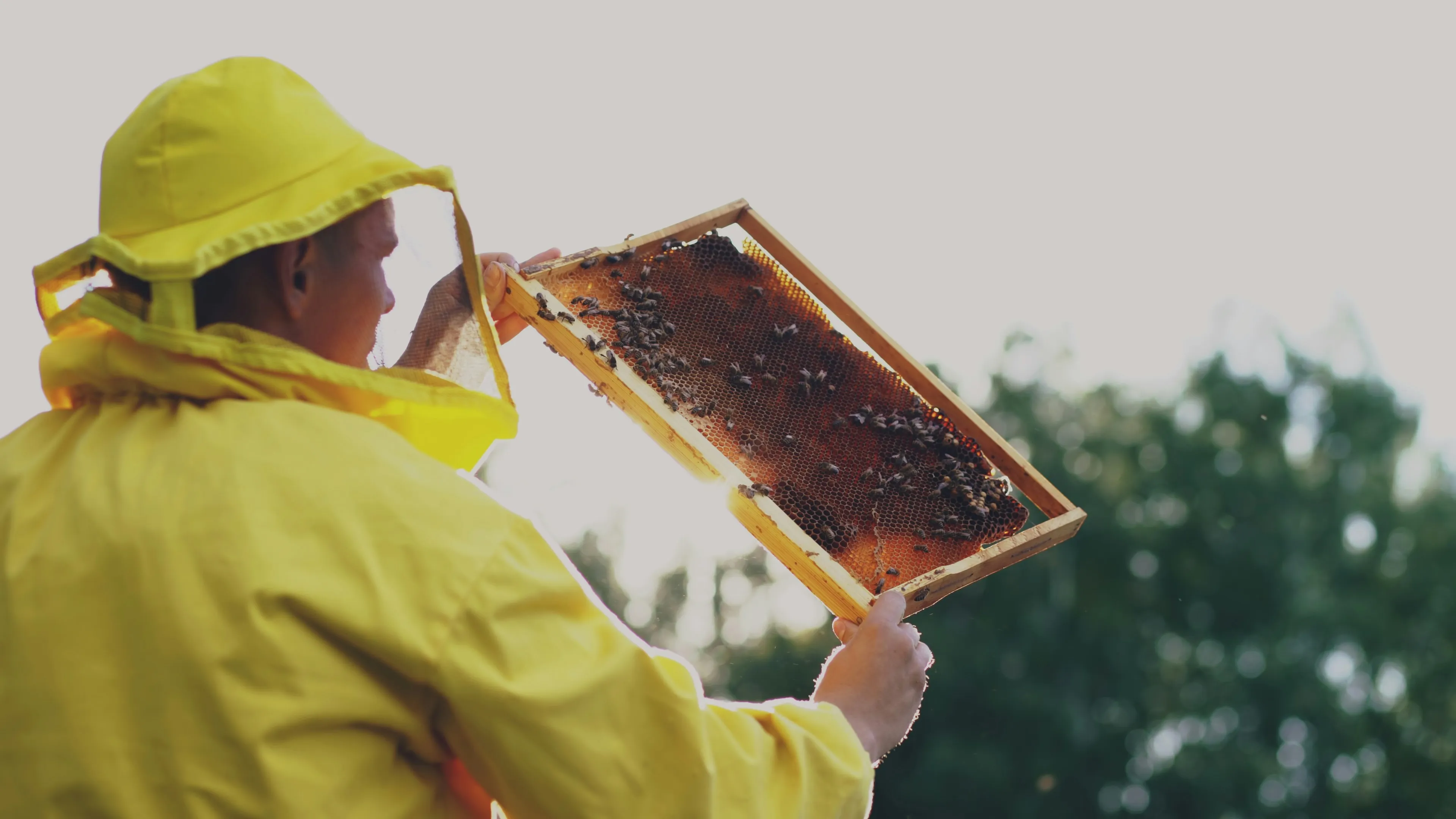
People ask how we get honey out of the hive. They picture something clean and efficient — stainless steel, white suits, honey pouring in a golden stream into a neat row of jars. There are operations that look like that. Ours does not. We have six hives, a borrowed extractor, and a kitchen we will be scrubbing for days afterward.
This is what extraction day actually looks like.
Deciding When to Pull
The first decision is timing. You do not pull supers whenever you feel like it — you pull them when the honey is ready, which means waiting until at least eighty percent of the cells in a frame are capped with wax. Capped cells mean the bees have fanned the nectar down to roughly eighteen percent moisture and sealed it for storage. Uncapped honey is too wet. It will ferment in the jar.
In Loudoun County, the main nectar flow — mostly tulip poplar, with some black locust and wildflower mixed in — runs from late April through early June. We leave the supers on through the flow and check them in late June or early July, once the bees have had time to finish curing. If a frame is mostly capped, it comes out. If it is still open and glistening, it stays.
We also weigh the math. Each colony needs sixty to eighty pounds of honey to survive winter in Zone 7a. We do not touch the deep boxes where the brood nest lives — those stores belong to the bees. We only harvest from the medium supers we added above the queen excluder specifically for surplus. If a colony did not fill its supers, we do not take anything. Some years, some hives give us nothing. That is fine. The bees come first.
Clearing the Bees
There are several ways to get bees off honey supers. You can blow them off with a leaf blower, which is fast and violent. You can use chemical repellents like Bee-Go, which smell terrible and leave residue. We use escape boards — simple one-way exits that let bees leave the super but not return. You slide one under the honey super the evening before extraction day. By morning, most of the bees have moved down into the brood box and cannot get back up.
It is not perfect. There are always a few dozen stragglers. We brush them off gently at the hive, frame by frame, before carrying the supers inside. But the escape board does the heavy lifting without stress to the colony. The bees barely notice.
Carrying Supers
This is the part nobody warns you about. A full medium super weighs thirty-five to forty-five pounds. A full deep super — which we have used in past seasons — can weigh sixty to ninety. You are carrying a wooden box full of liquid, with no handles that are designed for that kind of weight, across uneven ground, from the apiary to the house.
Our apiary is about a hundred yards from the back door. That walk, with a forty-pound super balanced against your chest and a few confused bees circling your head, is where the romance of beekeeping fades and the work begins. We make the trip two or three times per hive, depending on how many supers we are pulling. By the fourth trip, we are done talking.
We bring the supers into the kitchen, set them on a tarp, and close every window. Any bees that follow the scent will find their way in otherwise, and then you have a different kind of day.
Uncapping
Before you can spin honey out of comb, you have to remove the wax cappings the bees built over each cell. Some beekeepers use heated uncapping knives — electric blades that melt through the wax in a smooth pass. We use a cold knife and an uncapping fork. No heat.
The reason is simple. Heat changes honey. Even modest warming — a hundred and ten, a hundred and twenty degrees — begins to break down the enzymes and volatile compounds that make raw honey different from the processed kind on grocery shelves. We want to keep every bit of what the bees put into it. A cold knife is slower and messier, but the honey stays as it was in the comb.
You hold the frame vertically over a bin and slice downward with the knife, shaving off the top layer of wax. The cappings fall in pale curls, heavy with honey. Where the comb surface is uneven — and it always is — the knife misses low spots. That is where the fork comes in. You scratch across the missed cells, puncturing each cap so the honey can flow out during extraction. It is tedious, particular work. A single frame takes two or three minutes. We have anywhere from twenty to fifty frames on extraction day.
The cappings pile up in the bin — a sticky, fragrant mass of beeswax and residual honey. We deal with them later.
Spinning
We do not own an extractor. They cost three hundred to eight hundred dollars for a decent manual model, and we use ours once, maybe twice a year. Instead, we borrow a two-frame hand-crank extractor from a beekeeper in our local club. It is older than we are, slightly dented, and works fine.
You load two uncapped frames into the basket, one on each side for balance, and crank the handle. The basket spins the frames, and centrifugal force pulls the honey out of the cells and onto the drum walls. It runs down to a gate valve at the bottom. You spin one side, flip the frames, spin the other side. Each pair of frames takes about five minutes.
The moment the honey first flows from the gate is the best part of the entire season. You open the valve and this thick, dark amber stream pours into the bucket below. The color is deep — nothing like the pale gold you see in stores. The smell fills the kitchen immediately. Warm beeswax, floral sweetness, and something faintly earthy underneath. It is not a scent you can reproduce or describe well. It is the smell of a season’s work, the bees’ and ours, arriving in a bucket.
With a two-frame extractor, the process is slow. Twenty frames takes close to an hour of cranking. Fifty takes most of the afternoon. Your arm gets tired. You switch hands. You develop a rhythm — load, crank, flip, crank, drain, repeat. It is physical, repetitive, meditative work.
Straining and Settling
The honey coming out of the extractor is not clean. It contains wax flakes, the occasional bit of propolis, and sometimes a bee wing or a fragment of comb. We strain it through a coarse mesh — a double-layered stainless steel sieve, roughly a 400-micron weave. This catches the debris and lets the honey pass through.
That is the only filtration we do. No fine filters, no pressure filtering, no diatomaceous earth. Commercial packers often ultra-filter honey to remove pollen — which makes it clear and shelf-stable but also removes the thing that makes raw honey identifiable as honey from a particular place. We want the pollen in there. It is part of the product.
After straining, the honey goes into a food-grade five-gallon bucket with a lid. It sits for twenty-four hours. During that time, air bubbles trapped during extraction rise to the surface and form a thin foam. We skim the foam off before bottling. That is the entire settling process.
No heating. No pasteurizing. No blending with honey from other sources. The honey that goes into the jar is the honey that came out of the comb, strained through a coarse mesh and given a day to rest. That is it.
Bottling
After settling, we open the gate valve on the bucket and fill jars one at a time. We use eight-ounce and sixteen-ounce glass jars with metal lids. The honey is thick enough that filling is slow — you open the valve, position the jar, wait, and close the valve when it reaches the shoulder. Drips are constant. The outside of every jar gets wiped down two or three times.
We label by hand. Each label includes the harvest date, the weight, and our name. That is all there is to it.
The Aftermath
Extraction day ends with a kitchen that looks like a crime scene. Every surface the honey touched — and honey touches everything — is sticky. The extractor, the uncapping bin, the strainer, the bucket, the knife, the fork, the tarp, the counter, the floor, our hands, our arms, our clothes. Cleanup takes almost as long as extraction.
The wax cappings go into a separate container. Over the next week, we render them — melting the wax slowly in a double boiler, straining out debris, and pouring it into molds. Beeswax is valuable. We use it for candles and lip balm, and sometimes trade blocks of it with other beekeepers for equipment or queens. Nothing from extraction day is wasted.
The empty frames — still coated with a thin layer of honey and drawn comb — go back onto the hives before dark. Drawn comb is irreplaceable. It takes bees roughly eight pounds of honey to produce one pound of wax. Returning drawn frames saves the colony enormous energy. The bees will clean every cell spotless overnight and have them ready for the next flow, or for storing winter syrup if the season is late.
How Much Honey, Really
People hear “six hives” and assume we are swimming in honey. We are not. In a good year — strong colonies, good weather during the flow, no major losses — six hives might produce a hundred to a hundred and fifty pounds of surplus honey. That is surplus, after leaving each colony its sixty to eighty pounds for winter. In a bad year, with weak colonies or a poor flow, it might be forty pounds. Or nothing.
A hundred and fifty pounds sounds like a lot until you start filling jars. It is roughly three hundred eight-ounce jars, or about two hundred twelve-ounce jars. If we sell some, give some away, and keep some for ourselves, it goes fast. We usually run out by December.
This is what small-scale beekeeping looks like. It is not a livelihood. It is not even a reliable side income. It is seasonal, weather-dependent, and most years it runs out by December. We harvest what is left over, and some years there is more left over than others.
Why We Write This Down
When you know what went into it, the jar means something different. You understand that this is not a product manufactured to spec. It is the end point of a season that started with pollen in April and ended with a sore arm in July, with a thousand decisions by the bees and a few dozen by us in between.
References and further reading:
- Winston, Mark L. The Biology of the Honey Bee. Harvard University Press, 1987 — comprehensive reference on wax production, comb building, and the energy cost of wax secretion (roughly six to eight pounds of honey per pound of wax).
- Seeley, Thomas D. The Lives of Bees: The Untold Story of the Honey Bee in the Wild. Princeton University Press, 2019 — winter store requirements and colony-level resource management in temperate climates.
We sell what the bees don’t need. Interested in trying some? Drop us a line.