- harvest
- honey
- sensory
- extraction
- process
The Smell After a Harvest
For two weeks after extraction day, the house smells like warm beeswax and honey. A story told through one sense.
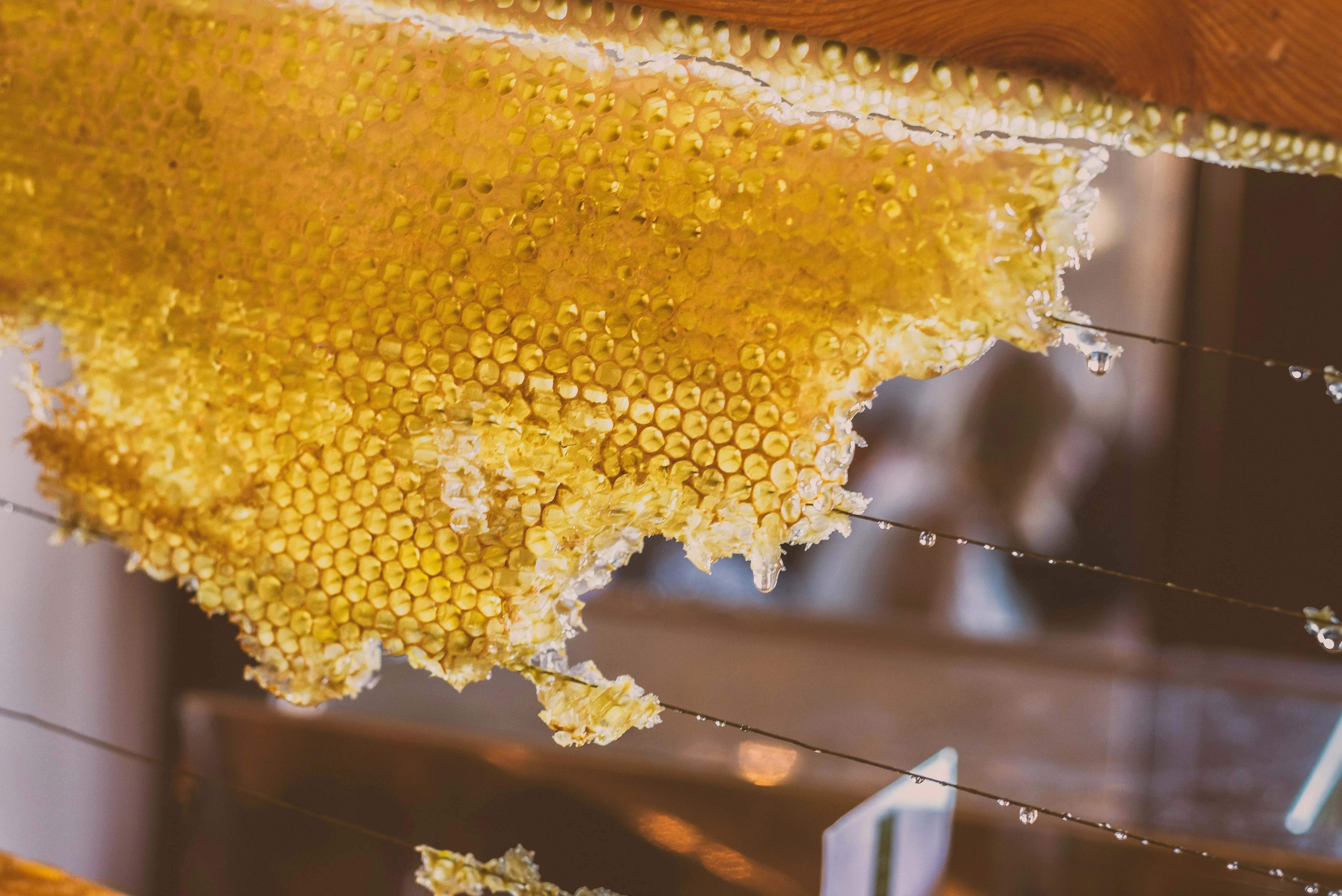
You can clean the kitchen. You can scrub the counters, mop the floor, wipe down the cabinets, and run the dishwasher twice. The house will still smell like honey for two weeks.
This is a piece about that smell — where it comes from, where it goes, what it is made of, and why it persists long after the extractor is back in the garage and the last jar is labeled.
The Chemistry
The smell of honey is not one compound. It is hundreds.
Honey contains over 600 identified volatile organic compounds, the specific profile of which varies by floral source, processing method, and age.1 The major categories include alcohols, aldehydes, ketones, acids, esters, and terpenes. The particular combination and concentration of these volatiles is what gives each honey its distinctive aroma — what makes tulip poplar honey smell different from clover honey, and what makes raw, unheated honey smell different from the pasteurized product on a grocery shelf.
During extraction, these volatiles are released in concentration. Uncapping a frame of cured honey — slicing the thin wax caps off each cell with a heated knife or cold fork — exposes the honey’s surface to air for the first time since the bees sealed it. The volatile compounds, held in equilibrium under the wax cap, begin to off-gas. The warm uncapping knife accelerates this, heating the wax and honey surface and driving more volatiles into the air.
Beeswax itself has its own volatile profile. It is a complex mixture of esters, hydrocarbons, and fatty acids — over 300 identified compounds.2 When warmed, particularly when sliced with a heated uncapping knife, it releases a characteristic smell that is sweeter and more resinous than the honey underneath. The wax cappings that fall into the collection tray continue to off-gas as they sit in a warm kitchen, filling the room with a scent that is part floral, part waxy, part something that does not have an easy analogue.
The combination — honey volatiles plus beeswax volatiles, released over the course of several hours in a warm, enclosed kitchen — is what produces the smell that takes over the house on extraction day.
Where It Goes
The smell does not stay in the kitchen.
Volatile organic compounds are airborne. They move through doorways, through HVAC ducts, into fabrics, carpets, and curtains. Textiles are particularly effective at adsorbing volatiles — the complex fiber structure traps aromatic molecules and releases them slowly over days or weeks.3 This is the same mechanism that makes a house smell like cooking long after the stove is off, or why a smoker’s jacket retains the smell of tobacco.
After extraction day, the smell distributes itself through the house along predictable pathways. The kitchen is the epicenter — countertops, grout lines, towels, the caulk around the sink. The warm wax residue on the uncapping tank and extractor continues to off-gas in the garage. The truck that carried the supers from the apiary has a residual sweetness in the cab that lasts for days. The bee suits, hung in the mudroom, carry propolis and wax from the frame-pulling process.
The timeline is roughly this: peak intensity on extraction day itself, strong for two to three days, gradually fading over one to two weeks, and then a faint background note that persists in the kitchen until the next deep clean. The wax residue on the extractor, if not thoroughly cleaned, can produce a detectable smell for months.
What We Smell
The human olfactory system can distinguish an estimated one trillion distinct scent combinations.4 We are not normally aware of this resolution — most of the time, we categorize smells broadly (pleasant, unpleasant, food, not-food) and move on. But when an unfamiliar smell fills a familiar space for an extended period, the resolution sharpens. You start parsing it.
The smell after a harvest is not uniform. It layers.
The top note — the first thing you smell walking into the house — is bright and floral. This is the honey volatiles: the terpenes and esters that carry the floral signature of whatever the bees were foraging on. For us, that means tulip poplar in most years — a honey with a slightly resinous, dark-amber character that some people describe as having a hint of molasses.
Beneath that is the wax note — warmer, rounder, with a sweetness that leans toward vanilla. Beeswax contains vanillin and related compounds that register as sweet even though the wax itself is not sugar-based.5 This is the mid-layer, the note that persists after the honey volatiles have mostly dissipated.
At the base is propolis — the resin the bees collect from tree buds to seal cracks and coat the interior of the hive. Propolis has a deep, complex smell: piney, slightly medicinal, with a warmth that suggests incense. It is not as volatile as the honey or wax compounds, but it gets into fabric and wood and stays. The propolis residue on our hive tools and gloves contributes a baseline note that never fully clears from the mudroom.
The Neuroscience of Smell and Memory
There is a reason the smell after a harvest feels significant in a way that other persistent household smells do not.
Olfaction is the only sense whose primary pathway routes directly to the limbic system — the brain structures involved in emotion and memory — before reaching the cortex for conscious processing.6 Visual, auditory, and tactile information goes through the thalamus first, a relay station that filters and organizes before forwarding. Smell bypasses this filter. The olfactory bulb connects directly to the amygdala (emotion) and the hippocampus (memory formation).
This anatomy produces what researchers call the Proust effect — the phenomenon where a smell triggers involuntary, vivid, and emotionally laden memories with a specificity that other sensory cues cannot match. A 2004 study by Herz and Schooler found that odor-evoked memories were rated as significantly more emotional and more vivid than memories triggered by the same event’s visual or auditory cues.7
What this means in practice: the smell of warm beeswax in the kitchen in late August becomes fused to the memory of extraction day — the specific light, the specific temperature, the effort and satisfaction of pulling full frames and spinning them down. The smell encodes the memory in a way that a photograph of the same event does not.
We did not set out to build olfactory memories. We set out to extract honey. But the neuroscience says that the smell is doing something beyond filling the house. It is anchoring the experience in a part of the brain that holds things long-term and releases them involuntarily. The next time we smell warm beeswax — on a candle, in a woodworking shop, in someone else’s honey — August comes back.
The Calendar of Smells
Extraction day is the most intense olfactory event in the beekeeping year, but it is not the only one.
Spring installation. A new package of bees has a smell — concentrated bee pheromone, the slight almond note of the queen’s mandibular pheromone if you get close enough, and the fresh pine of new woodenware. It smells like a project starting.
The smoker. Lit burlap, pine needles, or dried sumac produces a specific smoke that clings to the suit and hair. Beekeeping smoke has its own chemical signature — cooler and less acrid than campfire smoke, with a sweeter undertone from the natural materials. It lingers in hair for a day.
Propolis in warm weather. On a ninety-degree July afternoon, the hives themselves are fragrant. Propolis softens in heat and releases its terpenes. Walking past the apiary on a hot day, you can smell the hives from ten feet away — a warm, resinous, faintly medicinal note that is distinctive and, once you know it, unmistakable.
Goldenrod flow. Goldenrod nectar has a sharp, almost pungent smell while the bees are curing it — some beekeepers describe it as sweaty or gym-sock-like. It mellows considerably once fully cured, but during the active flow in September, hives processing goldenrod nectar have a distinctive tang that carries downwind.
Winter. The hives in winter have almost no external smell. The propolis is cold and inert. The entrance is reduced. The bees are clustered inside. If you press your ear to the hive wall on a January day, you may hear a faint hum. But you will not smell much. The absence of smell in winter is its own information — it means the volatile processes of foraging, curing, and propolis work have stopped. The colony is sealed in, metabolizing stores, waiting.
What Stays
The extractor is clean. The kitchen is scrubbed. The wax has been rendered and the cappings are put away. And yet, for days after, you catch it — a thread of sweetness in the hallway, a note of beeswax when you open the linen closet, a warmth in the garage when the afternoon sun heats the wall where the extractor hangs.
We do not photograph extraction day much. We probably should. But the truth is that the smell preserves it better than any image could. It is the record the house keeps of the season.
References and further reading:
- Manyi-Loh, C. E., Ndip, R. N., and Clarke, A. M. “Volatile compounds in honey: a review on their involvement in aroma, botanical origin determination and potential biomedical activities.” International Journal of Molecular Sciences 12, no. 12 (2011): 9514-9532. Comprehensive survey of honey’s volatile organic compound profile and its variation by floral source.
- Tulloch, A. P. “Beeswax — Composition and analysis.” Bee World 61, no. 2 (1980): 47-62. Standard reference on the chemical composition of beeswax, including its 300+ identified compounds.
- Weschler, C. J. and Nazaroff, W. W. “Semivolatile organic compounds in indoor environments.” Atmospheric Environment 42, no. 40 (2008): 9018-9040. Research on how volatile organic compounds adsorb to and desorb from indoor surfaces and fabrics.
- Bushdid, C., Magnasco, M. O., Vosshall, L. B., and Keller, A. “Humans can discriminate more than 1 trillion olfactory stimuli.” Science 343, no. 6177 (2014): 1370-1372. Landmark study estimating the discriminatory capacity of the human olfactory system.
- Bankova, V. “Chemical diversity of propolis and the problem of standardization.” Journal of Ethnopharmacology 100, no. 1-2 (2005): 114-117. Overview of propolis chemistry including terpene and vanillin-related compound profiles.
- Gottfried, J. A. “Central mechanisms of odour object perception.” Nature Reviews Neuroscience 11, no. 9 (2010): 628-641. Review of the neuroanatomical pathways of olfaction, including the direct limbic routing that distinguishes smell from other senses.
- Herz, R. S. and Schooler, J. W. “A naturalistic study of autobiographical memories evoked by olfactory and visual cues: testing the Proustian hypothesis.” American Journal of Psychology 115, no. 1 (2002): 21-32. Empirical evidence for the heightened emotional vividness of odor-cued memories.
We sell what the bees don’t need. Interested in trying some? Drop us a line.