- honey
- pollen
- science
- terroir
- food-science
What Honey Remembers
Each jar of honey contains a microscopic record of what bloomed nearby. Pollen analysis can read it like a map.
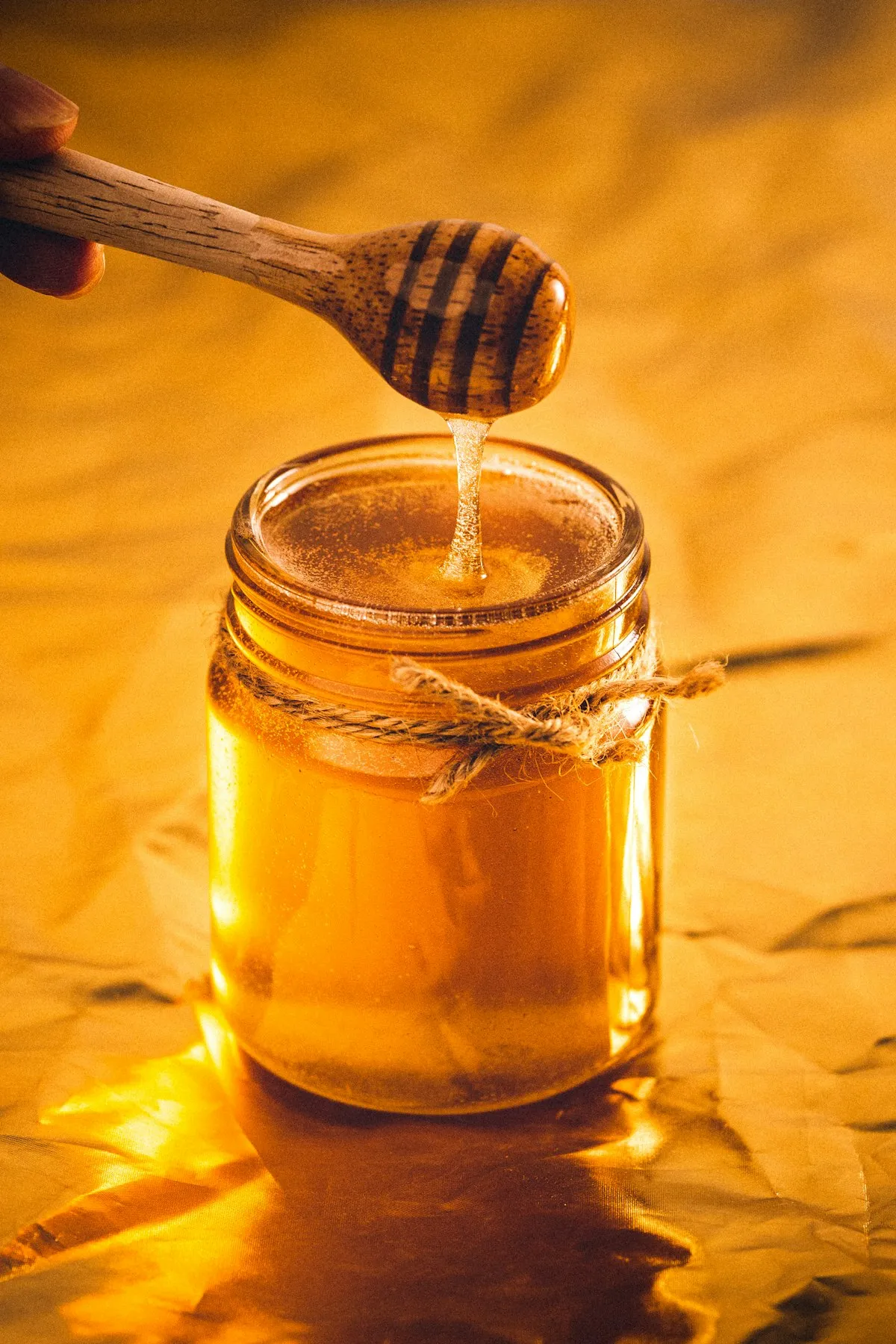
We did not set out to learn about pollen forensics. We set out to understand why our honey tastes the way it does — dark, resinous, with that particular depth that comes from tulip poplars in late May. Somewhere along the way, we fell into a field of science called melissopalynology, which is the study of pollen grains found in honey. It sounds obscure because it is. But the premise is simple, and once you understand it, you will never look at a jar of honey the same way.
Every jar of honey is an archive. Not metaphorically — literally. Suspended in that thick amber liquid are thousands of microscopic pollen grains, each one traceable to a specific plant species, each one a record of what was blooming within foraging range of the hive during the weeks or months that honey was being made. A trained palynologist can put a drop of honey on a glass slide, stain it, place it under a microscope, and read it like a botanical census of the surrounding landscape.
Your honey is a map. It just requires a microscope to read it.
The Science of Reading Pollen
Melissopalynology — from the Greek melissa (honey bee) and palynos (fine meal, or pollen) — was formalized in the early twentieth century, though people had been observing pollen in honey for longer than that. The discipline sits at the intersection of botany, entomology, and food science, and it has practical applications that range from fraud detection to ecological monitoring to allergy research.
The method is straightforward in principle, painstaking in practice. You dissolve a measured sample of honey in warm water, centrifuge it to concentrate the sediment, mount the sediment on a slide, and stain it with a dye — usually basic fuchsin or safranin — that makes the pollen grains visible under a light microscope. Then you count and identify them.
Pollen grains are remarkably distinctive. Each plant family, genus, and often species produces grains with characteristic shapes, sizes, surface textures, and aperture patterns. Tulip poplar pollen (Liriodendron tulipifera) is monosulcate — it has a single elongated groove — and measures roughly 40 to 60 micrometers. White clover (Trifolium repens) is tricolporate, with three evenly spaced pores and a much smaller diameter, around 25 to 30 micrometers. Goldenrod (Solidago) grains are echinate — covered in tiny spines that give them a distinctive spiky appearance under magnification. Each species leaves a signature that cannot be faked.1
A single ten-gram sample of raw honey might contain tens of thousands of pollen grains representing dozens of plant species. The relative proportions tell you which plants were the primary nectar sources (these show the highest pollen counts) and which were minor contributors. Some researchers have documented over a hundred distinct pollen types in a single regional honey sample.2
The counts are not perfect proxies for nectar contribution — different plants produce different amounts of pollen per flower, so a species that sheds pollen heavily may be overrepresented in the count relative to its actual nectar yield. Tulip poplar, for instance, produces abundant pollen, so it tends to show up prominently in pollen spectra even when other species contributed meaningful amounts of nectar. Palynologists account for this with correction factors, though there is still debate about the best way to calibrate them. The science is useful but not precise — a theme we keep running into in beekeeping.
How Pollen Gets Into Honey
Here is something that surprised us: most of the pollen in honey is not there on purpose.
When a forager bee visits a flower for nectar, she is inevitably dusted with pollen. It clings to the branched hairs on her body — the same hairs that make bees such effective pollinators. She packs some of it deliberately into her corbiculae (pollen baskets) to bring back as protein for the colony, but the rest stays on her body. When she returns to the hive and transfers her nectar load to a house bee through trophallaxis — mouth to mouth, essentially — pollen grains fall from her body into the nectar. Other grains drift loose as she moves across the comb.
Inside the hive, the contamination continues. Pollen stores are often kept in cells adjacent to honey stores. As bees walk across the comb, they track pollen into neighboring cells. The warm, active environment of the hive — sixty thousand bees moving constantly across wax surfaces dusted with pollen — means that stray grains end up everywhere, including in the honey.
There is also airborne pollen. The hive interior is not sealed. Air circulates through the entrance and across the comb as bees fan to regulate temperature and cure nectar. Wind-dispersed pollen from trees, grasses, and weeds drifts in and settles on open cells of ripening nectar.
The result is that raw honey contains a pollen record that reflects not just what the bees were foraging on, but what was blooming in the general area — a radius of roughly two to three miles from the hive, which is the typical foraging range of Apis mellifera.3 It is accidental data collection, performed continuously by tens of thousands of field workers over a season.
The bees are not trying to document the landscape. They are making food. The documentation is a side effect.
What the Pollen Record Reveals
A pollen analysis of a honey sample can answer several questions at once, and the answers are more specific than most people expect.
Plant species identification. The most direct application. By identifying the pollen types present and their relative abundance, you can determine which plants provided the nectar. A honey that is labeled “clover” should show a dominant proportion of Trifolium pollen. A honey labeled “wildflower” should show a diverse spectrum reflecting multiple nectar sources. If a sample labeled “orange blossom” contains predominantly corn syrup residues and almost no Citrus pollen, something is wrong.
Geographic origin. Plants grow in specific regions, so the combination of pollen types in a honey sample acts as a geographic fingerprint. Honey from Loudoun County, Virginia, will contain a pollen spectrum dominated by tulip poplar, black locust (Robinia pseudoacacia), clover, and whatever wildflowers were in bloom — likely goldenrod and aster in the fall crop, dogwood and redbud in the spring. Honey from the central valley of California will show a completely different profile — almond, citrus, sage, star thistle. Honey from New Zealand will contain Leptospermum scoparium (manuka) pollen that grows nowhere else. Each region has a botanical fingerprint, and the pollen records it.4
Bloom timing and seasonality. Because different plants bloom at different times, the pollen spectrum can indicate when the honey was produced. A spring honey from our area might show heavy tulip poplar, black locust, and autumn olive pollen. A late summer harvest would shift toward goldenrod, boneset, and aster. By reading the pollen, you can reconstruct not just where the honey came from, but when.
Landscape ecology. This is the application that researchers find most interesting. Pollen in honey provides a snapshot of what is actually growing and blooming in a given area during a given period. Changes in the pollen spectrum over years or decades can track shifts in land use, the spread of invasive species, the loss of native flowering plants, or the effects of development on pollinator forage. Honey bees are unintentional environmental monitors — sampling the botanical landscape continuously and storing the results in wax cells.5
We find this last application quietly extraordinary. A beekeeper who saves a sample from each harvest is, without trying, building a botanical time series of their local landscape. Go back and analyze samples from five or ten years ago and you might see a decline in black locust pollen as old trees die and are not replaced, or a rise in autumn olive as that invasive species spreads along the fence lines west of Leesburg. The honey remembers what the landscape looked like. It does not editorialize. It just records.
Honey Fraud and the Absence of Pollen
This is where the science moves from interesting to consequential.
We touched on honey fraud in our piece on crystallization, but it is worth returning to here because pollen is the linchpin. The global honey market has a significant fraud problem, and the mechanism of that fraud depends, in large part, on removing the very evidence that pollen analysis could detect.
Ultra-filtering — the industrial process of heating honey, diluting it, and forcing it through fine filters — strips out all pollen along with wax particles, air bubbles, and other particulates. The stated purpose is shelf stability and visual clarity. The practical effect is that the honey becomes untraceable. Without pollen, no laboratory can determine where it was produced or what plants the bees were foraging on.
This matters because of the economics. Chinese honey has been subject to US anti-dumping tariffs since 2001, making it significantly cheaper than domestically produced or legally imported honey. The incentive to launder Chinese-origin honey through third countries — India, Vietnam, Malaysia, Australia — and sell it as a product of those countries is substantial. Ultra-filtering removes the pollen that could prove the true origin. Some of this honey is also adulterated with corn syrup, rice syrup, or sugar beet syrup to increase volume.6
The European Commission’s 2023 coordinated investigation tested honey samples from across the EU and found that 46 percent were suspected of adulteration — nearly half. The most common adulterants were sugar syrups engineered to pass basic authenticity tests.7 In the United States, the FDA does not require pollen to be present in honey for it to be labeled as honey, which means ultra-filtered product can be sold legally without any indication that its provenance has been erased.
Vaughn Bryant, a palynologist at Texas A&M University who spent decades analyzing commercial honey samples, described the situation bluntly. He found that the majority of honey sold in US grocery stores contained no detectable pollen whatsoever. His work, along with reporting by Food Safety News, helped bring public attention to the scale of the problem — but regulation has not caught up to the science.8
The Codex Alimentarius — the international food standards body jointly run by the WHO and FAO — states that honey should not have pollen removed by methods other than normal straining. But compliance is voluntary, enforcement is thin, and the economic incentives run the wrong way. The cheapest honey on the shelf is often the most processed, the least traceable, and the most likely to be something other than what the label claims.
We are not trying to alarm anyone. We are trying to explain why the presence or absence of pollen is not a trivial detail. Pollen is provenance. Remove it, and you remove the only reliable record of what the honey actually is.
Terroir — The Word Wine Borrowed First
Terroir is a French term that wine people have made their own, but it applies to honey with equal — possibly greater — precision. The concept is that a food product expresses the specific conditions of the place where it was produced: the soil, the climate, the elevation, the surrounding vegetation. In wine, terroir explains why a Pinot Noir from Burgundy tastes different from a Pinot Noir from Oregon. In honey, it explains why our tulip poplar honey from Loudoun County tastes nothing like clover honey from central Iowa.
The parallel is not superficial. Wine gets its character from a single plant species — Vitis vinifera — and the terroir comes from how that vine responds to its environment. Honey gets its character from the entire flowering plant community within foraging range, filtered through the biology of the colony that made it. If anything, honey’s terroir is more complex because it draws on dozens of species rather than one.
Consider two jars of honey produced in the same season, fifty miles apart. One from our hives near Leesburg, surrounded by mature tulip poplars, black locust along the fencerows, clover in the hay fields, and patches of goldenrod and aster in the unmowed margins. The other from hives in the Shenandoah Valley, tucked into an apple orchard with sourwood on the ridgeline and basswood along the creek. The nectar sources are different. The pollen spectra are different. The sugar ratios are different. The flavor, color, aroma, and crystallization behavior are different. Same bees, same species, same state — completely different honey.
Scale that out further. Clover honey from a large operation in the upper Midwest, where bees forage on thousands of acres of clover and alfalfa monoculture, will have a narrow pollen spectrum — predominantly Trifolium and Medicago, with little else. It will be light in color, mild in flavor, and relatively uniform from year to year. Our honey, drawn from a diverse suburban-rural landscape with dozens of flowering species within range, will have a wide, variable pollen spectrum. The flavor and color shift from harvest to harvest depending on what bloomed when and how the weather affected the flows.
Neither is better. They are different records of different places. The Midwest clover honey tells you something true about that landscape — its scale, its uniformity, its agricultural focus. Our honey tells you something true about ours — the poplars, the mixed hardwood edges, the wildflower margins that persist because our corner of Loudoun County has not been fully developed yet.
The pollen in our honey is partly a record of what remains.
The Enzymes Bees Add
The pollen record is not the only signature in a jar of honey. The bees themselves leave biochemical markers — enzymes they add during nectar processing that are distinctive to real, minimally heated honey.
When a forager bee collects nectar, she stores it in her honey crop (a specialized foregut). During storage and transfer, glandular secretions mix with the nectar. These secretions contain several key enzymes.
Invertase (also called sucrase) breaks sucrose — the primary sugar in most floral nectars — into glucose and fructose. This is why honey’s sugar profile is dominated by monosaccharides rather than the disaccharide sucrose found in raw nectar. The conversion is not instantaneous. It continues in the comb as the honey ripens, which is one reason freshly capped honey tastes slightly different from honey that has been stored for months.9
Diastase (amylase) breaks down starch into simpler sugars. Its precise role in honey is not entirely understood — nectar does not contain much starch, so the enzyme may be more about processing pollen stores than nectar. But diastase activity has become one of the standard markers for honey quality because it degrades predictably with heat exposure. The diastase number (DN) of a honey sample tells you something about how it has been handled since extraction. Fresh, unheated honey typically has a DN above 8. Honey that has been pasteurized or held at high temperatures for extended periods will show a diminished DN, sometimes dropping below 3. The Codex Alimentarius sets a minimum DN of 8 for most honeys.10
Glucose oxidase is perhaps the most interesting. This enzyme converts glucose into gluconic acid and hydrogen peroxide. The gluconic acid is what gives honey its mildly acidic pH — typically between 3.5 and 4.5 — which itself inhibits microbial growth. The hydrogen peroxide provides active antimicrobial activity, which is why honey has been used on wounds for millennia and why medical-grade honey products (like Medihoney) exist today. The enzyme is active in diluted honey — when it contacts moisture on a wound surface, for instance — but largely dormant in full-strength honey, where the low water content and high sugar concentration suppress the reaction.11
These enzymes are heat-sensitive. Pasteurization — heating honey to 161 degrees Fahrenheit (72 Celsius) to kill yeast and delay crystallization — denatures most of them. Ultra-filtering, which involves sustained heating, does the same. So the enzyme profile of a honey sample, like its pollen content, is a marker of how it has been handled. High diastase, active glucose oxidase, intact invertase — these are the fingerprints of honey that went from the comb into the jar without being cooked.
Our honey has never been heated above hive temperature — roughly 95 degrees Fahrenheit. We strain it through coarse mesh to catch wax cappings and debris, and then it goes into jars. The enzymes the bees added are still there, still active, still doing what they have been doing since the nectar was in the comb. We do not test for them — we do not have a lab — but the chemistry is straightforward enough that we trust the process. If you do not heat it, you do not lose it. That is it.
What Our Honey Would Show
We have never had our honey analyzed by a palynologist. We would like to, someday — it is on the list of things we keep meaning to do, somewhere between requeening the irritable hive on the south end and fixing the fence the deer keep leaning on.
But we can make a reasonable guess about what a pollen analysis would reveal, based on what we know about our landscape and what we watch the bees foraging on through the season.
A spring harvest sample would be dominated by tulip poplar pollen — Liriodendron tulipifera — because the poplar flow is the main event from late April through early June. Mixed in, you would find black locust (Robinia pseudoacacia), which blooms at roughly the same time and grows along the fence lines and roadsides within range. There would likely be clover (Trifolium), dandelion (Taraxacum), and possibly autumn olive (Elaeagnus umbellata) — an invasive shrub that has spread aggressively through Loudoun County and, whatever its ecological drawbacks, produces nectar the bees work heavily.
A late summer or fall sample would shift. Goldenrod (Solidago) would be prominent — it is everywhere in our area by August, and the bees work it hard. Aster (Symphyotrichum) would appear. Japanese knotweed (Reynoutria japonica), another invasive that blooms in late summer along the creek corridors near Leesburg, might show up. There would be traces of whatever garden flowers, flowering herbs, and ornamental plantings exist within the two-to-three-mile radius our bees cover.
The pollen spectrum would also contain wind-pollinated species that do not produce nectar — grasses, ragweed, oak, pine. These grains blow into the hive on air currents and settle into open cells. They would not indicate foraging; they would indicate what was releasing pollen into the atmosphere at the time. Even this is data. It tells you about the season, the local ecology, the balance between forest and field.
If someone analyzed our honey ten years from now and compared it to a sample from this season, the differences would tell a story about what changed in this part of Loudoun County. Which trees came down. Which fields were developed. Which invasive species gained ground or were pushed back. The pollen does not know it is recording this. It is just there — microscopic, durable, specific.
An Accidental Archive
What strikes us most about all of this is how incidental it is. The bees are not documenting the landscape. They are feeding their colony. The pollen ends up in the honey because bees are fuzzy and flowers are messy and the physics of small particles in a warm, crowded space makes contamination inevitable. There is no intent, no design, no archive built on purpose.
And yet the record is there. Durable, specific, readable — if you know how to look. A jar of honey from our hives, sitting on a shelf, contains a compressed botanical history of this corner of Virginia during the weeks it was produced. The tulip poplars that were blooming along Goose Creek. The goldenrod that covered the unmowed pastures north of Route 7. The black locust that lines every old fence line between here and Purcellville.
There is a German word for this kind of thing — Umweltarchiv — an environmental archive. Materials that record environmental conditions without being designed to do so. Tree rings are one. Ice cores are another. Lake sediment. Coral. And, in its modest way, honey.
We are not suggesting that our six hives near Leesburg are producing data of the same significance as an Antarctic ice core. But the principle is the same. The honey records what was here. When it is gone — when the trees are cut, the fields paved, the wildflowers mowed — the honey from this year will still contain the pollen from those plants. It will still remember what bloomed.
We find that worth knowing. Not because it makes the honey more valuable as a product — we would feel strange about marketing provenance like it is a feature. But because it changes what a jar of honey means. It is a record of a place and a season, written in a language of pollen grains and enzymes, authored by sixty thousand bees who were just trying to get through the winter.
The jar remembers. Even after the flowers are gone.
References:
- Erdtman, G. An Introduction to Pollen Analysis. Chronica Botanica Company, 1943. Revised editions remain a foundational reference for pollen morphology and identification techniques.
- Louveaux, J., Maurizio, A., and Vorwohl, G. “Methods of Melissopalynology.” Bee World 59.4 (1978): 139-157. The standard international protocol for pollen analysis of honey.
- Beekman, M. and Ratnieks, F.L.W. “Long-range foraging by the honey-bee, Apis mellifera L.” Functional Ecology 14.4 (2000): 490-496.
- Von Der Ohe, W. et al. “Harmonized methods of melissopalynology.” Apidologie 35.S1 (2004): S18-S25.
- Jones, G.D. and Bryant, V.M. “Melissopalynology in the United States: A Review and Critique.” Palynology 20 (1996): 215-228.
- Schneider, A. “Asian Honey, Banned in Europe, Is Flooding U.S. Grocery Shelves.” Food Safety News, August 2011.
- European Commission, Joint Research Centre. “EU Coordinated Action on Honey Authenticity.” 2023.
- Bryant, V.M. “Pollen Analysis of Honey.” HerbalGram 115 (2017): 56-61. Summarizes decades of pollen survey work on commercial honey samples.
- White, J.W. “Composition of American Honeys.” USDA Technical Bulletin No. 1261 (1962).
- Codex Alimentarius Commission. “Standard for Honey.” CODEX STAN 12-1981, revised 2001.
- Bang, L.M. et al. “The Effect of Dilution on the Rate of Hydrogen Peroxide Production in Honey and Its Implications for Wound Healing.” The Journal of Alternative and Complementary Medicine 9.2 (2003): 267-273.
We sell what the bees don’t need. Interested in trying some? Drop us a line.