- foraging
- colony-behavior
- observation
- summer
Water Carriers
Some bees spend their entire foraging lives collecting water instead of nectar. They bring home nothing storable, and the colony cannot survive without them.
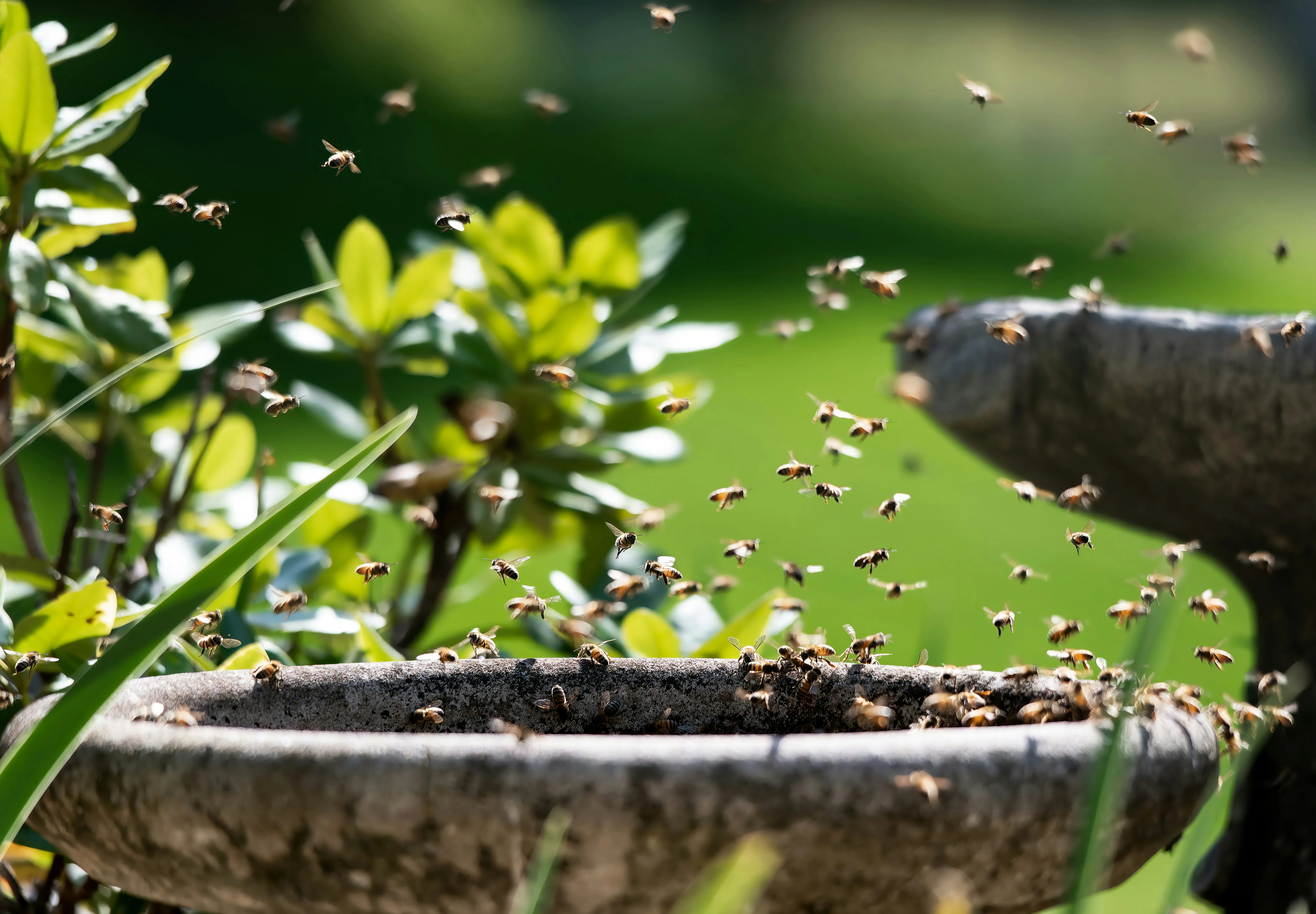
Every account of the honeybee colony tells the same story. Foragers leave at dawn, work the flowers, and come home heavy with nectar or bright with pollen. The colony converts that cargo into food, stores it in wax cells, and survives the winter on the surplus. It is a story about accumulation — about bringing things home and putting them away.
But there is a subset of foragers that nobody writes about, because what they bring home cannot be stored. They carry water. Plain water, collected from puddles, creek edges, wet stones, dripping faucets, and the condensation on a garden hose left in the grass. They fill their honey stomachs with it, fly it back to the hive, and pass it off to house bees who use it immediately. Nothing goes into a cell. Nothing gets capped. By the end of the day, every drop has evaporated or been consumed, and there is no evidence the water carrier was ever there.
What the Water Is For
A honeybee colony uses water for three things, and all three are essential.
The first is evaporative cooling. On a hot day in Loudoun County — and July here delivers plenty of those, with afternoons above ninety-five degrees and humidity to match — the interior of a hive can climb past the threshold where brood dies. Developing larvae need the brood nest held between ninety-two and ninety-seven degrees Fahrenheit. Above that, pupae cook in their cells. The colony’s solution is simple: water carriers bring water into the hive, house bees spread thin films of it across the surface of capped brood comb, and fanner bees stationed at strategic points create airflow across the wet surfaces. The water evaporates. The evaporation absorbs heat. The temperature drops. It is air conditioning, built from water, wax, and ten thousand tiny wings.
The second use is diluting honey to feed larvae. Nurse bees cannot feed raw honey to young brood — it is too thick, too concentrated. They mix it with water to create a thinner solution that the larvae can consume. Every larva in the hive is being fed diluted honey for at least part of its development, which means the colony’s demand for water tracks directly with how much brood it is raising.
The third is humidity regulation. The brood nest needs to be not just warm but humid — roughly fifty to sixty percent relative humidity — to prevent developing pupae from desiccating inside their cells. In dry conditions, water carriers help maintain that moisture balance. This matters less in Virginia summers, when the ambient humidity often does the job on its own, but it matters in spring and fall when the air is drier and the colony is still rearing brood.
On a hot day at the peak of summer, a single colony can consume a quart of water. Some estimates run higher. That is a remarkable volume for an organism that carries it home a fraction of a milliliter at a time.
The Paradox of the Water Forager
Here is the thing that makes water carriers unusual among foragers, and the thing that drew us to pay attention to them in the first place.
A nectar forager brings home sugar. That sugar gets processed into honey, stored in cells, capped with wax, and kept — sometimes for months. The colony’s survival through winter depends on those stores. A pollen forager brings home protein. It gets packed into cells, preserved with a thin layer of honey, and consumed as the raw material for feeding larvae and producing royal jelly. Both nectar and pollen are investments. They represent future value.
A water forager brings home something that is used immediately and then gone. Nothing is stored. Nothing accumulates. At the end of a ten-hour day of water foraging — flying to the source, filling up, flying back, unloading, flying out again, dozens of trips — the water carrier has contributed nothing that persists in the hive overnight. If you opened the colony the next morning and tried to find evidence of her labor, you would find none.
And yet, without her, the brood would overheat, the larvae would starve for lack of diluted food, and the colony would collapse in a matter of days during a heat wave. The water carrier’s work is invisible precisely because it is so immediately consumed. The colony needs it the way we need breath — constantly, and with nothing left over to show for it.
Dirty Water and Why They Prefer It
If you have ever kept bees near a swimming pool, you already know this problem. Bees prefer water that, by human standards, is not clean. They will pass over a pristine birdbath to crowd around a muddy puddle, a leaking compost pile, or the slime-covered rim of a flower pot saucer that has not been emptied in weeks.
This is not a mistake. The bees are selecting for minerals and scent.
Standing water that has been in contact with soil, decaying organic matter, or algae contains dissolved minerals — sodium, potassium, calcium, magnesium — that the colony needs in trace amounts. Clean, chlorinated tap water offers almost none of these. A muddy puddle is a mineral supplement. The scummy water in a neglected plant saucer is, from a bee’s perspective, richer than what comes out of the garden hose.
Scent matters too. Water foragers navigate partly by smell, and a water source with a strong, distinctive odor — the mineral tang of wet soil, the vegetable smell of algae, even the chlorine of a swimming pool — is easier to relocate than a source that smells like nothing. Once a water forager learns a scent, she returns to that exact source with remarkable fidelity. This is why bees at a neighbor’s pool are so difficult to redirect. The forager has memorized the location and the scent. She will keep going back even if you place a closer, cleaner alternative right next to the hive.
The solution — the only reliable one we have found — is to establish a water source before the bees find one you do not want them using. Once they have imprinted on a source, it is very hard to break the habit. But if your water station is the first thing they find in spring, they will stick with it.
How to Set One Up
We keep a shallow basin near our hives — a large terra cotta saucer, the kind sold for planters, about eighteen inches across. We fill it with a thin layer of gravel and add water until it just covers the stones. The gravel gives the bees a landing surface. Bees cannot swim and they drown easily in open water. They need something to stand on while they drink — stones, wine corks, sticks, marbles, anything that breaks the surface.
We let it get a little dirty on purpose. A thin film of algae, some leaf litter, the mineral buildup that develops on the gravel over a few weeks — all of it makes the water more attractive to the bees. We top it off daily in summer rather than dumping and refilling. The goal is a consistent, slightly funky water source that smells the same every day.
The location matters. Close enough to the hives that a water forager does not burn much energy on the trip, but not so close that the flight path to the water crosses our working area in the apiary. We keep ours about twenty feet from the nearest hive, in partial shade so it does not evaporate as fast. A water source in full sun on a July afternoon in Virginia can dry out by midmorning.
It is a small thing. It took five minutes to set up. But it has kept our bees out of the neighbors’ bird baths, and watching them line up along the rim of the saucer on a hot afternoon — dozens of them, standing on the gravel, proboscises extended into the water — is one of the quiet pleasures of keeping bees.
The Communication Chain
The part of this story that still astonishes us is how the colony regulates its water supply, because it does so without any central authority and with a communication system that is beautifully indirect.
Here is how it works. A water forager returns to the hive and offers her load to a house bee. The speed at which the house bee accepts the water is the signal. If the colony is hot — if the brood nest is climbing past the safe range and fanner bees are working hard — the house bees need water urgently. They grab the water from the returning forager almost immediately, sometimes before she has fully entered the hive. The forager reads this eagerness as a signal: water is in high demand. She turns around and goes straight back to the source without delay.
If the colony is cool — if the temperature inside is comfortable and the house bees have enough water — the reception is slow. The returning forager offers her load and has to wait. She walks around, tries another house bee, waits again. The house bees are not refusing the water outright. They are just in no hurry. And that delay is the signal. The forager reads the slow reception as low demand and may switch to collecting nectar instead, or she may stop foraging altogether and wait inside the hive.
No bee gives an order. No bee has a global picture of the colony’s temperature, brood needs, and water reserves. The entire regulation happens through the speed of a handoff — a single, local interaction between two bees, repeated thousands of times across the colony, producing a calibrated response to environmental conditions that shift by the hour.
Thomas Seeley at Cornell has documented this feedback loop in detail. What strikes us about it is how much information is carried by so simple a signal. Not the content of the message — just the tempo. Fast means go. Slow means wait. The colony allocates its water workforce in real time, without planning, without language, without hierarchy. Just urgency, expressed as the eagerness of a handshake.
Watching Them Work
We have spent a lot of time watching the entrance of our hives. You learn to recognize the nectar foragers by their heavy flight, the pollen carriers by the bright pellets on their legs. But the water carriers look like nothing. They leave empty and come back looking empty — no visible pollen, no distended abdomen heavy enough to notice from the outside. They are indistinguishable from any other bee unless you know what you are looking at.
We started noticing them only after we set up the water station. Bees coming and going from the saucer all day, especially on the hottest afternoons — the same individuals, as far as we could tell, making the same trip over and over. Researchers have found that water carriers are specialists. Once a bee begins foraging for water, she tends to stick with it for the rest of her foraging life. She does not rotate to nectar or pollen. She carries water until she wears out — two to three weeks at midsummer — and leaves nothing storable behind.
We notice them now.
References:
- Seeley, Thomas D. The Wisdom of the Hive. Harvard University Press, 1995 — water foraging regulation, feedback loops between foragers and receivers
- Lindauer, Martin. Communication Among Social Bees. Harvard University Press, 1961 — early documentation of water collection behavior and division of labor
- Kuhnholz, Susanne and Seeley, Thomas D. (1997) — “The control of water collection in honey bee colonies,” Behavioral Ecology and Sociobiology — the unloading-speed feedback mechanism
- Human, Hannelie et al. (2006) — “Do honeybees, Apis mellifera scutellata, regulate humidity in their nest?” Naturwissenschaften — brood nest humidity requirements
- Winston, Mark L. The Biology of the Honey Bee. Harvard University Press, 1987 — water consumption rates and thermoregulation
We sell what the bees don’t need. Interested in trying some? Drop us a line.