- dearth
- management
- summer
- behavior
Robbing Season
When the nectar dries up in late summer, desperate colonies raid their neighbors. The violence is startling and instructive.
There is a version of beekeeping that lives in soft focus. Bees drifting between lavender stems. Honey dripping from a wooden spoon. A calm beekeeper lifting a frame of perfect comb in golden afternoon light.
That version is not wrong, exactly. But it leaves out late August.
The Dearth
In Loudoun County, the nectar calendar has a hole in it. The tulip poplars finish in early June. Clover and black locust carry things through the end of the month, maybe into July if the rain holds. Then, gradually and then all at once, the flowers stop. The fields go brown. The roadsides turn to seedheads and dried stems. From late July through September, there is almost nothing blooming that produces nectar in meaningful quantities.
Beekeepers call this the dearth. It is the word they use because it is the right one.
For a strong colony with sixty or eighty pounds of capped honey in the supers, the dearth is a lean time but a survivable one. The foragers come back empty. The queen slows her laying. The population contracts. They wait.
For a weak colony — one that went into summer light on stores, or lost its queen in June, or never built up after a late split — the dearth is something else entirely. It is the beginning of the end, though not always in the way you would expect.
What Robbing Looks Like
We saw it for the first time in August of last year. Hive 6 — our package colony, the one that built up slower than the others — had been struggling since midsummer. Low population, spotty brood pattern, not much stored honey. We had been planning to combine it with a stronger colony but hadn’t gotten to it yet.
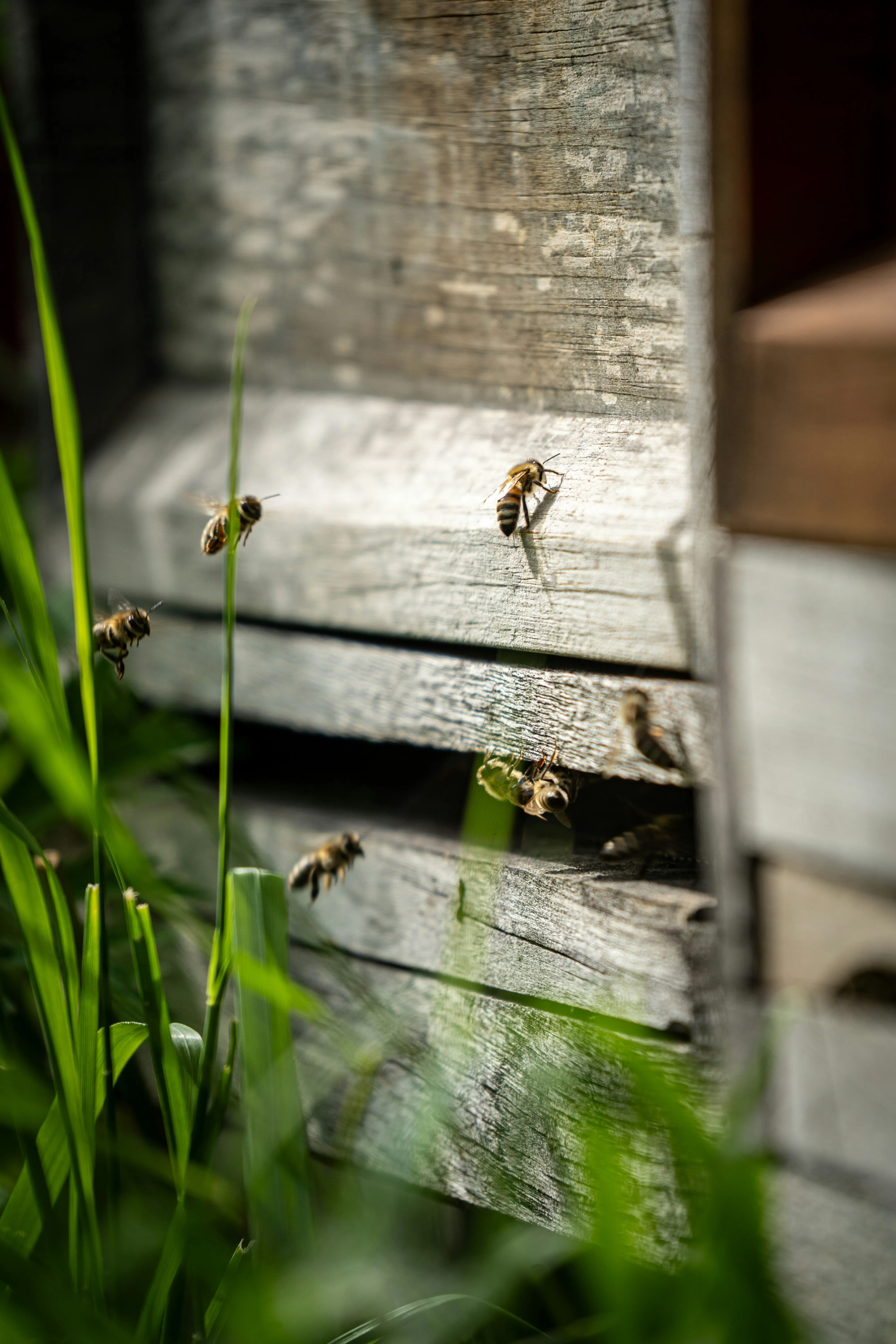
One afternoon, the hive entrance looked wrong. There was flight activity, but it was not the orderly coming-and-going of a healthy colony. Bees were zigzagging in tight, erratic patterns in front of the landing board. Dozens of them, hovering and darting, weaving side to side like they were searching for a way in. The sound was different too — higher-pitched, more frantic than the steady hum of normal foraging traffic.
On the landing board itself, bees were fighting. Not the brief scuffle you sometimes see when a guard bee checks a returning forager — this was different. Pairs of bees locked together, rolling, stinging. Dead bees on the ground below. Some of the bees crawling on the front of the hive were shiny and dark, their hair rubbed off from wrestling past the guards.
We opened the hive the next morning to assess the damage. Wax cappings on the honey frames had been torn open — not the neat, deliberate uncapping that bees do when they are consuming their own stores, but ragged, ripped-apart cappings with jagged edges. Some frames that had been half-full of honey the week before were dry. Completely empty.
Hive 6 was being robbed.
Why It Happens
The logic is simple and merciless. A strong colony has ten or fifteen thousand foragers with nothing to forage. The nectar is gone. Every scout that goes out comes back empty. But somewhere within flying range — two miles, three miles — there is the scent of honey. An open hive. A weak colony that cannot defend its entrance.
The foragers from the strong colony are not malicious. They are doing exactly what evolution built them to do: find a food source and recruit others to it. A weak colony’s honey stores are, from the perspective of a forager bee, just another food source.
The problem is the cascade. Once robbing begins, it escalates. The bees that breach the weak colony’s defenses carry honey back to their own hive and perform waggle dances — the same recruitment behavior they use when they find a patch of goldenrod or a stand of clover. More foragers arrive. The weak colony’s guards are overwhelmed. The scent of exposed, uncapped honey drifts downwind. Bees from other colonies — colonies that had nothing to do with the initial raid — pick up the scent and join in.
A colony being robbed can be stripped of its entire honey supply in a day or two. Without stores, it will not survive into fall. The robbing itself often kills the queen, either directly in the chaos or indirectly when the depleted colony cannot maintain the cluster around her. What started as one strong colony exploiting one weak colony can cascade through an apiary, with each newly robbed hive becoming a target that draws more robbers from farther away.
How Beekeepers Make It Worse
This is the part that is hard to admit. Most robbing events in a managed apiary are triggered or worsened by the beekeeper.
Leaving honey supers exposed during extraction — even for a few minutes in the open air — sends a scent signal that can draw bees from a mile away. We learned this the first year, when we set a box of wet frames on the tailgate of the truck after extracting. Within twenty minutes, there were hundreds of bees on it, and the frenzy at the nearest hive entrances had already started.
Open feeding — pouring sugar syrup into a tray or bucket near the hives — does the same thing. It rewards the strongest, most aggressive foragers while advertising the location of every hive in the yard. The colonies that need the feed most are the ones least able to compete for it.
Inspecting hives during the dearth is another trigger. Every time you crack a hive open, honey scent escapes. In the middle of a nectar flow, it barely matters — there is food everywhere, and no one is desperate. In August, when every forager within two miles is searching for anything that smells like sugar, opening a hive is like ringing a dinner bell.
Even a drip of syrup on the ground near the entrance can start things. The threshold for triggering robbing during the dearth is remarkably low.
What You Can Do
Prevention is more effective than intervention. Once a full-scale robbing event is underway, it is very difficult to stop. The bees have recruited. The scent is in the air. Closing the entrance entirely can trap robbers inside with the colony’s bees, making the fighting worse.
What we have learned — mostly from making mistakes and then reading everything we could find:
Entrance reducers go on in July. Before the dearth hits. A strong colony can defend a small entrance. A weak colony cannot defend a wide one. We reduce every hive to its smallest entrance setting before the nectar stops. It looks restrictive, but the bees adapt within a day.
Robbing screens work. These are simple devices — a screen over the entrance that forces bees to navigate around a corner or through a maze to get in. The resident bees learn the route quickly. Robbers, who are following scent and trying to fly directly into the entrance, are confused by the barrier. It does not eliminate robbing, but it slows it dramatically and gives the colony’s guards a fighting chance.
We do not inspect during the dearth unless something is clearly wrong. No routine frame-by-frame inspections in August. We observe from outside — entrance activity, orientation flights, dead bees on the ground. If we need to go in, we do it quickly, late in the day when flight activity is winding down, and we keep the hive open for as little time as possible.
Feeding happens inside the hive. We use in-hive feeders — the kind that sit inside an empty super on top of the frames, where only that colony’s bees can access them. No open feeding. No entrance feeders, which leak and attract robbers. The syrup goes where only the bees that need it can reach it.
Wet supers go back on the hives immediately after extraction. The bees clean them out overnight, inside the hive, where the scent is contained. We never leave extracted frames sitting in the open.
The Colony That Did Not Make It
We tried to save Hive 6. We reduced the entrance to a single-bee gap. We put a wet towel over the hive to disrupt the scent. We moved it to the far side of the property after dark, when the robbers had returned to their own hives.
It was not enough. The colony had already lost most of its stores and a significant portion of its population. The bees that remained were demoralized — there is no better word for it. They clustered loosely on the frames, barely moving. The queen was alive but had stopped laying. There was no brood, almost no food, and not enough bees to forage or defend even with the reduced entrance.
We combined the survivors into Hive 2 using the newspaper method — a sheet of newspaper between the two colonies, which the bees chew through slowly enough that the pheromones mingle before the populations mix. The Hive 6 bees were absorbed. Their queen did not survive the merge.
It was, by any measure, a failure of management. We should have combined earlier, before the dearth exposed how vulnerable that colony was. We should have reduced entrances sooner. We should have been watching for the signs — the erratic flight, the fighting at the entrance — before the damage was done.
What the Bees Are Telling You
Robbing is not cruelty. It is not aggression in the way we usually mean the word. A robber bee is not angry at the colony it is raiding. It has no concept of theft. It found a food source, and it is bringing food home to its family. That is the entire calculation.
They are doing what tens of millions of years of evolution taught them to do — survive the lean season by any means available.
Our job is to pay attention, to anticipate the pressure before it arrives, and to give every colony the best chance we can. Sometimes that is enough. Sometimes it is not.
The dearth will come again this summer, the way it always does in Loudoun County. Late July, the fields will go quiet. We will reduce the entrances, install the robbing screens, and keep the syrup inside the hives where it belongs. We will watch the landing boards every evening, looking for the zigzag flight and the fighting that means we were too slow.
We are getting better at this.
References and further reading:
- Winston, Mark L. The Biology of the Honey Bee. Harvard University Press, 1987 — colony defense mechanisms, robbing behavior, and the role of guard bees in nest protection.
- Free, J.B. “The behaviour of robber honeybees.” Behaviour 7, no. 4 (1954): 233–240 — early systematic description of robbing behavior, recruitment, and escalation dynamics.
- Seeley, Thomas D. Honeybee Ecology: A Study of Adaptation in Social Life. Princeton University Press, 1985 — foraging economics, resource competition between colonies, and the ecological context of robbing.
We sell what the bees don’t need. Interested in trying some? Drop us a line.