- weather
- colony-behavior
- observation
- seasonal
Rain Days
When weather grounds 50,000 bees, the colony turns inward. Rain days are when the hive does its most important domestic work.
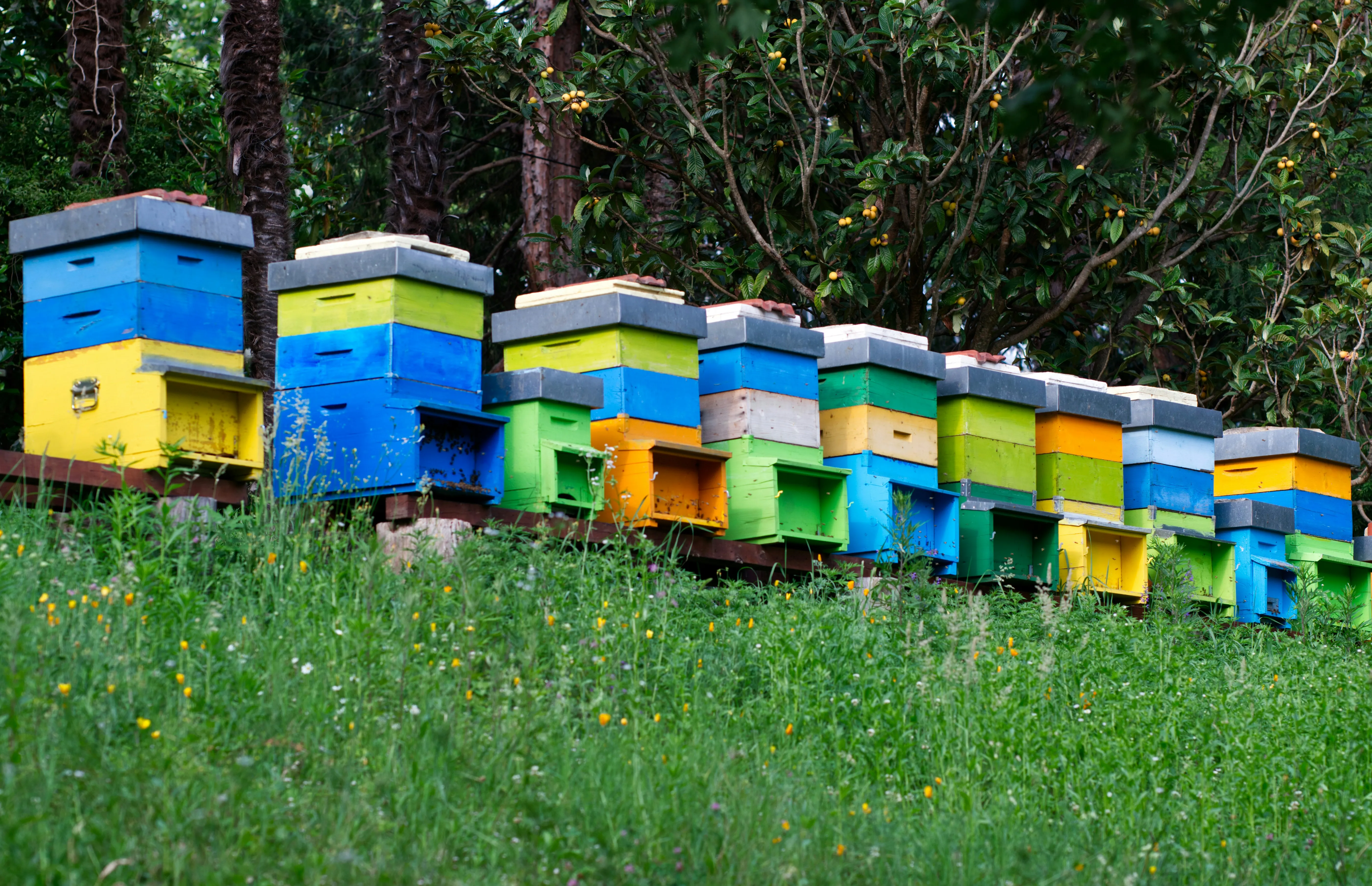
There are days when nothing happens in the apiary. The sky is low and gray over Leesburg, rain coming in sheets off the Blue Ridge, and the hives sit there — closed, quiet, unchanged from the outside. No bees at the entrance. No foragers in the air. No visible sign that anything alive is inside at all. A neighbor driving past might think we had abandoned them.
We have spent a lot of time watching hives on days like this. More than we expected to, honestly. It started because there was nothing else to do — you cannot inspect in the rain, cannot pull frames when water is running down the comb — and turned into something else. A different kind of attention. The days when the bees cannot fly are the days when the colony does some of its most essential work, and standing outside a hive in the rain, listening, you begin to hear it.
The Threshold
Honeybees are precise about their flying conditions. They will not fly in rain — not because they cannot, technically, but because the cost is too high. A raindrop weighs roughly the same as a bee. Getting hit mid-flight is like a person being struck by a water balloon the size of a basketball. Their wings, which beat over two hundred times per second, rely on a thin layer of hydrophobic hairs and wax to shed water, but sustained rain overwhelms that defense. Wet wings are heavy wings, and a waterlogged bee on the ground two hundred yards from the hive is a dead bee.
Temperature matters too. Below roughly 55 degrees Fahrenheit, a bee’s flight muscles lose the ability to generate enough lift. The threshold is not absolute — we have seen individual foragers leave in the low fifties on a sunny day — but it is close. Sustained winds above 20 miles per hour ground them as well. A forager weighs about a tenth of a gram. At 25 miles per hour, the energy cost of fighting the wind exceeds whatever nectar she might bring home.
A rainy day in Loudoun County in June can trip all three thresholds at once. The temperature drops ten degrees when the clouds roll in. The wind picks up ahead of the storm front. Then the rain itself. In a matter of an hour, fifty thousand bees that were fanning out across a three-mile radius — working the tulip poplars, the clover along the roadsides, the wildflowers in the meadows east of town — are all indoors.
Every single one.
The Sound Changes
The first thing we noticed, the first time we stood near a hive during a sustained rain, was the sound.
A hive in full summer flight hums at a frequency that is high and scattered — the composite of thousands of individual departures and arrivals, each bee adding her own note at her own tempo. It is busy. It sounds like a system with a lot of moving parts, because it is. On a good foraging day, a strong colony may send out ten thousand sorties. The acoustic result is layered, shifting, alive with variation.
On a rain day, that sound drops. The frequency settles lower, and the variation smooths out. Instead of the scattered, overlapping hum of flight, you hear something more continuous — a drone, almost. It is the sound of a colony with all its members home, all its energy directed inward, every vibration contained within the walls of the box. The hive is not louder. It is more even. More concentrated. If the summer flight hum sounds like a busy intersection, the rain-day hum sounds like a building where all the machines are running but no one is going in or out.
We do not have a good scientific source for this observation. It is something we have noticed across multiple rainy days over several seasons, and other beekeepers we have talked to describe the same thing. The hive sounds different when the bees are grounded. Whether that reflects a change in the type of work being done inside, or simply the acoustic effect of having the full population clustered on the comb instead of dispersed across the countryside, we cannot say with certainty. Probably both.
Wax and Comb
Rain days are building days.
Bees produce wax from glands on the underside of their abdomens — four pairs of glands, each secreting thin, translucent flakes that the bee then chews to soften before pressing into place on the comb. Wax production requires two things: a full stomach and warmth. The glands are most productive when the bee is young — between ten and eighteen days old — and when she is surrounded by the metabolic heat of other bees.
During normal foraging weather, the hive’s population is spread thin. Thousands of bees are out in the field. The wax-producing bees are home, but the hive is less dense, the clustering less tight, the ambient temperature on the comb slightly lower. The conditions for wax production are adequate but not optimal.
On a rain day, the full colony is packed onto the comb. Body heat builds. The temperature inside the hive rises. Bees that would otherwise be doing other things — receiving nectar from returning foragers, ventilating the entrance — are now available for construction. The wax glands respond to the warmth and the gorging. Production increases.
We have opened hives the morning after a hard rain and found fresh comb that was not there two days prior — white and new, the cells still rough at the edges where the bees had not yet polished them. The smell of fresh beeswax is unmistakable: warm, faintly sweet, slightly resinous. It is the smell of the colony investing in infrastructure, adding storage capacity, preparing for a future harvest that has not happened yet.
The cells are built at a precise thirteen-degree angle from horizontal — tilted slightly upward so that uncured nectar does not run out. The walls are thinner than a human hair in some places. All of this is done in the dark, navigated by touch and vibration, by bees who have never seen what they are building.
Capping Honey
There is a moment in the life of every cell of honey when the work shifts from chemistry to architecture. Nectar comes into the hive at roughly eighty percent water. Through days of enzymatic conversion and evaporative fanning, the bees reduce that moisture content to below eighteen percent. At that point, the honey is ripe — shelf-stable, resistant to fermentation, ready to store indefinitely. And the bees seal it.
Capping is the act of covering a finished honey cell with a thin layer of wax — a cap about a millimeter thick, slightly concave, airtight. It is the bees’ way of saying this one is done. The cap protects the honey from absorbing ambient moisture and signals to the rest of the colony that this cell is storage, not workspace.
On foraging days, capping competes with a dozen other priorities. Incoming nectar needs receiving. Pollen needs packing. The entrance needs fanning. But on a rain day, with no new nectar arriving and the processing pipeline emptying out, the bees can turn their attention to finishing work. Capping the cells that are ready. Sealing the inventory.
We have noticed — and this is anecdotal, based on our own observations across three seasons — that the amount of capped honey in a hive seems to jump after a day or two of rain. The uncapped cells that were nearly ready get finished. The honey that was sitting at nineteen percent moisture gets fanned down to seventeen and sealed. It is as if the colony uses the downtime to close its open tabs.
The Nursery Shifts
A healthy queen in summer lays between twelve hundred and two thousand eggs per day. Each egg hatches into a larva after three days. Each larva must be fed — individually, in its cell — for roughly six days before it pupates. During those six days, nurse bees visit each larval cell hundreds of times, depositing a mixture of glandular secretions (royal jelly for the first three days, then a blend of honey and pollen) directly into the cell. The feeding is precise. The quantity and composition of the food change as the larva grows.
On a busy foraging day, the division of labor inside the hive is stretched. Nurse bees are nursing, but they are also doing other things — cleaning, building, processing nectar, responding to whatever the colony needs most urgently. The attention each larva gets is sufficient, but the system is running close to capacity.
When the foragers are grounded, the workforce consolidates. Bees that would normally be receiving nectar at the entrance are now free. The house bees’ attention is less divided. We cannot prove that larvae get more attentive care on rain days — that would require a level of observation we do not have — but the logic is coherent, and it aligns with what researchers have described about flexible task allocation in honeybee colonies. When one type of work disappears (foraging), the bees reassign themselves to whatever else needs doing. On a rain day, what needs doing is domestic.
Processing the Backlog
Nectar does not become honey the day it arrives. The conversion is a multi-step process that unfolds over several days, and much of it happens in exactly the conditions that a rain day provides.
When a forager returns with a load of nectar, she passes it to a house bee at the entrance — mouth to mouth, a transfer that takes several minutes. The house bee carries the nectar to a cell and deposits it, but she does not just dump it in. She manipulates it first, extending her proboscis and exposing the nectar to air in thin films, beginning the evaporation process before the nectar even reaches the comb. This is called “nectar processing” in the literature, and it is surprisingly labor-intensive. A single load of nectar may be transferred between several bees, each one adding enzymes — invertase, glucose oxidase — that break the complex sugars into simpler ones and add a mild antimicrobial layer.
Once the nectar is in the cells, the fanning begins. Bees position themselves near the comb and beat their wings to move air across the open cells, driving off moisture. The fanning is organized — not random. Bees near the entrance draw air in, and bees deeper in the hive direct it outward, creating a circulation pattern that moves moist air out of the hive. The whole colony functions as a dehydrator.
On a rain day, the last foraging loads have already come in — yesterday, or the day before. The incoming pipeline is empty. But the cells are full of nectar at various stages of ripeness, and the full workforce is home to process it. The fanning intensifies. The enzymatic work continues. If you press your ear to the hive on a rainy afternoon, part of what you are hearing is this — thousands of bees beating their wings not for flight but for evaporation, curing the raw material that arrived during the last good weather into something that will still be edible in a thousand years.
Propolis
There is one more material the bees work with on rain days, and it is the one that gets the least attention: propolis.
Propolis is a resinous mixture that bees collect from tree buds and bark — in our area, primarily from poplars, which produce a sticky, fragrant resin that the bees gather and carry home on their hind legs the way they carry pollen. Inside the hive, they use it for everything. Sealing cracks. Smoothing rough surfaces. Coating the inside of cells before the queen lays in them. Narrowing the entrance in fall. Gluing down frames so thoroughly that separating them requires a hive tool and real effort.
Propolis is also antimicrobial. Bees coat the interior walls of the hive with a thin propolis varnish — called the propolis envelope — that inhibits the growth of bacteria and fungi. Researchers have found that colonies with a well-developed propolis envelope have lower pathogen loads than colonies in smooth, new equipment. The bees are not just building. They are sterilizing.
On a rain day, propolis work increases. The material is easier to manipulate when the hive is warm — propolis is brittle when cold and pliable when warm, which is why removing it from frames in January is so much harder than in July. With the full colony home and the interior temperature elevated, the bees can work propolis effectively, applying it to joints and seams and the rough grain of the wooden boxes.
We notice this most in spring, after a week of intermittent rain. The hives that seemed loosely sealed in March are suddenly tight by mid-April. The propolis has been worked into every gap. The hive smells different when we crack it open — that distinctive propolis scent, warm and resinous, somewhere between pine sap and old varnish. The bees have been busy in the margins, doing maintenance work that is invisible from the outside but essential to the colony’s health.
The Guards Who Watch for Nothing
Even in a steady rain, with no foragers flying and no robber bees in the air, the entrance is not unattended.
Guard bees hold their position. Two or three of them, sometimes four, facing outward from the landing board, antennae forward, bodies low. They are screening for threats that are not coming. No wasps in this weather. No bees from neighboring hives looking to steal honey. No wax moths, which prefer the cover of darkness anyway. The entrance is quiet, rain dripping off the landing board in a thin curtain, and the guards stand there behind it.
We find this oddly affecting. It would be easy to call it instinct and leave it at that — the guard response is hardwired, and the bees cannot evaluate whether their post is necessary on a given day. But there is something in the image of those two or three bees at the entrance, in the rain, watching for nothing, that feels like a kind of discipline. The colony does not take days off from vigilance. The perimeter is always held.
It also serves a practical function we did not consider at first. The guards help regulate airflow at the entrance, and on a humid rain day, managing the moisture level inside the hive is critical work. The entrance is the primary ventilation point. Even when no one is coming or going, the air exchange through that narrow slot is part of the system that keeps the interior dry enough for comb building, honey curing, and brood rearing. The guards are not just guards. They are part of the climate system.
When the Rain Breaks
The first flight after a rain day is one of the most dramatic things we see at the apiary.
It usually does not begin gradually. There is a moment — the clouds thin, the temperature nudges past 55, the wind drops — and the hive responds almost instantly. Within five minutes of the first break in the weather, the entrance goes from empty to flooded. Foragers pour out in a density that exceeds normal departure traffic by a wide margin. They have been inside for a day, sometimes two, with a full stomach and nothing to forage. The pent-up energy releases all at once.
The air around the hive fills with bees. Not the steady, directional traffic of a normal foraging day — this is more explosive, more chaotic, like a crowd leaving a building after a long confinement. The bees orient quickly — circling the hive once, twice, then locking onto a heading and climbing — but for the first few minutes, the sheer volume of departures creates a cloud that is visible from across the yard.
We have learned to stand back during these moments. Not because the bees are aggressive — they are not, in our experience, any more defensive after rain than on a normal day — but because there are so many of them in the air at once that standing near the entrance means standing in the flight path of several hundred bees per minute. It is a little like standing in a hallway when a lecture lets out.
The foragers that leave first are the ones that were loaded with purpose before the rain shut them down. Scouts who had identified productive sources the previous day. Foragers who know exactly where the tulip poplars are blooming along the creek. They leave with direction, and they leave fast. Behind them come the less committed — bees on orientation flights, younger bees testing the weather, foragers who will follow the dances when the scouts return with directions.
By the time the post-rain rush settles into normal traffic — usually thirty or forty minutes after the first departure — the hive has sent out a significant fraction of its foraging force into a landscape that has not been visited in a day or more. The flowers have been accumulating nectar. The tulip poplars in particular, which produce nectar so copiously in June that you can feel a fine mist under the canopy on warm days, are loaded. The first foragers back carry full honey stomachs and pollen baskets packed tight. It is the colony making up for lost time, and the efficiency of it is striking. They do not ease back into foraging. They surge.
When Rain Becomes a Problem
One day of rain is a domestic day. Two days is still manageable — the colony has stores, the internal work continues, the rhythm adjusts. But by the third day, things begin to shift.
The issue is consumption. A hive-bound colony is eating through its honey stores without replenishing them. Fifty thousand bees need fuel to maintain brood temperature, to produce wax, to do the physical work of running the hive. On a foraging day, the incoming nectar offsets the consumption. On a rain day, the balance goes negative. The colony is drawing down.
For a strong colony with abundant stores, three or four days of rain is an inconvenience, not a crisis. But in spring — when the colony is building up, the population is expanding rapidly, and the brood nest is demanding huge quantities of food — an extended rain period can create real stress. We have seen it in May, when a week of cold rain coincides with the peak of brood rearing. The colony is feeding thousands of larvae with no incoming nectar. The frames that were heavy with honey two weeks ago start to feel light. If the beekeeper is not paying attention, the colony can starve — not in winter, when you expect it, but in late spring, surrounded by blooming trees it cannot reach.
This is one of the scenarios where we check our hives after a long rain. Not a full inspection — just a quick heft of the back of the hive to gauge the weight. If it feels notably lighter than before the rain, we consider feeding. A gallon of one-to-one sugar syrup can bridge the gap until the weather breaks. We do not like feeding — it feels like an admission that something went wrong, or that we did not leave enough stores — but the alternative is watching a colony burn through its reserves and weaken at a time when it should be growing.
Extended rain also makes the colony restless. We have no scientific citation for this — it is a thing beekeepers talk about, and a thing we have observed. A colony that has been grounded for three or four days in warm weather becomes more reactive when you do open the hive. The bees are more defensive on the first inspection after a long rain than they are during normal conditions. Whether this is genuinely increased agitation, or simply the effect of having the full population home when you pull the lid off, we are not sure. Either way, we smoke a little more generously after a rain week.
Virginia Storms
Loudoun County gets its share of weather. The summer thunderstorms — the ones that build over the Blue Ridge in the afternoon and come rolling east across the piedmont around four o’clock — are as regular as the foraging schedule. June and July, you can almost set your watch by them. The sky darkens in the west. The wind shifts. The tulip poplar leaves turn silver-side up, which we have been told is a reliable rain indicator and which, in our experience, is about as accurate as any forecast.
The bees know before we do. We have watched the entrance traffic change in the twenty minutes before a storm that we had not yet noticed. The outgoing flights slow. The incoming flights increase. Foragers that would normally be working until dusk start coming home early, their pollen baskets sometimes only half-full — cutting a trip short because something in the barometric pressure or the light or the wind told them to come home now. By the time the first drops fall, the entrance is already quiet. The colony has recalled its workforce.
How they know is not entirely clear. Honeybees are sensitive to barometric pressure changes, and research has shown that foraging activity decreases measurably before storms arrive. They may also respond to shifts in humidity, light intensity, or electromagnetic fields — the literature is suggestive but not conclusive. What we can say from watching our own hives is that the bees are rarely caught out by a storm. A few stragglers, maybe. A handful of foragers who were too far out to make it back in time and will shelter under a leaf until the rain passes. But the vast majority are home before the first thunder.
We sit on the porch sometimes and watch the storms cross the apiary. The hives take rain well — the telescoping outer cover sheds water, the entrance is sheltered by the overhang of the cover, and the slight forward tilt we set in spring ensures that any water that does reach the landing board runs off instead of pooling. The rain drums on the metal covers. The wind pushes through the poplars. The hives sit there, solid and quiet, holding fifty thousand lives each inside six walls of pine.
There is something grounding about it. The storms pull you out of whatever you were thinking about. You stand there and watch the rain and listen to the hives and there is nothing to do. Nothing to fix. Nothing to manage. The bees are inside doing their work and you are outside doing nothing, and for once, that feels like the right allocation of effort.
References:
- Seeley, Thomas D. The Lives of Bees: The Untold Story of the Honey Bee in the Wild. Princeton University Press, 2019. Colony organization, task allocation, and the domestic economy of a hive during non-foraging periods.
- Tautz, Jurgen. The Buzz about Bees: Biology of a Superorganism. Springer, 2008. Wax production, nectar processing, and the conditions under which bees build comb.
- Simone-Finstrom, M. and Spivak, M. “Social immunity and the superorganism: behavioral defenses protecting honey bee colonies from pathogens and parasites.” Bee World 89, no. 1 (2012): 1–4. The antimicrobial function of the propolis envelope and its effect on colony health.
- He, X. J., Tian, L. Q., Wu, X. B., and Zeng, Z. J. “The effect of weather conditions on honeybee foraging behavior.” Apidologie 47 (2016): 380–387. Quantitative analysis of how temperature, wind, rain, and barometric pressure affect foraging activity.
- Winston, Mark L. The Biology of the Honey Bee. Harvard University Press, 1987. Foundational reference on wax gland development, comb construction mechanics, and the division of labor in Apis mellifera.
We sell what the bees don’t need. Interested in trying some? Drop us a line.