- winter
- losses
- dead-out
- management
Two Hives Down
A warm February afternoon, two dead-outs, and the math of going into winter with too few bees.
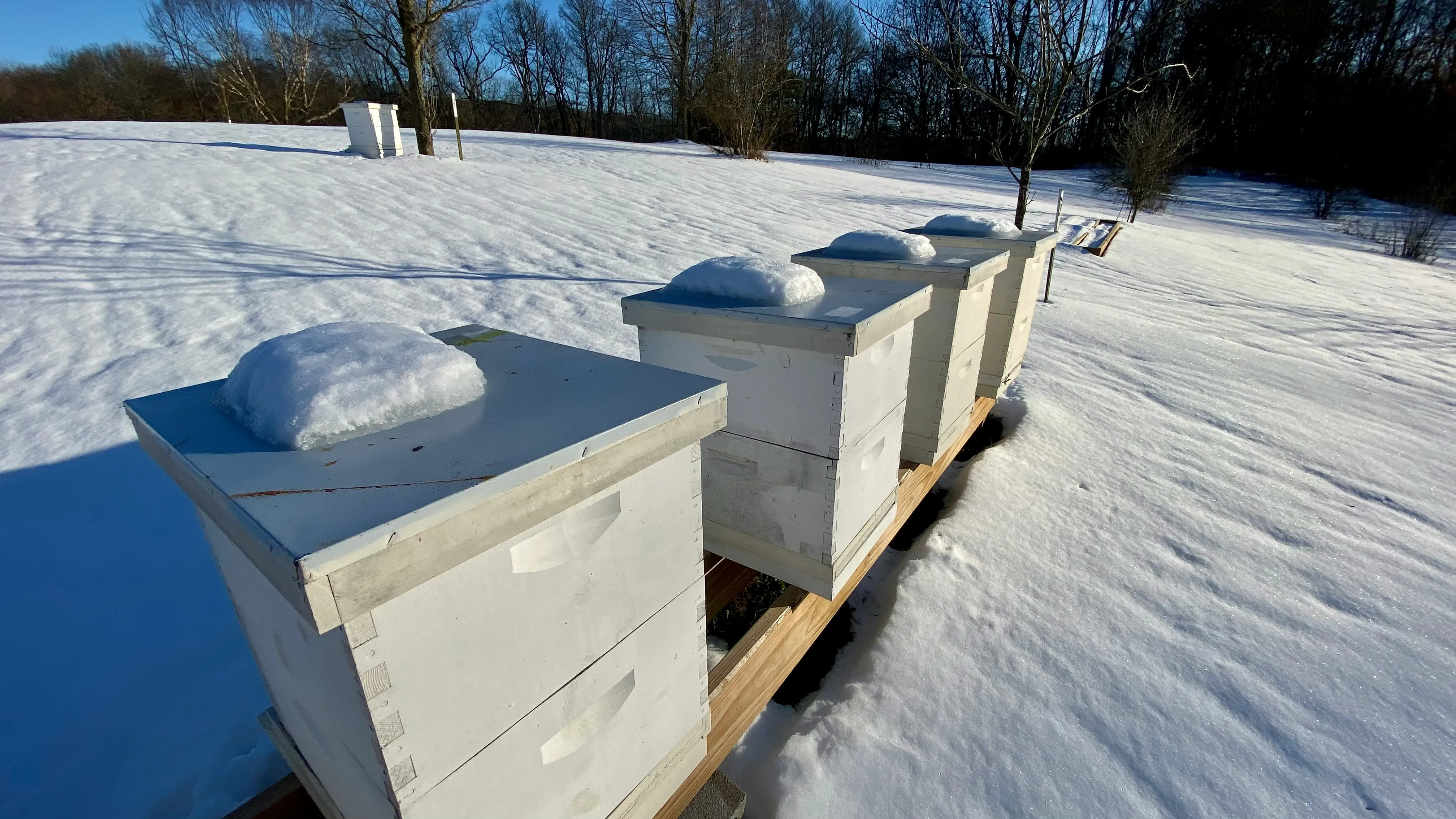
It was sixty degrees today. We used the warmth to check on two hives we’d been watching — low activity at the entrances on recent mild days, no movement when every other colony in the apiary was sending out cleansing flights. We’d suspected what we were going to find. We found it.
Both hives are dead.
The 8-frame double deep and the 10-frame double deep — both gone. There were still bees inside, but not many. Not nearly enough. Both colonies had feed on them. This wasn’t starvation — it was a population problem.
A winter cluster survives by shivering. Thousands of bees vibrate their flight muscles to generate heat, rotating between the warm core and the cold outer shell so no individual bee stays exposed too long.2 But the system has a floor. Below a certain number of bees, the cluster can’t generate enough heat to sustain itself. The outer bees chill faster than the colony can cycle them inward, and once that starts, it doesn’t reverse.
Both of these colonies were small going into fall. We knew it. They were mildly stressed through the summer — never building up the way our stronger hives did. We fed them, reduced their entrances, and hoped the numbers would be enough. They weren’t. We’re sad about it, but not surprised.
A 2019 Penn State study found that colony weight in October — a rough proxy for both population and stores — was the strongest predictor of winter survival. Colonies under about 44 pounds had low survival rates. Colonies over 66 pounds survived at around 94 percent.1 We didn’t weigh these two hives on a scale last fall, but we didn’t need to. They were light.
We started winter with six hives. We’re heading into spring with four. Our plan to reach twelve this year hasn’t changed — it just means more of that growth will come from packages or caught swarms rather than splits from our own stock.
There is a practical upside: we now have two complete sets of drawn comb, boxes, frames, and hardware ready for new colonies. A package installed on drawn comb can skip weeks of wax production and get straight to building population and foraging. The loss is real, but the hardware will give two future colonies a head start.
We’ve written before about the mechanics of the winter cluster and about reading dead bees. A colony needs enough bees to thermoregulate, and no amount of feed or insulation substitutes for population. We knew this going into fall. Both colonies were marginal — too weak to reliably survive, but not so obviously doomed that combining them felt justified at the time.
Next fall, we’ll be more decisive. A colony that looks marginal in September needs a plan — combine it with a stronger hive, consolidate it into a nuc, or make some other call that gives it better odds. We’re at four hives now, with spring coming and two empty boxes ready to fill.
References:
- Doke, M. A., McGrady, C. M., Otieno, M., Grozinger, C. M., and Frazier, M. “Colony Size, Rather Than Geographic Origin of Stocks, Predicts Overwintering Success in Honey Bees (Hymenoptera: Apidae) in the Northeastern United States.” Journal of Economic Entomology 112, no. 2 (2019): 525–533. Study finding colony weight in October — a proxy for population and stores — as the strongest predictor of overwinter survival.
- Stabentheiner, A., Pressl, H., Papst, T., Hrassnigg, N., and Crailsheim, K. “Endothermic heat production in honeybee winter clusters.” Journal of Experimental Biology 206 (2003): 353–358. Direct evidence of shivering thermogenesis in winter clusters and the role of core bees in heat production.
We sell what the bees don’t need. Interested in trying some? Drop us a line.