- winter
- moisture
- management
- engineering
- research
Three Gallons of Water
Every winter, a colony exhales three gallons of water into its hive. Where that water goes determines whether the bees live or die.
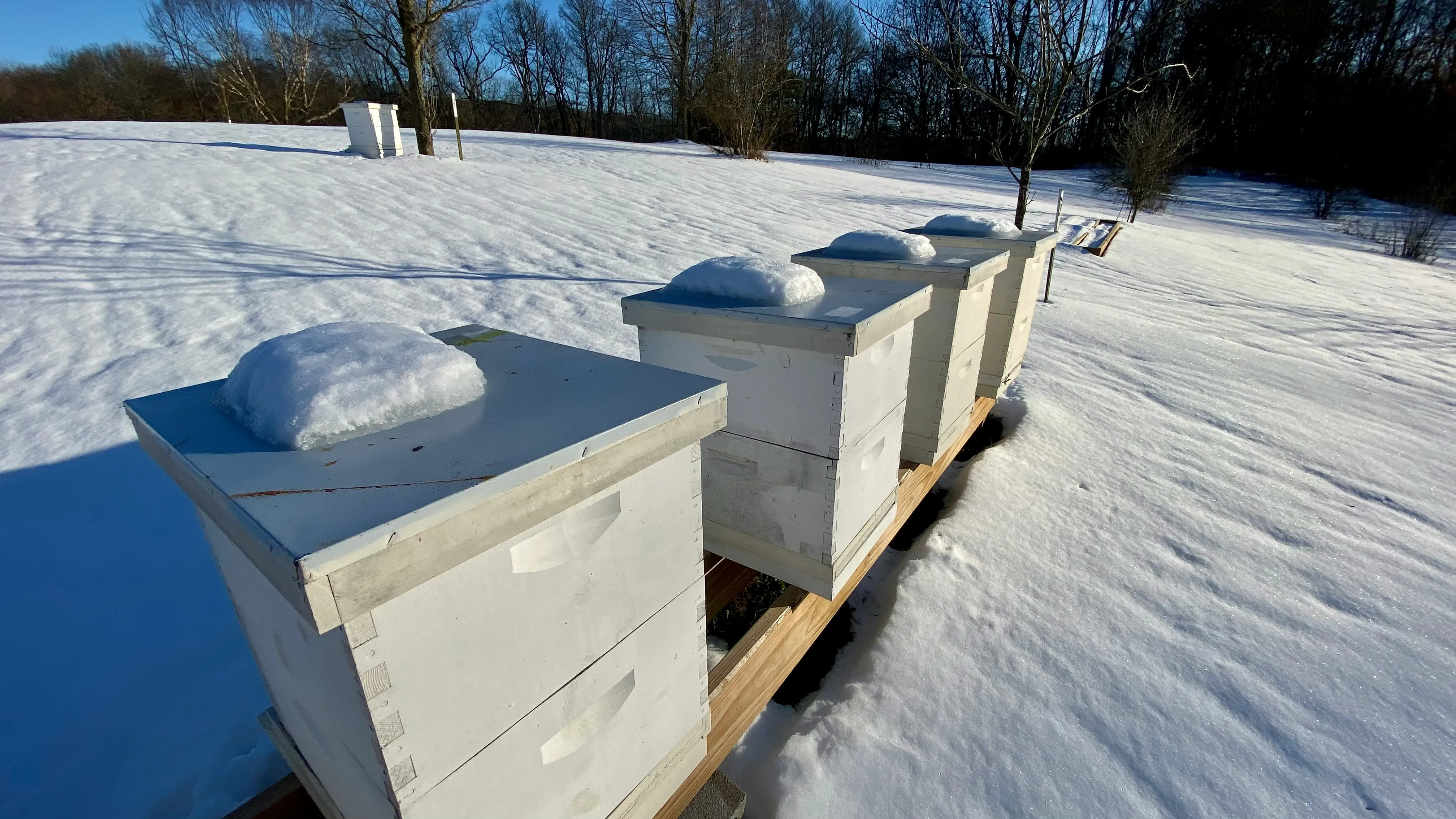
We opened a dead hive on a warm afternoon in February. The frames were damp. A thin film of mold crept along the tops of the bars and into the corners of the box. Bees lay scattered across the bottom board — not clustered, not head-down in cells reaching for honey. Just scattered. Wings splayed, bodies soft. The kind of dead that looks wrong even before you understand what happened.
There was honey in the hive. Plenty of it — twenty pounds, maybe more. Capped, undisturbed, within easy reach of where the cluster had been. This colony did not starve. The temperature the night before had been twenty-six degrees — cold, but nothing a healthy cluster of ten thousand bees cannot handle. This colony did not freeze.
It drowned.
Not in standing water. Not in rain or flooding. It drowned in the moisture of its own breath — three gallons of water, exhaled into a thin-walled wooden box over the course of a winter, condensed on the cold ceiling four inches above the cluster, and dripped back down as a slow, killing rain.
What We Think Is Happening, and What We Plan to Do About It
Beekeepers have treated winter moisture as a ventilation problem for decades — drill a hole, add a vent, install a quilt box, let the humid air escape. But ventilation removes heat along with moisture, forcing bees to burn more honey, which produces more water, which demands more ventilation. It is a self-defeating cycle.
We think the problem is not moisture. The problem is a cold ceiling.
A honeybee colony exhales roughly three gallons of water vapor over the course of a winter. In a tree cavity — where bees evolved — that moisture condenses harmlessly on the thick, warm walls and runs down, away from the cluster. In a standard Langstroth hive, with its three-quarter-inch pine walls and a thin inner cover that drops to outdoor temperature within minutes, the moisture condenses on the ceiling directly above the bees and drips back onto them. That cold rain is what kills colonies that have plenty of honey and no disease.
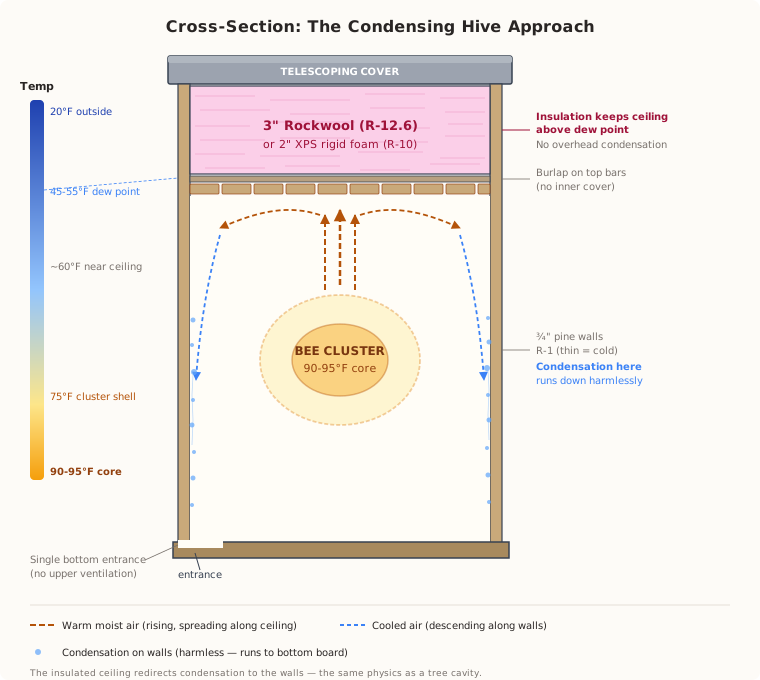
The fix, we believe, is simple: insulate the ceiling heavily enough that its inner surface stays above the dew point. If the ceiling never gets cold enough for condensation to form, there is nothing to drip. Moisture still condenses — but it condenses on the cooler walls, where it runs down harmlessly. This is exactly what a tree does, and exactly what a growing number of beekeepers in the condensing hive movement have been doing with reported winter survival rates above ninety percent.
This fall, we are going to test two approaches on six hives: three inches of mineral wool (rockwool) on two, two inches of rigid foam (XPS) on two, and our usual quilt box setup on two as controls. The insulation costs about fifteen dollars total. We will track temperature, humidity, and honey consumption through the winter with BroodMinder sensors.
The rest of this post is the science behind why we think this will work — the chemistry, the physics, the research, and the honest complications we have found along the way.
The Chemistry of Breathing
A honeybee colony survives winter by metabolizing honey. The chemistry is simple cellular respiration — sugar plus oxygen yields carbon dioxide, water, and heat:
C₆H₁₂O₆ + 6O₂ → 6CO₂ + 6H₂O + energy
The heat is the point. A winter cluster maintains its core at seventy-five to ninety-five degrees by shivering — thousands of bees flexing their flight muscles without extending their wings, generating warmth and rotating between the hot core and the insulating outer shell.1
But heat is not the only product. For every pound of honey a colony burns, it exhales roughly two-thirds of a pound of water vapor. A typical colony consumes about a third of a pound of honey per day through winter — a half cup of water, rising as warm breath from the cluster every twenty-four hours.2
Over the course of a Loudoun County winter — late November through mid-March — a colony working through forty pounds of stores will produce approximately twenty-seven pounds of water. That is three and a quarter gallons of water vapor, released into a wooden box with a volume of roughly two cubic feet.
Most beekeepers worry about cold. The real threat is water.
Where the Water Goes
Warm air holds more moisture than cold air. When warm, humid air contacts a surface that is colder than its dew point, the vapor condenses into liquid. This is why your breath fogs a cold window and why a glass of ice water sweats on a summer afternoon.
Inside a winter hive, the bee cluster is a furnace of warm, moist air surrounded by surfaces that are very nearly at outdoor temperature. A standard Langstroth hive body is three-quarters of an inch of pine — essentially no insulation. The inner cover, a thin slab of wood or Masonite sitting directly beneath the telescoping cover, gets as cold as the January air within minutes of sunset.
The warm, moist breath of the cluster rises. It hits the ceiling. It condenses.
Now here is the part that matters: where the condensation forms determines whether it is benign or lethal. Water that condenses on the hive walls runs down the sides to the bottom board, away from the bees. It may pool, it may freeze, but it does not contact the cluster. Water that condenses on the ceiling — directly above the bees — has nowhere to go but down.
It drips.
Cold water, at or near freezing, falling onto a cluster of bees that are working to maintain ninety degrees. Not a flood. A slow, steady rain. Drop by drop, hour after hour, through the coldest nights of the year.
Why Wet Kills
Honeybees can survive extraordinary cold when dry. Laboratory tests have documented clustered colonies surviving one hundred and twelve degrees below zero Fahrenheit for twelve hours.3 The cluster’s insulating mantle — a shell of tightly packed bees whose branched body hairs trap pockets of still air, much like down feathers — is remarkably effective at limiting heat loss through convection and radiation.
Water destroys this system.
When cold water saturates a bee’s hair, the air pockets collapse. Water conducts heat roughly twenty-five times faster than still air. A dry bee is wearing a down jacket. A wet bee is wearing a wet cotton shirt. The insulating layer is gone, and heat pours out of the body.
It gets worse. Water evaporating from the surface of a bee’s body requires energy — about 540 calories for every gram of water that transitions from liquid to vapor. This evaporative cooling pulls heat directly from the bee, chilling it faster than the ambient temperature alone.
And then the spiral begins. The wet, chilled cluster burns more honey to compensate for the heat loss. More honey burned means more water exhaled. More water vapor rises to the cold ceiling. More condensation forms. More cold water drips onto the bees. The cluster gets wetter, works harder, burns through stores faster, produces more moisture, and the cycle accelerates until the colony is dead.
Individual bees that get wet enough enter chill coma below about fifty degrees — total immobility. They fall from the cluster, reducing its mass and insulating capacity. The cluster shrinks. The spiral tightens. A colony with adequate stores, adequate population, and no disease can be killed in a matter of days by nothing more than cold water falling from its own ceiling.
The beekeeper’s axiom: bees can survive cold, and bees can survive wet, but they cannot survive cold and wet at the same time.
What Everybody Does
The standard response to winter moisture falls into two categories, and they work against each other.
Ventilate. Add a notch to the inner cover. Drill an auger hole in the upper box. Prop the telescoping cover with a popsicle stick. Install a quilt box — a shallow frame of pine shavings and screened vents above the cluster. The goal: let the warm, moist air escape before it condenses. This works. It removes moisture. But it also removes heat. Warm air leaving through the top of the hive is heat the bees paid for with honey, now gone. The colony burns more stores to stay warm, which produces more water vapor, which demands more ventilation. The approach is self-limiting.
Insulate. Wrap the hive in tar paper, rigid foam, or commercial insulated sleeves. The goal: slow heat loss so the cluster can maintain temperature with less effort. This also works. Insulation reduces honey consumption and stabilizes internal temperature. But without ventilation, moisture has nowhere to go. If the insulation is insufficient to keep the inner surfaces above the dew point — and a single inch of foam on the lid often is not — you have trapped the moisture inside a slightly warmer box where it will still condense and still drip.
Every standard approach is a compromise between these two opposing goals. You are either losing heat to remove moisture or trapping moisture to retain heat. The quilt box — pine shavings that absorb moisture while providing some insulation, with screened vents for gradual drying — is the most popular middle ground. It works well enough that many beekeepers report significant improvements in winter survival after adopting one.
But it is a workaround. It manages the symptom without addressing the underlying problem: a thin-walled wooden box is the wrong thermal environment for a superorganism that evolved inside trees.
What a Tree Does
Tom Seeley spent decades studying feral honeybee colonies in the Arnot Forest of upstate New York. Wild colonies choose tree cavities — not because trees are the only option, but because scout bees evaluate dozens of potential homes and select for specific properties. The cavities they prefer share a consistent profile: roughly forty liters of volume, a single small entrance near the bottom, and walls of living or recently dead wood six to fifteen centimeters thick.4
In 2023, Derek Mitchell at the University of Leeds published a study in the Journal of the Royal Society Interface that quantified something beekeepers had long suspected: managed hives are thermally hostile compared to the cavities bees evolved with. A standard Langstroth hive, with its nineteen-millimeter pine walls, loses heat at roughly seven times the rate of a natural tree cavity with one-hundred-and-fifty-millimeter walls.5 Mitchell’s computational fluid dynamics modeling showed that the tight winter clustering we observe in managed hives may not be normal behavior at all — it may be a stress response to excessive heat loss in thin-walled boxes.
But the thermal finding is only half the story. The other half is what happens to the moisture.
A tree cavity does not ventilate. There is no upper entrance, no screened vent, no quilt box. The bees seal every gap with propolis except the single entrance below the comb. And yet feral colonies in tree cavities do not drown in condensation. Why?
Three reasons. First, the thick walls stay warm enough on their inner surface that condensation occurs gradually and diffusely — on the walls and lower surfaces far from the cluster, not on the ceiling directly above it. Second, the wood itself is hygroscopic — it absorbs moisture through capillary action, pulling liquid water into its grain the way a paper towel wicks a spill. The punky, partially decomposed interior wood of a tree cavity acts as a sponge. Third, when water vapor condenses, it releases latent heat — the same energy that was required to evaporate it. In a ventilated hive, that water vapor and its latent heat escape together, wasted. In a condensing tree cavity, the heat is released back into the hive interior when the vapor condenses on the walls. The tree recycles the energy.
The tree does not fight moisture. It manages it — absorbing what the bees exhale, storing it in the wall material, and releasing the heat. No moving parts. No vents. No maintenance.
The Engineering Question
So what would it take to keep the ceiling warm?
For our climate in Zone 7a, where winter nights regularly hit the low twenties, the inner surface of the hive roof needs to stay above the dew point of the humid air inside the hive — roughly forty-five to fifty-five degrees Fahrenheit when the cluster is active. With an outdoor temperature of twenty degrees and an interior temperature near the ceiling of perhaps sixty, that requires an R-value of eight to ten in the roof assembly.
A standard Langstroth telescoping cover, with its single layer of three-quarter-inch pine and a sheet of Masonite, provides roughly R-1. It might as well not be there.
The answer is mineral wool.
Rockwool — spun from basalt and steel slag at over two thousand degrees — insulates at R-4.2 per inch.6 A three-inch slab provides R-12.6, well above what the dew point calculation demands. But insulation value is only part of why it works here. Rockwool is hydrophobic. Water does not absorb into the fibers — it beads and runs off. This means that in the event condensation does form on the underside of the outer cover above the rockwool, it cannot wick downward through the insulation toward the bees. The water has no path through.
Rockwool does not rot. It does not support mold growth. It does not compress under the weight of a telescoping cover. It does not off-gas at hive temperatures — its fibers were formed in a furnace hotter than any summer afternoon. Mice will not nest in it. Wax moths have no interest in it.
And it is absurdly simple to implement. A ComfortBatt panel from the hardware store costs three to five dollars — enough to insulate two hives. You cut it with a bread knife to the interior dimensions of your telescoping cover, set it on top of the inner cover, and put the outer cover back on. No quilt box. No screened vents. No moisture board. No pine shavings to replace every fall. One slab of stone fiber, doing nothing but keeping the ceiling warm.
There is a complication, and we should be honest about it.
Rockwool is vapor-permeable. Water vapor passes through it as though it were not there — the fibers repel liquid water, but they do nothing to stop vapor. In a winter hive, that means warm, moist air from the cluster will rise through the rockwool and condense on the cold underside of the telescoping cover above it. The drip does not fall on the bees — it falls on top of the rockwool, which is good — but over a long winter, moisture accumulating on the upper surface of the insulation could degrade its performance. A peer-reviewed study on humidity cycling found that mineral wool exposed to repeated high-humidity conditions lost twelve percent of its insulating value, and the loss was partially irreversible.7
There is also the question of the inner cover. If the rockwool sits on top of a standard inner cover — a thin slab of wood with a bee escape hole in the center — that thin wood is the coldest surface directly above the cluster. The insulation above it does not help if condensation forms below it. Building scientists call this a cold bridge: an uninsulated surface sandwiched between warm air and insulation, where the dew point is reached at exactly the wrong place. The bee escape hole, if left open, makes it worse — it becomes a chimney for moist air to contact the cold underside of the telescoping cover, bypassing the insulation entirely.
The fix for the inner cover is straightforward: seal the bee escape hole with a piece of tape, or remove the inner cover entirely and lay the rockwool on a piece of burlap or cotton cloth resting directly on the top bars. Either approach eliminates the cold bridge and puts the insulation where it belongs — between the warm hive air and the cold exterior.
The vapor permeability question is more interesting. One answer is rigid foam — extruded polystyrene, the blue or pink board sold at the same hardware store. XPS insulates at R-5 per inch, and because it is closed-cell, it acts as its own vapor barrier. Moisture cannot pass through it. A two-inch piece of XPS provides R-10, blocks vapor migration entirely, and has been used in European polystyrene hives for decades with no reported problems. It may, in fact, be the more practical choice for a hive roof.
But the vapor permeability of rockwool might not be a flaw. In a condensing hive — one with heavy top insulation and no upper ventilation — moisture is meant to condense on the cooler walls, not the ceiling. The rockwool’s job is to keep the ceiling warm enough to redirect condensation to the walls. If it does that job, the small amount of vapor that passes through and condenses above the rockwool may be trivial — a few ounces of water on the top surface, held away from the bees, evaporating during the next warm spell. Whether this is a real problem or a theoretical one is something we can only learn by running the experiment.
This is what the tree does. Not through some complex moisture-management system, but through the simplest possible mechanism: mass. A hundred and fifty millimeters of living wood keeps the inner surface warm. Three inches of mineral wool — or two inches of rigid foam — does the same thing in a fraction of the weight, at a fraction of the cost, with none of the rot.
The idea is not new. A growing community of beekeepers, sometimes called the condensing hive movement, has been practicing exactly this approach: heavy top insulation, no upper ventilation, a single bottom entrance. Bill Hesbach, an Eastern Apicultural Society master beekeeper, describes it simply — you are not eliminating moisture from the hive, you are giving it a safe place to condense. Practitioners report winter survival rates above ninety percent, thirty to fifty percent less honey consumption, and larger spring populations.8 The principle is identical to what happens in a tree cavity. The only difference is the material.
The physics of what happens inside a well-insulated hive has been studied directly. Warm, moist air rises from the cluster and hits the insulated ceiling. Because the ceiling is above the dew point, the moisture does not condense there. Instead, the warm plume spreads outward along the ceiling in a mushroom pattern — rolling from the center toward the edges until it contacts the cooler, thinner walls. That is where condensation forms. It runs down the walls by gravity, away from the cluster, exactly as it does in a tree.
This is not just theoretical. In 2013, Kaarel Toomemaa placed thin metal condensation collectors both above and below the frames of overwintering colonies in Estonia. The result: only two and a half percent of total condensed water collected on the upper surfaces. Ninety-seven and a half percent condensed at the sides and below — on the walls and bottom, away from the bees.9 The insulated ceiling did not need to be sloped, peaked, or shaped. It just needed to be warm.
The elegance is in the simplicity. You are not fighting moisture. You are not managing it, absorbing it, venting it, or buffering it. You are preventing the condition that makes it dangerous. If the ceiling never gets cold enough for condensation to form overhead, there is nothing to drip. The moisture that the cluster exhales still condenses — but it condenses on the thin walls lower in the hive, where it runs down to the bottom board and evaporates or exits through the entrance. On warmer days, the bees drink it. Exactly what happens in a tree.
We are not presenting this as a proven solution. We are thinking through the physics and reading what others have found. The R-value math checks out. The material properties are well documented. The condensing hive practitioners report strong results. Toomemaa’s measurements confirm the mechanism. But we have not done it ourselves, and we are not going to pretend otherwise.
What We Plan to Try
This coming September, we are going to set up six hives in three pairs. Two hives get three inches of rockwool ComfortBatt laid on a piece of burlap directly on the top bars — no inner cover, bee escape hole eliminated. Two hives get two inches of XPS rigid foam cut to fit inside the telescoping cover, sealed against the inner cover with the escape hole taped shut. Two hives get our usual setup — a quilt box with pine shavings and a notched inner cover. We will install a BroodMinder TH2 temperature and humidity sensor under the roof of each hive. Six hives, three treatments, one winter.
We want to answer three questions. First, does heavy ceiling insulation — whether rockwool or XPS — keep the inner roof surface above the dew point, preventing overhead condensation? Second, does the vapor-permeable rockwool perform differently from the vapor-blocking XPS — does one stay drier, hold its R-value better, produce a more stable humidity curve? Third, do the insulated hives consume less honey than the ventilated controls, and do they come through winter with larger clusters?
The total cost of the insulation is about fifteen dollars. The time investment is half an hour with a bread knife and a utility knife.
We do not know what we will find. The physics says this should work. The building science literature says this should work. A growing number of beekeepers say it works for them. Whether it works in our hives, through freezing rain and January wind and the particular chaos of ten thousand insects exhaling into a wooden box — that is a different question, and the only way to answer it is to run the experiment.
If it does not work, we will have six very warm hives with condensation problems we did not predict, and we will write about that instead.
References and further reading:
- Stabentheiner, A., Pressl, H., Papst, T., Hrassnigg, N., and Crailsheim, K. “Endothermic heat production in honeybee winter clusters.” Journal of Experimental Biology 206 (2003): 353–358. Direct evidence of shivering thermogenesis in winter clusters and the role of core-to-mantle rotation.
- Oliver, Randy. “Understanding Colony Buildup and Decline, Part 13a.” Scientific Beekeeping. Detailed metabolic analysis of honey consumption, water production, and CO₂/O₂ exchange in winter clusters.
- Southwick, E. E. “Metabolic energy of intact honey bee colonies.” Comparative Biochemistry and Physiology 71A (1982): 277–281. Laboratory survival data for clustered colonies at extreme low temperatures.
- Seeley, Thomas D. The Lives of Bees: The Untold Story of the Honey Bee in the Wild. Princeton University Press, 2019. Comprehensive study of feral colony nest site selection, cavity preferences, and implications for managed hive design.
- Mitchell, Derek. “Ratios of colony mass to thermal conductance of tree and man-made nest enclosures of Apis mellifera.” Journal of the Royal Society Interface 20 (2023): 20230488. Computational fluid dynamics modeling showing 4–7x greater heat loss in standard Langstroth hives compared to natural tree cavities.
- Rockwool Group. “Stone Wool Insulation Technical Data.” Thermal conductivity, hydrophobic properties, and fire resistance specifications for mineral wool insulation products.
- “Impact of Humidity Cycles on Long-term Thermal Conductivity of Mineral Wool.” Research Square (2025). Peer-reviewed study documenting 12.4% irreversible thermal conductivity loss in mineral wool after 50 humidity cycles at 95% RH.
- Hesbach, Bill. “The Condensing Hive Concept.” Betterbee. Overview of heavy-insulation, no-upper-ventilation hive management and its rationale in condensation physics and colony survival data.
- Toomemaa, K., et al. “Determining the amount of water condensed above and below the winter cluster of honey bees in a North-European Climate.” Journal of Apicultural Research 52, no. 2 (2013): 81–87. Experimental measurement showing 97.5% of hive condensation forms at the sides and below the cluster, not above.
- “Wait, How Much Water?” Bee Culture. Accessible treatment of the water-production arithmetic and its implications for winter moisture management.
We sell what the bees don’t need. Interested in trying some? Drop us a line.