- swarms
- bee-biology
- spring
- colony-management
Swarm Season
Swarming is not a failure. It is how honey bees have reproduced for millions of years — the highest expression of colony fitness.
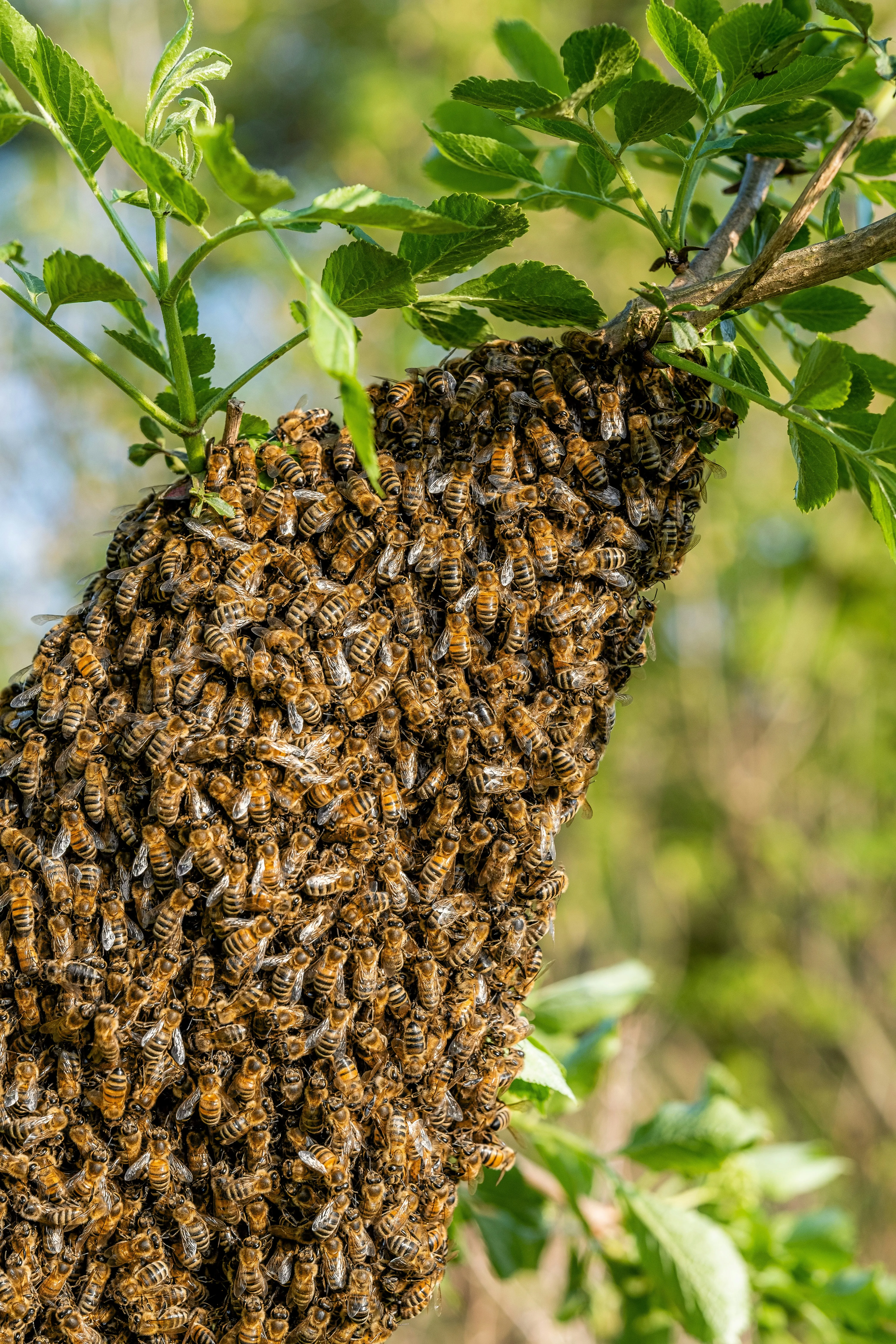
Every spring, someone in Loudoun County posts a photo to a neighborhood group: a dark, humming mass of bees clinging to a fence post, a mailbox, the branch of a crepe myrtle. The comments fill with alarm. Who do we call. Are they dangerous. Should we spray them.
The bees are not dangerous. They are not lost. They are not angry. What you are looking at is the oldest reproductive act in the social insect world — a colony dividing itself in two. It has been happening for somewhere between 80 and 130 million years, since the Cretaceous, since before the flowering plants they now depend on had fully diversified across the continents. Every swarm hanging from a branch in your yard is a thread in a lineage that predates grass.
Swarming is the most misunderstood event in beekeeping. New beekeepers feel like they failed. Neighbors think something went wrong. But swarming is not a malfunction. It is how the superorganism reproduces. A colony that swarms is a colony that succeeded.
The Biology of Division
A honey bee colony is a single reproductive unit. The queen lays the eggs, the workers build the comb and raise the brood and forage, but none of them are the organism. The organism is the colony itself — all sixty thousand bees functioning as one body. Jurgen Tautz calls it a superorganism, and the term is not metaphorical. The colony regulates its own temperature, allocates labor, makes collective decisions, and responds to its environment as a unified entity. Individual bees are more like cells than creatures.
When that superorganism reproduces, it does not lay an egg. It divides. The process looks like this.
In late spring — typically April through May here in Loudoun County — a strong colony begins to feel crowded. The queen’s pheromone, which circulates through the hive via physical contact between workers, becomes diluted in a large population. Workers at the margins of the nest receive less of it. This is probably one of several triggers. The exact mechanism is still debated, but the colony begins raising new queens — not because the old queen is failing, but because the colony intends to split.
The workers build queen cells, usually along the bottom edges of frames. These are distinctive — peanut-shaped, textured, hanging vertically rather than lying horizontal like worker cells. They feed royal jelly to the larvae inside. Multiple queen cells develop simultaneously, because the colony hedges its bets.
Before the new queens emerge, the old queen leaves. She departs with roughly sixty percent of the workers — a massive exodus of tens of thousands of bees. Before they go, they gorge themselves on honey, filling their crop with enough fuel for the journey. A bee loaded with honey is a bee with no interest in stinging. This is why swarms are docile. They have no home to defend, no brood to protect. They are pilgrims carrying their provisions.
The swarm pours out of the hive entrance in a torrent. Within minutes, the air fills with bees — a swirling, roaring cloud that can be thirty feet across. They settle on a nearby surface, clustering around the queen, and wait. This temporary bivouac — the ball of bees on the branch — is a staging point, not a destination.
Back in the parent hive, the remaining bees — now queenless — wait for the first new queen to emerge from her cell. She may kill her sisters still in their cells. She may fight a rival who emerges at the same time. Eventually, one queen survives, takes her mating flights, and begins laying. The parent colony continues with a new monarch and a reduced but still viable population.
Two colonies where there was one. The species propagates.
The Democratic Decision
The swarm on the branch has a problem to solve. It needs a home — a cavity of roughly forty liters, elevated, dry, with a small entrance facing south or southeast. The standards are specific because the colony’s survival depends on them.
Tom Seeley spent years studying how swarms choose their new home, and the process he documented is one of the most remarkable examples of collective decision-making in the natural world. He published his findings in Honeybee Democracy, and the details are worth understanding.
A few hundred scout bees leave the cluster and search the surrounding landscape — up to several miles in every direction. They investigate tree cavities, hollow logs, gaps in buildings, empty equipment. Each scout evaluates a potential site against a set of criteria that appears to be innate: volume, entrance size, height, dryness. A scout who finds a promising site returns to the cluster and performs a waggle dance on the surface of the swarm.
The waggle dance encodes both the direction and distance of the site. The angle of the dance relative to vertical indicates the direction relative to the sun. The duration of the waggle run indicates the distance. A scout who found a good site dances vigorously and repeatedly. A scout who found a mediocre site dances briefly and without enthusiasm.
Here is where it becomes remarkable. Multiple scouts find multiple sites simultaneously. They return and dance for different locations. The swarm does not follow the first scout or the loudest one. Instead, the scouts visit each other’s sites. A bee dancing for site A may be recruited to inspect site B. If site B is better, she switches allegiance and begins dancing for B instead. If it is worse, she returns to advocating for A.
Over hours — sometimes over days — the competing dances converge. Scouts gradually coalesce around a single site as the better options recruit more advocates and the weaker options lose them. Seeley found that the swarm almost always selects the best available cavity. The process is slow, noisy, and decentralized. No single bee has all the information. The intelligence is in the aggregation.
When a quorum of scouts agrees on a site, the swarm lifts off. The scouts who know the destination fly through and over the airborne cluster in streaks, guiding the mass toward the new home. Within minutes, tens of thousands of bees are pouring into a hole in a tree that none of them had seen before that morning.
We have watched this happen once — a swarm we caught from a tulip poplar lifting off from the nuc box we had temporarily placed them in, apparently dissatisfied with our offering. They rose into the air in a loose, purposeful column and moved east, over the tree line, and disappeared. We stood in the yard and said nothing for a while.
The Sound and the Silence
If you have never witnessed a swarm issuing from a hive, it is hard to convey the scale of the event.
The hive gets loud first. A rising hum that you can hear from twenty feet away — higher-pitched than normal, unsettled, building. Then the bees begin pouring from the entrance in a way that looks wrong, like the hive is overflowing. They are not flying in organized foraging lines. They are erupting in all directions, filling the air until the light changes — the sun dims slightly through the mass of bodies.
The sound is not a buzz. It is a roar. A low, resonant, almost mechanical sound, like a generator running in the distance. It fills your chest. You feel it before you identify it. Tens of thousands of wings beating in a confined area produce something closer to weather than to insect noise.
Then they settle. The cloud contracts. Bees begin landing on a branch or a post, and the cluster grows — first a handful, then a mass, then a football-sized clump, then something the size of a watermelon, dense and shifting and alive. The queen is somewhere inside, surrounded by layers of workers maintaining temperature and waiting for the scouts to decide.
And the parent hive goes quiet. Walk up to it an hour later and the difference is visceral. The entrance traffic is thin. The hum is subdued. The population has been cut nearly in half. It feels emptied. Diminished.
This is the part that catches beekeepers off guard. You open the hive and it feels like something went wrong. But it did not. The colony did exactly what a strong, healthy colony is supposed to do. It reproduced.
Catching Swarms
A swarm clustered on a branch is one of the easiest things in beekeeping to collect, if you get to it in time.
The window is short. A swarm may stay on its temporary perch for an hour or for two days, depending on how quickly the scouts reach consensus. Most leave within twenty-four hours. The standard technique is to hold an open hive body or cardboard box beneath the cluster and shake the branch sharply. The bees fall into the box in a single mass. If the queen is in the box, the rest will follow. You close it up, bring it home, transfer them into a hive, and hope they stay.
We have caught three swarms in two years. The first was from one of our own hives — we saw the queen cells and knew it was coming, but we were still too slow to prevent it. The swarm landed on a low branch of one of the tulip poplars at the edge of our property, about eight feet up. We set a ladder in the grass, held a nuc box underneath, and shook. Most of the bees dropped in. We watched the stragglers march into the box over the next hour, following the queen’s pheromone. By evening they were settled.
The second was a call from a neighbor in Leesburg who found a swarm on a downspout. That one was harder — no good angle to shake, bees wedged into the gap between the downspout and the siding. We scooped them with a dustpan, handful by handful, and dumped them into a box. It took forty minutes and we were never sure we got the queen until we saw her walking across the top bars the next morning.
The third we lost. A swarm in a cherry tree on someone’s property south of town. By the time we arrived, they had already lifted off. The homeowner described the departure — the rising cloud, the sound, the sudden emptiness of the branch. We stood under the tree and looked at the faint smear of beeswax left behind. That is how it goes sometimes.
The Beekeeper’s Dilemma
Managed beekeepers try to prevent swarming. The reasons are practical. A colony that swarms loses most of its foraging force right before the main nectar flow. The parent hive, depleted and raising a new queen, will not produce surplus honey that season. For a beekeeper counting on a harvest, a swarm is a significant economic event — not a disaster, but a setback.
The prevention techniques are well established. Split the colony before it swarms. Remove queen cells. Add space. Requeen with young stock that is less inclined to swarm. These methods work, most of the time. They are part of standard management.
But there is a tension here that we think about more as we learn. Swarming is how honey bees create new, genetically independent colonies. In the wild, swarming is the mechanism of population growth — the way bees colonize new territory, maintain genetic diversity, and adapt to local conditions. When we prevent every swarm in every managed hive, we are suppressing the reproductive cycle of the species in our care.
This matters more than it used to. Wild honey bee populations in North America are under severe pressure from Varroa mites, habitat loss, and pesticide exposure. Feral colonies that survive without treatment are rare and valuable — they represent natural selection operating on the problem. Every swarm that escapes into a hollow tree is a potential founding colony, a participant in that selective process. Some of those colonies will fail. Some will develop resistance. That is how evolution works — slowly, wastefully, without guarantees.
We do not have a clean answer for this. We manage our hives. We try to prevent swarms when we can, because we want the honey and we want strong colonies going into winter. But we also leave room for the biology. When a swarm gets away from us, we do not chase it with regret. We watch it go and think about what it might become.
Thirty Million Springs
Here is what stays with us.
Every April, when the tulip poplars outside Leesburg are beginning to bud and the first strong colonies are building toward their peak population, the impulse to divide is already stirring inside the hive. Scout bees are already evaluating cavities. Nurse bees are already shaping queen cells from wax. The colony is reading its own density, its own pheromone gradients, its own readiness — and preparing to do what honey bees have done through ice ages and warming periods, through the rise and fall of forests, through continental drift and mass extinctions.
Swarming is older than the Appalachian Mountains. It is older than the tulip poplar. It is older than flowers as we know them. The behavior we watch in our backyard in Loudoun County was refined across a timescale that makes human agriculture — ten thousand years, give or take — look like a passing thought.
When a colony swarms, it is not failing. It is not confused. It is not responding to poor management, though poor management can trigger it prematurely. A colony that swarms is a colony that grew strong enough to reproduce. It built up its population, stored enough resources, and made the collective decision to divide — to send half of itself into the unknown with nothing but a mated queen and a crop full of honey, trusting the scouts to find a home and the workers to build it from nothing.
References:
- Seeley, Thomas D. Honeybee Democracy. Princeton University Press, 2010 — scout bee decision-making, quorum sensing, and nest site selection
- Seeley, Thomas D. The Lives of Bees: The Untold Story of the Honey Bee in the Wild. Princeton University Press, 2019 — wild colony biology and the case for natural selection in managed landscapes
- Tautz, Jurgen. The Buzz about Bees: Biology of a Superorganism. Springer, 2008 — superorganism theory, colony-level reproduction, swarm thermoregulation
- Winston, Mark L. The Biology of the Honey Bee. Harvard University Press, 1987 — swarming physiology, queen cell development, and swarm behavior
- Virginia Cooperative Extension, “Swarm Management for Virginia Beekeepers” — regional timing, prevention techniques, and swarm collection
We sell what the bees don’t need. Interested in trying some? Drop us a line.