- propolis
- hive-health
- bee-biology
- beekeeping-practice
Propolis: The Hive's Medicine Cabinet
Tree resins, bee enzymes, and an antimicrobial envelope most beekeepers scrape away. We stopped scraping.
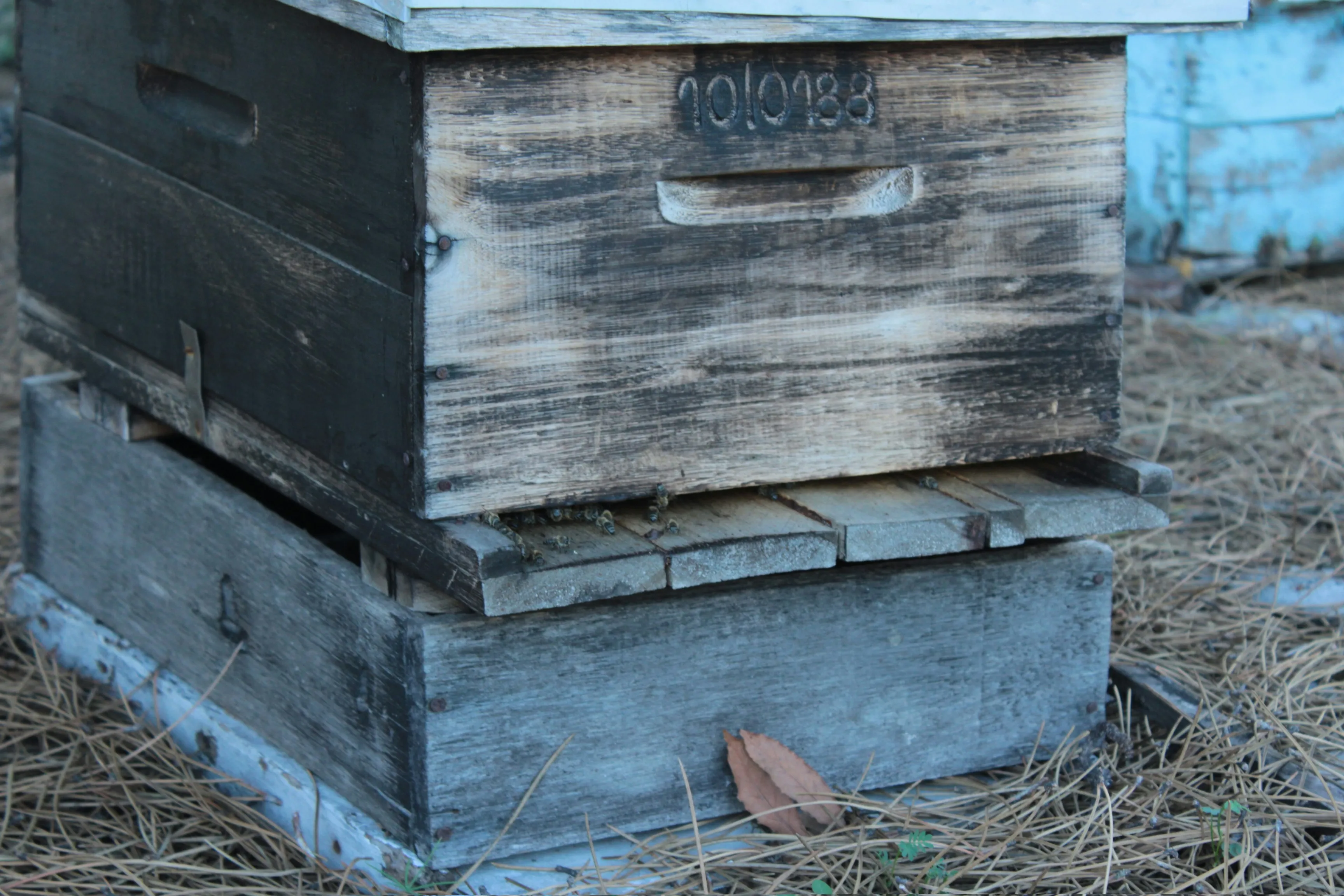
Open a hive in late summer and the first thing you notice is the smell. Not honey — that comes later, sweet and warm and obvious. The first smell is something deeper. Resinous, like pine sap warming on a fence rail. Slightly sweet, but earthy. It sticks to your gloves, your hive tool, the cuffs of your jacket. It stains everything it touches a permanent dark brown.
That is propolis. And for years, we scraped it off like it was a nuisance.
What Propolis Actually Is
Propolis is not a single substance. It is a composite — a mixture of tree resins, beeswax, essential oils, pollen, and enzymes the bees add during processing. The word comes from the Greek: pro (before) and polis (city). Before the city. The defense at the gate.
The raw material comes from trees. In Loudoun County, our bees collect resin primarily from the buds of tulip poplars, the sap of Virginia pines, and the bark wounds of wild cherry. Different trees produce different resins with different chemical profiles, which means propolis composition varies by geography, by season, and even by hive. A colony in our poplar stand does not produce the same propolis as a colony in a pine hollow in the Shenandoah.
Forager bees collect the resin on warm afternoons, when it is soft enough to work. They pack it into their pollen baskets — the same corbiculae they use for pollen — and carry it back to the hive. Other bees then chew the resin, mix it with wax and their own salivary enzymes, and apply it where it is needed. The enzyme addition is not incidental. The bees are actively modifying the resin’s chemistry, enhancing its antimicrobial properties beyond what the raw tree resin provides on its own.1
They use it to seal cracks. To narrow the entrance against intruders. To coat the interior walls. To entomb anything too large to remove — a dead mouse, a beetle, a twig. In the wild, bees coat the entire inner surface of a tree cavity with a thin layer of propolis. Researchers call this the propolis envelope, and it turns out to be far more important than anyone realized.
The Propolis Envelope
Marla Spivak’s lab at the University of Minnesota has done some of the most careful work on what the propolis envelope actually does for a colony. The findings are striking.
In a series of experiments, Spivak and her colleagues compared colonies in hives with rough interior surfaces — which the bees coated in propolis — to colonies in standard smooth-walled Langstroth equipment, which the bees largely left bare. The colonies with the propolis envelope showed measurably lower bacterial loads. They showed reduced expression of immune genes, which sounds counterintuitive until you understand what it means: the bees’ immune systems were less stressed. The propolis was doing antimicrobial work that the bees’ bodies would otherwise have to do on their own.2
Think of it this way. The propolis envelope is a form of social immunity — a colony-level defense that functions alongside the individual immune systems of the bees themselves. A colony with an intact envelope invests fewer metabolic resources in fighting pathogens. That energy goes instead toward brood rearing, foraging, and building stores.
The chemistry supports this. Propolis contains over three hundred identified compounds — flavonoids, phenolic acids, terpenes, aromatic aldehydes. Many of these are antimicrobial. Propolis extracts have demonstrated activity against Paenibacillus larvae (the bacterium that causes American foulbrood), against Ascosphaera apis (chalkbrood fungus), and against a range of other bacteria and fungi that threaten colony health.3 Some studies have even shown antiviral properties, though that research is younger and less settled.
The bees did not learn this from us. They have been coating their homes in antimicrobial resin for millions of years. We are the ones who are catching up.
A Long Human History
We may be slow, but we are not the first humans to notice. Propolis has been used in human medicine for thousands of years — long before anyone understood the chemistry.
The ancient Egyptians used it in their embalming process. The word itself may have been coined by Aristotle, who described it in Historia Animalium as the substance bees use to close the entrance to their hive. Greek and Roman physicians prescribed propolis tinctures for wound healing. Hippocrates reportedly recommended it for internal and external ulcers.
During the Boer Wars in South Africa, field medics applied propolis to wounds when conventional antiseptics were unavailable. Soviet-era medicine used propolis preparations widely enough that the practice has its own literature, though much of it has not been translated or replicated under modern standards. The evidence base is real but uneven — some traditional uses hold up under clinical scrutiny, others remain anecdotal.4
One use that surprises people: violin varnish. Antonio Stradivari and other Italian luthiers of the seventeenth and eighteenth centuries are believed to have used propolis as a component in their varnish formulations. The resinous mixture hardens to a durable, amber-toned finish with acoustic properties that modern synthetic varnishes struggle to match. Whether propolis is the secret of a Stradivarius’s sound is debatable — but it was certainly in the workshop.
What connects these uses across continents and centuries is the same set of properties: antimicrobial activity, durability, and a warm amber color that ages well.
How Modern Beekeeping Works Against Propolis
Here is the part that makes us uncomfortable, because we did it too.
The standard Langstroth hive — the white stacked boxes you see in every orchard and backyard — was designed for human convenience. Removable frames. Smooth interior walls. Modular, interchangeable parts. Lorenzo Langstroth patented his movable-frame design in 1852, and it remains the foundation of beekeeping worldwide. It is genuinely ingenious.
But smooth walls and tight-fitting frames are exactly the surfaces bees do not coat with propolis. In a tree cavity, the interior is rough bark — the bees cover every surface. In a Langstroth box, the milled lumber is smooth, the frames are precision-fit, and there is little reason for the bees to build a full envelope. They still deposit propolis in the joints and crevices, but the continuous antimicrobial coating that characterizes a wild colony’s home is largely absent.
And then we scrape what little they do deposit. Every inspection, the hive tool comes out and we chip propolis from the frame rests, the top bars, the box joints. It gums up the equipment. It makes frames hard to remove. It bonds things together that we want to separate. So we scrape it, and we throw it away.
Spivak has described this as inadvertently working against the bees’ own immune system. We are, in effect, sterilizing the walls of their hospital and then wondering why they get sick.2
This is not an argument against Langstroth equipment. It works. It is practical. But it is worth reckoning with the tradeoff.
Propolis-Positive Beekeeping
There is a growing conversation — still small, still mostly at the margins — about what propolis-positive beekeeping might look like. The basic idea: stop fighting the propolis and start working with it.
Some practical approaches we have seen and, in some cases, started trying:
Roughened interior surfaces. Spivak’s research used propolis traps — textured inserts that encourage the bees to deposit propolis on the interior walls. Simpler approaches include scoring the inside of box walls with a saw blade or leaving the lumber unplaned. The bees will coat a rough surface. They will largely ignore a smooth one.
Less scraping. This is the easiest change and the hardest habit to break. When propolis is not interfering with frame removal, leave it. The brown staining on box joints is not dirt — it is the bees’ immune response doing its work. We have started leaving propolis on the inner cover, on the box rabbet, on any surface where it is not actively preventing us from managing the hive.
Propolis traps for harvest. If you do want to collect propolis — for tinctures, for sale, for the Stradivarius you are building — flexible propolis traps placed on top of the frames give the bees a dedicated surface to fill. You remove the trap, freeze it, flex it to crack the brittle propolis free, and replace it. The bees refill it. This is propolis collection that works with their instinct rather than against it.
Leaving the envelope intact between seasons. When we rotate old comb out and replace it, we used to scrape the boxes clean. Now we leave the propolis layer. The bees inspected the reused boxes and immediately went to work reinforcing the existing envelope rather than starting from scratch.
We are not purists about this. We still scrape when we need to remove a frame for inspection. We still use standard Langstroth equipment. But we have shifted our default from “remove the propolis” to “leave the propolis unless there is a specific reason not to.” It is a small change in practice. It may be a meaningful change for the bees.
What We Notice
We cannot claim to have measured outcomes. We have no control group, no lab, no peer review. What we have is observation, and observation is where beekeeping starts.
The hives where we have left more propolis intact seem — and we stress seem — to have slightly lower levels of chalkbrood. We had two colonies develop chalkbrood symptoms last spring. The colony in our oldest box, thick with years of propolis accumulation on the walls and inner cover, cleared it faster than the colony in new equipment. That is a single data point. It is not evidence. But it is consistent with what Spivak’s controlled studies have shown.
What we know for certain: propolis smells like the forest the bees live in. When we open a hive on a cool morning and that warm, resinous scent rises out of the box, it smells like tulip poplar buds and pine and something else — something the bees added, something we cannot name. It is one of the best smells in beekeeping, and for years we scraped it off and dropped it in the grass.
We have stopped doing that. The brown stains on our equipment are staying.
References:
- Simone-Finstrom, M. and Spivak, M. “Propolis and bee health: the natural history and significance of resin use by honey bees.” Apidologie 41.3 (2010): 295-311.
- Borba, R.S., Klyczek, K.K., Mogen, K.L., and Spivak, M. “Seasonal benefits of a natural propolis envelope to honey bee immunity and colony health.” Journal of Experimental Biology 218, no. 22 (2015): 3689–3699.
- Bankova, V. et al. “Chemical composition of European propolis: expected and unexpected results.” Zeitschrift fur Naturforschung C 57.5-6 (2002): 530-533.
- Sforcin, J.M. “Biological properties and therapeutic applications of propolis.” Phytotherapy Research 30.6 (2016): 894-905.
We sell what the bees don’t need. Interested in trying some? Drop us a line.