- drones
- mating
- bee-biology
- observation
The Drone Congregation
Drones get dismissed as freeloaders. The truth is stranger — a fatal mating flight and mysterious gathering spots no one can fully explain.
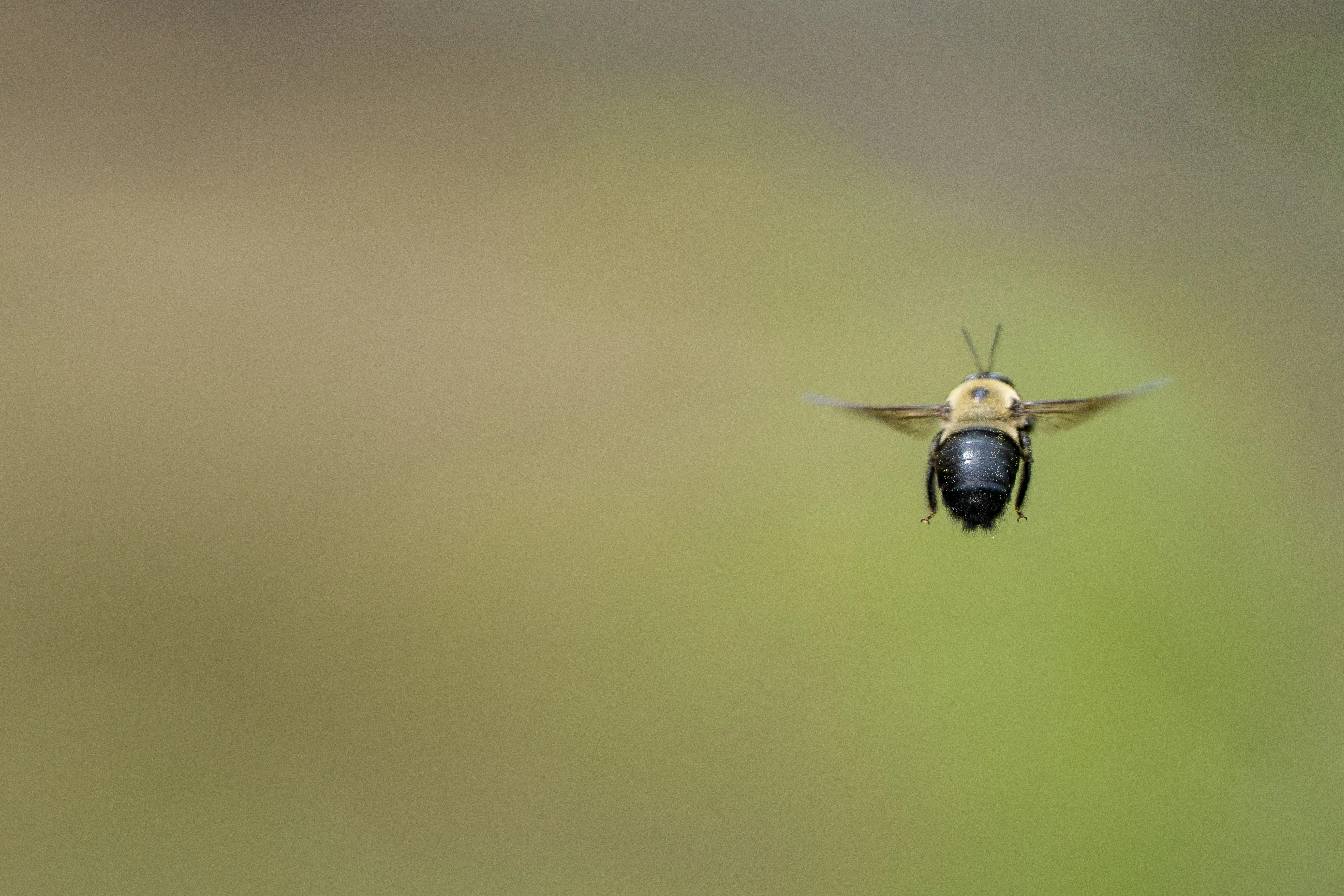
If you ask most beekeepers about drones, you will get something between a shrug and an eye roll. They do not forage. They cannot sting. They do not build comb, feed larvae, guard the entrance, or clean cells. In the popular imagination — even among people who keep bees — the drone is the freeloader of the hive, a fat, loud, purposeless male who eats honey he did not help produce and contributes nothing until the workers finally drag him out the door in autumn.
This is not wrong, exactly. But it misses the point entirely.
The drone exists for a single act. He will spend his entire life — six to eight weeks in summer, longer if he overwinters, which is rare — preparing for one afternoon. He will leave the hive, fly to a specific patch of sky, and wait. If a virgin queen passes through that patch, he will pursue her at speeds exceeding 20 miles per hour, catch her in midair, mate with her in a coupling that lasts less than five seconds, and die. His endophallus will be ripped from his body. He will fall from the sky. That is the entire arc of his existence — weeks of preparation for a moment of explosive, fatal purpose.
Most drones never get the chance. They fly to the congregation area day after day, circling for twenty or thirty minutes until their energy runs low, and return to the hive. They do this for weeks. Then autumn comes, and the workers push them out to starve.
We have watched drones leave our hives on warm afternoons in June, flying in a way that looks different from a forager’s departure — heavier, louder, less directed, rising in loose spirals above the tulip poplars before heading somewhere we cannot follow. We have no idea where they go. That is part of what makes this story worth telling.
Twenty-Four Days
A drone begins as an unfertilized egg. This is the first remarkable thing about him. Workers and queens develop from fertilized eggs — the queen controls which eggs receive sperm from her spermatheca as she lays. An unfertilized egg, laid in a cell slightly larger than a worker cell, becomes a drone. He is haploid, carrying only one set of chromosomes — his mother’s. He has no father. His genetics are entirely maternal, which means a drone is, in a sense, a flying delivery system for the queen’s genes.1
The egg hatches after three days. The larva is fed royal jelly for the first three days, then a mixture of honey and pollen for several more — the same basic feeding schedule as worker larvae, though the quantities differ. Drone larvae are larger and eat more. The workers cap his cell on day ten with a distinctively domed wax capping — raised and rounded, unlike the flat cappings on worker cells. This is one of the easiest things to spot during an inspection. The domed cappings cluster together, often at the margins of the brood nest or on the lower corners of frames, looking like small blisters on the comb surface.
Inside the capped cell, metamorphosis takes fourteen days. The total development time from egg to adult is twenty-four days — three more than a worker, three fewer than a queen, though comparisons across castes are not straightforward because the biology is fundamentally different.2
When the drone chews through his capping and emerges, he is not ready for anything. He is soft. His eyes — enormous, covering nearly the entire surface of his head, with roughly 8,600 ommatidia compared to a worker’s 6,900 — are functional but his flight muscles need time to develop. He cannot feed himself for the first few days. Workers feed him, mouth to mouth, through trophallaxis. He wanders the comb, bumping into things, occasionally emitting a low buzz that sounds almost plaintive. He is, by any practical measure, helpless.
This dependency has contributed to the drone’s reputation. A new beekeeper seeing a cluster of large-bodied, clumsy bees being fed by workers can easily form the impression that something parasitic is going on. It looks like welfare. It is not. It is preparation.
What Drones Do in the Hive
The honest answer is: not much. But “not much” is not “nothing,” and the distinction matters.
Drones do not forage. They lack the pollen baskets on their hind legs, the wax glands on their abdomen, and the long proboscis that workers use to gather nectar from deep flowers. They cannot sting — the ovipositor that became a stinger in female bees never developed in the male. They do not perform the waggle dance, do not tend brood, and do not process nectar into honey.
What they appear to do — and this has been studied more carefully in recent decades — is contribute to thermoregulation. Drones are large-bodied and generate significant metabolic heat. Their presence in the brood nest helps maintain the stable 93 to 95 degrees Fahrenheit that developing pupae require. Some researchers have suggested that drones serve as a thermal mass — absorbing and radiating heat as the brood nest temperature fluctuates.3 This contribution is passive, which may be why it was overlooked for so long. A drone sitting on brood comb looks idle. He may be doing something useful simply by being warm.
Drones also move between hives more freely than workers. They are generally accepted at any hive entrance, which is unusual — workers that drift to the wrong hive are often challenged or killed. This freedom of movement may serve a genetic purpose. A drone raised in one colony that mates with a queen from another contributes to the genetic mixing that keeps local bee populations resilient. His tolerance at foreign hive entrances is a feature, not a lapse in security.
But let us be direct. The drone’s contribution inside the hive is minimal compared to a worker’s. He is not built for hive work. He is built for one flight.
The Maturation Period
A newly emerged drone needs twelve to fourteen days before he is sexually mature and flight-capable. During this period, his sperm — produced during pupal development — migrates from his testes into his seminal vesicles, where it matures and becomes viable. His flight muscles strengthen. His enormous eyes, designed to track a fast-moving queen against an open sky, finish calibrating.
Around day twelve, he begins making orientation flights. These are short — five to fifteen minutes — and serve the same purpose as a young worker’s orientation flights: learning the landmarks around the hive so he can find his way home. He flies in expanding circles, facing the hive, memorizing the position of the entrance relative to the tree line, the slope of the ground, the angle of the light.
By day fourteen, he is making mating flights. These follow a different pattern. He leaves the hive in the early afternoon — typically between 1:00 and 4:00 PM, when temperatures are highest — and flies not in circles around the hive, but on a direct line toward something no one has adequately explained.
He flies to a drone congregation area.
The Congregation
A drone congregation area — DCA in the shorthand of bee researchers — is a specific volume of airspace, typically 30 to 200 meters above the ground, where drones from many colonies gather and wait for virgin queens. The concept sounds improbable until you read the research, and then it sounds even more improbable.
DCAs were first described systematically in the 1960s, though beekeepers had noticed the phenomenon earlier. Researchers found that if they tethered a virgin queen to a small helium balloon and raised it into the air above certain landscapes, they could reliably attract large numbers of drones — sometimes thousands — at specific altitudes and locations. Move the balloon a hundred meters in any direction, and the drones thinned or disappeared. Return it to the original spot, and they came back. The congregation area was a fixed point in the sky.4
The dimensions of a typical DCA are surprisingly small relative to the landscape — roughly 30 to 200 meters in diameter, hovering at a consistent altitude that varies by location but is often between 15 and 60 meters above the ground. The drones circle within this volume in a characteristic flight pattern — comet-shaped, with long gliding arcs interrupted by sharp turns, their large eyes scanning the sky above them for the silhouette of a queen.
Multiple colonies contribute drones to a single DCA. Studies using genetic analysis have identified drones from fifteen or more colonies at a single congregation area, with catchment ranges extending several miles from the DCA.5 This is important. A virgin queen who mates at a DCA is drawing from a genetically diverse pool — not just the drones from her own apiary but drones from colonies across the landscape, including feral colonies living in hollow trees and building walls. The DCA is, in effect, a gene-mixing station, and its geographic separation from any single colony prevents inbreeding.
A queen typically mates on one to three flights over the course of a few days, coupling with twelve to twenty drones per flight. She stores the sperm from all of these matings in her spermatheca and uses it for the rest of her life — two to five years of laying, fertilizing each egg individually from a reservoir she filled in a few afternoons when she was less than two weeks old.
For the drones, the math is brutal. Several thousand drones may be circling in a DCA on any given afternoon. A queen may mate with fifteen of them. The rest fly home, or do not fly home, and try again tomorrow.
The Mating Act
The coupling itself is violent and brief.
When a virgin queen enters a DCA, the drones detect her visually — a dark shape moving fast against the bright sky — and by her pheromone, which includes 9-ODA (9-oxo-2-decenoic acid) and several related compounds. The drones pursue in a streaming comet formation, the fastest and most vigorous males at the front.
The drone who catches the queen grasps her from behind and above, clasping her abdomen with his legs. He everts his endophallus — which is propelled outward by hemolymph pressure and a sort of muscular spasm — and inseminates her in midair. The coupling lasts between one and five seconds. At the moment of ejaculation, the drone’s abdomen contracts violently, his endophallus ruptures, and the tip — called the mating sign — breaks off inside the queen. The drone falls away, dead or dying. His abdominal cavity is open. He drops from the sky.
The next drone in the comet removes the previous drone’s mating sign and mates with the queen in the same way, leaving his own mating sign behind. This sequence repeats until the queen has received enough sperm or breaks away from the congregation area. She returns to her hive with the last mating sign still protruding from her abdomen — a visible marker that workers remove.
We have never witnessed a mating flight. Few beekeepers have. The events happen too high, too fast, and in locations that are not easy to access from the ground. What we know comes from researchers using radar tracking, tethered queens, sentinel drones, and patient observation over decades. But we have seen the aftermath. We have opened a hive and found a newly mated queen walking across the comb with the mating sign still visible — a small, pale, irregular structure trailing from her abdomen. It confirms something happened in the sky above our tulip poplars that we will almost certainly never see.
The Mystery of Location
Here is the part that no one can fully explain.
DCAs persist in the same locations year after year, sometimes for decades. The same patch of sky, over the same clearing or ridgeline, attracts drones season after season. This has been documented in Europe, where some DCAs have been studied for over forty years. Researchers return to the same GPS coordinates, raise a queen lure to the same altitude, and find drones circling in the same volume of air.6
But drones live for six to eight weeks. They do not overwinter. Every drone circling in a DCA in July is dead by October. Next spring’s drones are new individuals — sons of different queens, raised in different hives, some of which did not exist the previous year. They have never been to the DCA before. No older drone showed them the way, because there are no older drones. The information is not passed between generations through any social mechanism we can identify.
So how do they find it?
The leading hypothesis involves landscape features. DCAs tend to occur near distinctive topographic features — ridgelines, forest edges, valley intersections, clearings in otherwise dense canopy. The theory is that drones use visual landmarks and perhaps magnetic or solar cues to navigate to locations that share certain geographic characteristics, and these characteristics happen to be stable across years because the landscape does not change much from one season to the next. The DCA is not inherited knowledge but convergent behavior — new drones, following the same innate navigation rules, arrive at the same place because the same landmarks lead them there.7
This is plausible but not fully satisfying. Some DCAs persist even when surrounding vegetation changes. Some exist over relatively featureless terrain. And the precision of the congregation — drones circling within a specific column of air, not just anywhere over a given field — suggests something more refined than “fly toward the nearest tree line.” There may be additional factors. Residual pheromone deposition on vegetation below the DCA has been proposed, though it seems unlikely to persist through a Loudoun County winter. Geomagnetic anomalies have been suggested. Wind patterns may channel drones into consistent corridors.
The honest answer is that we do not know. This is one of those areas where the research is active and the conclusions are provisional. After thousands of years of beekeeping, we still cannot fully explain how a newly emerged drone — an insect with a brain smaller than a sesame seed — navigates to the same invisible meeting point in the sky that his predecessors used the year before he was born.
What We See
Our apiary sits in a clearing bordered by tulip poplars on three sides. On warm afternoons in late May through July, we can stand near the hives and watch the drones leave. They are easy to identify — larger than workers, with a heavier, more audible flight, and a barrel-shaped body that looks slightly too big for their wings. They emerge from the hive entrance and take off without the purposeful outward trajectory of a forager heading to a known patch. They rise. They spiral. They gain altitude.
We lose them in the canopy within seconds. They fly higher than we can track from the ground, and they do not come back on a predictable schedule the way foragers do. Some return after twenty minutes. Some do not return at all, and we have no way of knowing whether they mated and died, exhausted their energy and collapsed somewhere in the meadow, or simply got lost. Drones are not strong navigators. Disorientation is a real risk, especially in gusty weather.
What we notice most is the sound. A drone in flight produces a deeper, more resonant buzz than a worker — the result of his larger body and different wingbeat frequency. When several drones leave in quick succession, which often happens in the early afternoon, there is a brief low thrum near the hive entrance that is distinct from the usual traffic. It sounds heavier. More deliberate. Like something is leaving that does not entirely know where it is going.
On some afternoons, standing at the edge of the tree line with the sun behind us, we have seen drones flying high — thirty or forty feet up, silhouetted against the sky, heading in a consistent direction. Southeast, roughly, though we have never tried to plot it with any precision. We do not know if there is a DCA somewhere over the pastures between here and the Catoctin ridgeline. We do not know how we would confirm it without a helium balloon and a tethered queen, and we are not quite there yet.
But we watch them go. And we wonder about the patch of sky they are headed for — whether it was there last summer, and the summer before that, and whether it will be there next year when a new generation of drones, sons of queens who do not yet exist, find their way to the same point and begin circling.
The Autumn Eviction
The drone’s story has one more chapter, and it is not a gentle one.
In late summer and early autumn — usually around September here in Loudoun County, when the goldenrod is finishing and the aster flow is thinning — the workers turn on the drones. The timing varies by colony and by year, but the trigger is consistent: resources are tightening, winter is coming, and the colony cannot afford to feed members who are no longer serving a purpose. Mating season is over. The queens who needed to mate have mated. The drones are now a caloric liability.
The eviction is not immediate. It begins with a slow withdrawal of food. Workers stop feeding drones through trophallaxis. The drones, unable to feed themselves efficiently from honey stores — their shorter tongues make it difficult — begin to weaken. They become sluggish. They move to the margins of the comb, away from the brood nest, clustering near the top bars or the edges of outer frames.
Then the workers start pushing them out. We have watched this at the hive entrance on September afternoons — workers grabbing drones by the legs and wings, pulling them across the landing board, shoving them off the edge. The drones resist. They grab at the wood, try to climb back in, crawl toward the entrance. The workers are persistent and methodical. A drone who makes it back inside is grabbed again and pulled out again. It can go on for hours.
The drones that are evicted do not survive. They cannot forage. They are not accepted into other hives the way they were in summer — the tolerance that let drones drift between colonies during mating season disappears in autumn. They cluster on the outside of the hive, on the landing board, on the ground below. They slow down as the temperature drops. By morning they are dead, or near enough. We find them in the grass around the hives — large, dark bodies, their huge eyes dull, their legs curled.
It is difficult to watch and impossible to sentimentalize. The colony is not being cruel. It is making a calculation that has been validated by millions of years of selection pressure. Every calorie spent feeding a drone through winter is a calorie not available to the cluster. A colony that wintered its drones would enter spring with fewer stores, a smaller worker population, and a lower probability of survival. The math does not accommodate generosity.
Some colonies in the southern United States and in tropical regions keep a small number of drones through winter, especially if resources remain available. Our colonies in Loudoun County do not. By October, the drones are gone. The hive population is exclusively female — the queen and her workers — and will remain so until the colony begins raising new drones in early spring.
Built for One Flight
We think about drones differently now than when we started keeping bees. In our first year, we found them mildly amusing — the fat, bumbling males who wandered the comb and ate other bees’ food. We repeated the jokes every beekeeper hears: the drones are the lazy husbands of the hive, their only job is to mate, they are the definition of expendable.
But expendable is not the same as purposeless. The drone’s purpose is as sharply defined as any role in the colony. He exists to carry his mother’s genes into the sky and deliver them to a queen from another line, ensuring the genetic diversity that keeps the species resilient. Every adaptation of his body serves this single function — the enormous eyes for tracking a queen in flight, the powerful thoracic muscles for the speed required to catch her, the explosive reproductive anatomy that makes the mating irreversible and fatal. He is not a failed worker. He is a completely different kind of organism, built for a completely different task, and the task is as essential as foraging or brood-rearing or any other function the colony performs.
The congregation area — that persistent, unexplained point in the sky — is perhaps the most fitting symbol of the drone’s peculiar dignity. Something in his brain, in the neural architecture of an insect who will live for a few weeks and has never been shown the way, compels him to fly to a specific place and wait. He does not know what he is waiting for. He does not know that the act he is prepared for will kill him. He flies there anyway, afternoon after afternoon, because the tens of millions of years of evolution that shaped him determined that this was a good strategy for the species, and the strategy persists because it works.
We stand in our apiary in the long light of a June afternoon and watch them leave. They rise above the tulip poplars and vanish into a sky that contains, somewhere, a place they have never been but somehow know to find. We do not know where it is. We are not sure they do either, in any way we would recognize as knowing. But they go. And the species continues because they went.
References:
- Winston, Mark L. The Biology of the Honey Bee. Harvard University Press, 1987 — drone development, haplodiploidy, and the genetics of sex determination in Apis mellifera
- Strang, Graham E. “The Life Cycle of the Honey Bee Drone.” American Bee Journal, 1970 — comprehensive description of drone development from egg to adult
- Kovac, H., Stabentheiner, A., and Brodschneider, R. “Contribution of Honeybee Drones of Different Age to Colonial Thermoregulation.” Apidologie, 2009 — metabolic heat production by drones and their role in brood nest temperature stability
- Jean-Prost, Pierre. “Observations sur le vol nuptial des reines d’abeilles.” Comptes Rendus de l’Academie des Sciences, 1958 — early systematic documentation of drone congregation areas using queen lures and tethered queens
- Baudry, E., Solignac, M., Garnery, L., Gries, M., Cornuet, J.-M., and Koeniger, N. “Relatedness among honeybees (Apis mellifera) of a drone congregation.” Proceedings of the Royal Society B 265, no. 1409 (1998): 2009–2014; Koeniger, N., Koeniger, G., Gries, M., and Tingek, S. “Drone competition at drone congregation areas in four Apis species.” Apidologie 36, no. 2 (2005): 211–221 — genetic analysis of drone origins at congregation areas demonstrating multi-colony contribution, and comparative study of drone behavior across species
- Ruttner, Friedrich. “The Mating of the Honeybee.” Bee World, 1956; Ruttner, F., and Ruttner, H. “Untersuchungen uber die Flugaktivitat und das Paarungsverhalten der Drohnen.” Zeitschrift fur Bienenforschung, 1966 — long-term persistence of DCAs in documented European locations
- Loper, Gerald M., Wolf, W.W., and Taylor, O.R. “Honey Bee Drone Flyways and Congregation Areas: Radar Observations.” Journal of the Kansas Entomological Society, 1992 — radar tracking of drone flight paths and the role of landscape features in DCA formation
We sell what the bees don’t need. Interested in trying some? Drop us a line.