- observation
- behavior
- diagnostics
- field-guide
Reading the Landing Board
Ten minutes at the hive entrance can tell you more than a twenty-minute inspection. A field guide to what the bees are broadcasting.
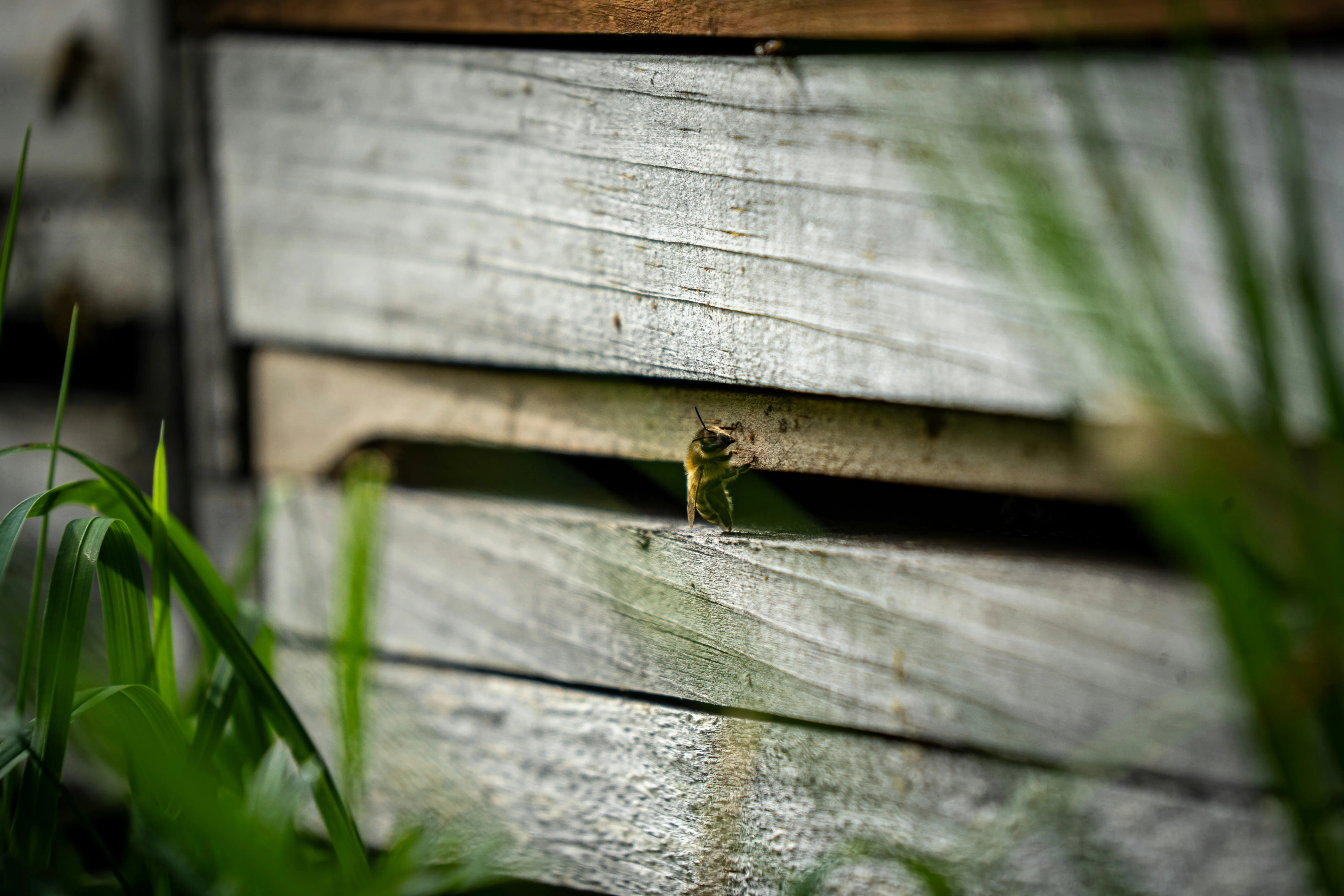
We keep a pair of folding chairs near the hives. Not for rest — for reading.
The landing board is a narrow strip of wood, maybe eight inches deep and the width of the hive body. It is where foragers arrive, where guards stand post, where undertakers drag out the dead, where young bees hover and learn what home looks like. Everything the colony is doing eventually shows up here. You just have to sit long enough to see it.
We have come to believe — after two years of keeping bees outside Leesburg, after opening hives too often and learning the cost — that ten minutes watching the entrance tells you more than a twenty-minute inspection. The landing board is the colony’s front page. What follows is our field guide to reading it.
Orientation Flights
Start with the easiest signal to misread. On a warm afternoon — usually between noon and two o’clock — you may see a cloud of bees hovering in front of the hive. They are not leaving. They are not arriving. They are hanging in the air, dozens or hundreds of them, facing the hive entrance and drifting in slow, widening arcs.
These are young bees on orientation flights. They are somewhere between twelve and twenty days old, and this is their first time outside. They are memorizing landmarks — the hive’s position relative to the tulip poplars behind it, the fence line, the angle of the afternoon sun. They face the hive because they need to learn what it looks like from the outside. They will expand their arcs over several flights, mapping larger circles, until they know the landscape well enough to forage.
The first time we saw this, we thought we were watching a swarm form. The sheer number of bees in the air, the intensity of it, the hum. A neighbor who came by that day asked if something was wrong. Nothing was wrong. It was the next generation of foragers learning to navigate. It is one of the most reassuring things you can see at a hive entrance — it means the colony is producing new workers at a healthy rate.
If you do not see orientation flights on warm afternoons during the active season, that is worth noting. A colony that is not producing young bees is a colony with a problem — possibly a failing queen, possibly a laying worker, possibly a brood disease. The absence of this signal matters as much as its presence.
Foragers: Heavy and Light
Watch the bees that are clearly coming and going — not hovering, not standing guard, but departing with purpose and returning with cargo.
An outbound forager is fast and light. She launches from the landing board, gains altitude quickly, and disappears. She knows exactly where she is going. An inbound forager is different. She comes in lower, slower, sometimes wobbling on approach. If she is carrying a full honey stomach — about 40 milligrams of nectar, nearly half her body weight — her abdomen is visibly distended, shiny and stretched. She may undershoot the landing board entirely and tumble into the grass, then crawl back up to the entrance. During a good nectar flow, you will see this over and over — bees crash-landing under the weight of what they are carrying home.
The ratio of heavy returnees to light ones tells you about the flow. When the tulip poplars are blooming in late May, the landing board is busy with heavy bees all day. When the dearth settles in by late July, the foragers come back light. Empty. You can track the transition day by day if you sit and watch. The landing board tells you when the flow starts and when it stops, usually before you notice the change in what is blooming.
Pollen Loads and the Color Calendar
Pollen is the most visual signal on the landing board. Foragers carry it in corbiculae — the smooth, concave surfaces on their hind legs — as compact pellets that are easy to see with the naked eye. The color of the pollen tells you what is blooming within foraging range.
Here is what we have learned to recognize in Loudoun County:
- Bright orange — dandelion. This is the first pollen of spring, appearing in March and April when not much else is available. It is vivid, almost fluorescent.
- Pale yellow — clover, both white and crimson. The dominant pollen color in early summer.
- Gray-green — tulip poplar. Our most important nectar source, blooming in late May through early June. The pollen is subtle, easy to overlook.
- Red-brown — sumac, which blooms along roadsides and field edges in June and July.
- Deep gold — goldenrod. Late summer into fall. Heavy, saturated color.
- Dark rust or burgundy — Virginia creeper, occasionally aster species.
Over time, this becomes an almanac. You stop needing to walk the property to know what is blooming — the bees wear the answer on their legs. And the diversity of pollen colors on any given day tells you something about the colony’s foraging range and the landscape’s floral health. A landing board showing three or four different pollen colors means the bees are working a varied landscape. A single color means one thing is dominant and everything else is sparse.
Watch the size of the pellets too. Full, symmetrical loads packed tight on both legs mean abundant forage. Small, lopsided loads — or foragers returning with pollen on only one leg — suggest the source is thinning out. The bees are telling you the state of the bloom before you walk the fields.
Washboarding
This is the behavior that still puzzles us, and apparently it puzzles the researchers too.
On warm afternoons, particularly in late summer, you may see rows of bees on the front face of the hive — not on the landing board itself but on the vertical surface above it — rocking back and forth in a rhythmic, synchronized motion. Their front legs move forward and back, their bodies sway. It looks like they are scrubbing the wood.
The published explanations are tentative. Some researchers suggest it is a cleaning behavior — the bees are smoothing propolis or removing debris from the hive surface. Others have proposed it is related to scent distribution or surface conditioning. Thomas Seeley has observed it but, as far as we have read, has not offered a definitive explanation.
What we can say from watching our own hives is this: washboarding seems to happen more when colonies are strong and well-provisioned. We see it most often in July and August, on hives that are doing well. It is mesmerizing to watch — the rhythm is almost mechanical, dozens of bees moving in unison. We have never seen it on a struggling colony. Whether it is a diagnostic signal or just a behavior of bees with time and energy to spare, we are not sure. We note it when we see it and keep watching.
Fanning
A bee standing at the entrance with her abdomen raised, the tip pointed upward, wings beating steadily — this is a fanner. She is exposing her Nasonov gland, which releases a pheromone that signals “home is here.” The fanning pushes that scent outward and also draws air into the hive.
Fanning serves two purposes. During orientation flights, fanners at the entrance help young bees find their way back. During a nectar flow, when the hive is full of uncured nectar with high moisture content, fanners move air through the hive to evaporate water and cure the honey. A row of fanners at the entrance on a warm evening means the colony is processing a heavy load of nectar — which is good news.
You can hear fanning before you see it. The wing-beat frequency is higher and more consistent than the general hum — a steady, whirring note. If you lean close to the entrance on a summer evening and hear that pitch, the colony is working. We learned to prop our inner covers slightly during heavy flows to help with ventilation after watching how many bees the colony was dedicating to this work.
Guard Bees
Not every bee at the entrance is arriving or departing. Some are standing still — antennae forward, body low, oriented outward. These are the guards.
Guard duty is a specific role in the colony’s division of labor, typically performed by bees between twelve and twenty-five days old. Their job is to inspect every bee that lands. They bump into arrivals, antennae touching, reading the chemical signature of the bee’s colony. A nestmate passes through. A bee from another hive — carrying the wrong scent — is challenged. The guard will grab, wrestle, or sting the intruder.
The number of guards at the entrance varies with conditions. During a nectar flow, when resources are abundant and there is little incentive for robbing, you may see only a few. During the summer dearth — late July through September here in Loudoun County — guard numbers increase. A hive that suddenly doubles its sentries at the entrance is responding to pressure. Something out there is testing the defenses. That is your signal to reduce the entrance width and watch for robbing behavior.
Robber Bees
Robbers do not approach a hive the way residents do. A forager returning home flies straight to the entrance — direct, unhesitating. A robber flies differently. She zigzags. She hovers at the entrance without landing. She drifts to the sides of the hive, looking for cracks, for gaps where she can slip in without passing the guards.
If you watch the landing board and see bees approaching sideways, weaving in erratic patterns, trying the corners of the hive body rather than the main entrance — that is robbing. The fighting is the confirmation. Pairs of bees locked together on the landing board, rolling, stinging. Dead bees on the ground below. Bees returning to the hive with a shiny, hairless appearance — their fuzz scraped off in the scuffling.
Robbing escalates fast. We wrote about this in detail after losing a colony to it — but the landing board gives you the first warning, if you are watching. The erratic flight pattern appears before the full-scale assault. A few zigzagging scouts become a dozen, then a hundred. The window between noticing and acting is narrow.
Bearding
On hot evenings — above 90 degrees, which happens plenty in a Virginia summer — you may find a dense mass of bees hanging on the front of the hive, covering the landing board and the hive body below the entrance. Hundreds of bees, sometimes thousands, in a thick, living curtain.
This is bearding, and it is not a problem. The bees are moving outside to reduce the heat load and congestion inside the hive. They are cooling the brood nest by removing body heat from it. It looks alarming the first time you see it — it looks like the colony is about to swarm, or like something has gone badly wrong.
Nothing has gone wrong. On a July evening when the air is still and humid, bearding is ordinary thermal management. The bees hang quietly, barely moving. By morning, when the temperature drops, they file back inside. We leave them alone. If a colony is bearding heavily every evening, it may benefit from more ventilation — a screened bottom board, a propped inner cover — but the behavior itself is not a symptom.
The Ominous Signs
There are things you do not want to see on the landing board, and their absence is part of what you are reading for.
No activity on a warm day. On an afternoon when the temperature is above 55 degrees and other hives in the yard are flying, a silent entrance means trouble. It may mean the colony has died. It may mean it is too weak to fly. Press your ear to the side of the hive. If there is no hum, open it.
Bees crawling instead of flying. Workers on the landing board that cannot take flight — stumbling, dragging themselves, falling off the edge — may indicate tracheal mites, pesticide exposure, or viral infection. Deformed wing virus is the most visible: bees with crumpled, stunted wings that will never fly. If you see crawlers, look closely at their wings.
Fighting at the entrance during a dearth. A handful of scuffles are normal. Sustained combat — multiple pairs of bees wrestling, dead bees piling up, the hive’s tone rising — means robbing is underway. Act now. Reduce the entrance. Install a robbing screen. Every hour you wait makes it harder.
Bees ejecting larvae. White, C-shaped larvae on the landing board can mean the colony is hygienic — detecting and removing diseased brood — or it can mean something is killing the brood faster than the bees can raise it. A few ejected larvae in spring, when the colony is dealing with temperature swings, is normal. A steady stream is a reason to inspect.
The Practice
We sit and watch the landing boards most evenings when the weather is warm. Not all six hives — usually one or two, whichever drew our attention that week. We bring the folding chairs and a notebook. We note the pollen colors, the traffic volume, the guard activity, whether we see washboarding or fanning or bearding. It takes ten minutes. Some evenings it takes longer because we cannot stop watching.
This is not a replacement for inspections. You still need to go into the hive for mite counts, for brood assessment, for swarm management in spring. But we open our hives less than we used to. The landing board tells us which hives need attention and which ones are asking, plainly, to be left alone.
The colony is a closed system — sixty thousand bees in a dark box, doing work we cannot see. But the entrance is a window. Everything that happens inside eventually registers there: the health of the queen in the orientation flights of young bees, the state of the bloom in the color on foragers’ legs, the threat level in the posture of the guards, the temperature in the bearding on a hot night.
You do not need to open the hive to learn these things. You need a chair, ten minutes, and the willingness to read what the bees are writing on that narrow strip of wood.
References and further reading:
- Seeley, Thomas D. The Lives of Bees: The Untold Story of the Honey Bee in the Wild. Princeton University Press, 2019 — foraging behavior, colony organization, and entrance dynamics
- Tautz, Jurgen. The Buzz about Bees: Biology of a Superorganism. Springer, 2008 — orientation flights, fanning behavior, guard bee chemosensory systems
- Winston, Mark L. The Biology of the Honey Bee. Harvard University Press, 1987 — age-based division of labor including guard duty and undertaking
- Free, John B. “The behaviour of robber honeybees,” Behaviour, 1954 — early observational research on robbing flight patterns
- Virginia Cooperative Extension, “Managing Colonies During the Summer Dearth” — seasonal guidance for Zone 7a beekeepers
We sell what the bees don’t need. Interested in trying some? Drop us a line.