- inspection
- observation
- hive-management
- philosophy
The First Fifteen Minutes
Most of what you need to know about a hive is available before you open it. The best diagnostic tool in beekeeping is patience.
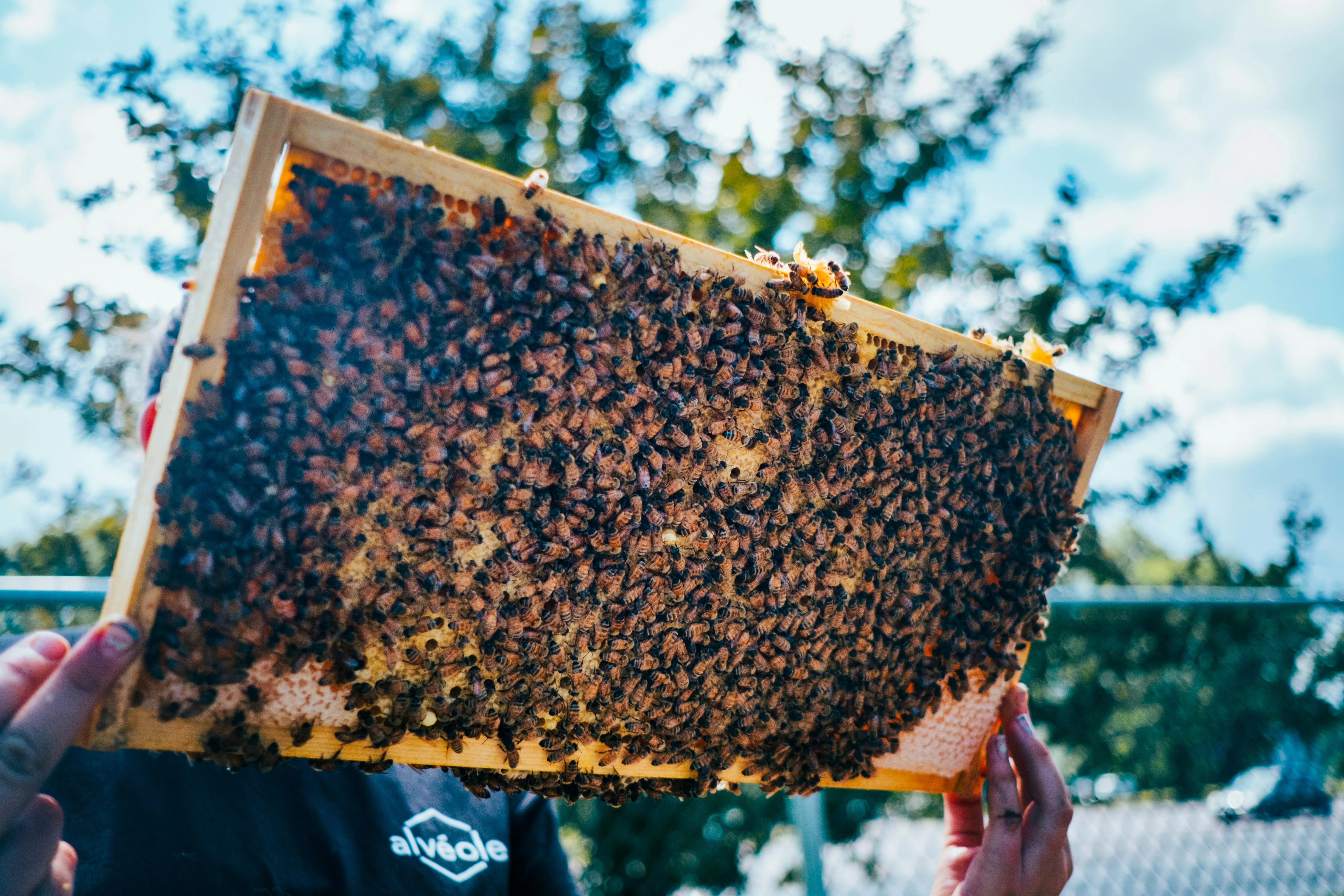
There is a tendency in beekeeping — especially early on — to open the hive first and ask questions later. You suit up, light the smoker, crack the lid, and start pulling frames. It feels productive. You are doing something. You are gathering information.
But most of the information you need is available before you ever lift the outer cover. It is available to anyone willing to stand still for fifteen minutes and pay attention.
We have been keeping bees in Loudoun County for two years now. The single most useful thing we have learned in that time is not a technique for finding queens or a method for treating mites. It is this: stand near the hive and watch. Watch before you act. Watch longer than you think you need to. The hive is already telling you what is happening inside — you just have to learn its language.
Reading the Air
Start ten feet back. Watch the flight pattern in the air above and in front of the hive.
On a warm afternoon during a nectar flow, you will see bees departing in a steady stream — fast, direct, purposeful. These are foragers. They leave the entrance, gain altitude quickly, and disappear over the tree line. When they return, they come in heavy. You can see the difference in how they fly — lower, slower, sometimes undershooting the landing board entirely and tumbling in the grass before crawling back up. A forager loaded with nectar or pollen does not fly the same as an empty one.
Now look for a different pattern. Younger bees taking orientation flights do something distinctive — they hover near the entrance, facing the hive, drifting in slow arcs and figure-eights. They are memorizing landmarks. If you see a cloud of bees hovering in front of the hive in the early afternoon, facing inward rather than outward, that is not a swarm forming. That is the next generation of foragers learning where home is.
Then there is washboarding — bees rocking back and forth in rhythmic rows on the front of the hive, as if they are scrubbing the surface with their bodies. We still do not fully understand why bees do this. Theories range from cleaning the surface to smoothing propolis to some kind of social signaling. It seems to happen more in late summer. It is mesmerizing to watch, and it generally indicates a healthy colony with bees to spare.
Three flight patterns, three different stories. None of them required opening the hive.
The Landing Board
If the flight pattern is the hive’s broad weather report, the landing board is the local news.
Watch what comes in. Foragers returning with pollen carry it in visible pellets on their hind legs — corbiculae, the technical name, though “pollen baskets” does the job. The color of the pollen tells you what is blooming. Bright yellow in May usually means dandelions or mustard. Pale gray-green is tulip poplar — our dominant flow here outside Leesburg. Deep gold in late summer is goldenrod. Dark red might be sumac or Virginia creeper. Over time, you build a mental almanac. You know what is blooming by what color the bees are wearing.
Watch the size of the pollen loads. Heavy, symmetric pellets mean abundant forage. Small or sparse loads might mean the flow is slowing down or the colony is not strong enough to field many foragers.
Watch for nectar-heavy returnees — bees that land and seem too full to walk gracefully, their abdomens distended and shining. During a good flow, the landing board is busy with these bees. When the flow stops, the traffic pattern changes within a day. You will notice.
Then watch the guards. At the entrance of a healthy hive, you will see bees that are not coming or going — they are standing, antennae forward, checking arrivals. Guard bees challenge strangers by bumping into them and smelling them. If a bee from another colony lands, the guards will wrestle it or chase it off. During a nectar dearth, when robbing pressure increases, the guards become more numerous and more aggressive. A hive that suddenly has twice as many bees standing at attention at the entrance is telling you something about resource scarcity in the area.
What You Can Hear
We did not take hive sound seriously until we lost a queen.
A healthy, queenright hive hums. It is a low, even, contented sound — a steady tone with no particular urgency. You can hear it by placing your ear near the side of the hive body, or sometimes just by standing close on a quiet morning. It is one of the more calming sounds in the natural world.
A queenless hive sounds different. The hum becomes a roar — higher-pitched, unsteady, agitated. Beekeepers call it the queenless roar, and once you have heard it, you do not mistake it again. The colony knows something is wrong before you do. If you walk up to a hive and the tone is off — louder, more anxious, with a wavering quality — that is your cue to investigate. But you already know what you are looking for before you open the lid.
Sound can also tell you about ventilation. On a warm evening, bees fan at the entrance to move air through the hive, evaporating moisture from uncured nectar. The fanning produces a higher-pitched whirring, distinct from the general hum. A large number of fanners means the colony is processing a lot of nectar — which is good news. It also means they might benefit from more ventilation. We learned to prop our inner covers for airflow during heavy flows, and the fanning behavior told us when to do it.
What You Can Smell
This one takes practice, and we are still learning it ourselves.
A healthy hive smells like beeswax and warm honey, with an undertone of propolis — the tree resin the bees collect and use as caulk, as medicine, as building material. It is a warm, slightly sweet, vaguely medicinal smell. Pleasant. Distinctive. Once you know it, you recognize it immediately.
Fermentation smells different. If uncured nectar has too much moisture and begins to ferment, you may catch a sour, slightly yeasty scent near the entrance. This is not necessarily a crisis — some fermentation happens during heavy flows when bees are processing more nectar than they can cure quickly — but it is worth noting.
The smell you never want is the one that indicates American foulbrood. It has been described as the smell of a dead animal, of rotten meat, of something deeply wrong. We have not encountered it in our own hives — and we hope not to — but every experienced beekeeper we have talked to says the same thing: you know it when you smell it, and you cannot unknow it. If you catch that scent near a hive, you open it. That is one of the few situations where immediate inspection is not optional.
Most days, though, the smell check is reassuring — warm wax, honey, propolis, the smell of a healthy hive.
Behavior at the Entrance
A few more things you can read from the outside.
Bearding — a mass of bees hanging in a dense cluster on the front of the hive, often on hot evenings — is usually a ventilation behavior, not a sign of trouble. The bees are moving outside to reduce the heat load inside. It looks alarming if you have never seen it. It is generally fine.
Undertaker bees carry out the dead. Every colony has bees assigned to this work — hauling deceased workers out of the hive and dropping them a few feet from the entrance. A few dead bees in the grass near the landing board is normal turnover. A sudden increase is worth paying attention to. After a pesticide exposure, or during a bad nosema outbreak, the number of dead bees being carried out rises sharply. The undertakers tell you about the colony’s mortality rate in real time.
Bees defecating on the front of the hive — yellow-brown streaks on the landing board — can indicate dysentery, particularly in late winter when bees have been confined for weeks. Clean landing boards suggest healthy digestion. Streaked ones suggest the colony may be stressed.
Why We Open Less Often
Here is the thesis, stated plainly: most of what you need to know about a hive is available from the outside. Opening the hive should confirm what you already suspect — not be your first method of inquiry.
Every time you open a hive, you disrupt it. You break propolis seals that the bees spent days building. You expose the brood nest to outside air and temperature fluctuations. You crush bees when you shift frames — inevitably, no matter how careful you are. You stress the colony for thirty to sixty minutes while they reorganize and repair. If you are in the hive every week, that is a significant cumulative disruption across a season.
We are not saying never open your hives. You need to inspect for disease. You need to assess brood patterns and queen status. You need to check for swarm cells in spring and evaluate honey stores going into winter. These are not optional.
But you do not need to do them as often as you think, and you should not do them without a reason. The fifteen minutes you spend watching before you suit up will tell you whether today is a day that warrants opening the hive — or whether the bees are telling you everything is fine and you should leave them to their work.
The best beekeepers we have met open their hives the least. They have learned to read what the bees are broadcasting from the outside — the flight patterns, the sounds, the smells, the behavior at the entrance — and they reserve the disruption of a full inspection for when the external signs suggest something needs attention.
We are still learning to do this well. Some days we open a hive and realize we already knew what we would find. Stand still and watch.
References:
- Seeley, Thomas D. Honeybee Democracy. Princeton University Press, 2010 — collective decision-making and colony behavior
- Tautz, Jurgen. The Buzz about Bees: Biology of a Superorganism. Springer, 2008 — orientation flights, fanning behavior, colony communication
- Virginia Cooperative Extension, “A Beekeeper’s Year in a Virginia Apiary” — seasonal management practices for Virginia Zone 7a
- Spivak, M. and Reuter, G.S. “Varroa destructor infestation in untreated honey bee (Hymenoptera: Apidae) colonies selected for hygienic behavior.” Journal of Economic Entomology 94, no. 2 (2001): 326–331 — hygienic behavior and its role in disease resistance in managed colonies
We sell what the bees don’t need. Interested in trying some? Drop us a line.