- feeding
- management
- philosophy
- nutrition
- seasonal-management
Feeding
When does supplemental feeding cross from stewardship into life support? The chemistry, the mechanics, the calendar — and the question we keep circling.
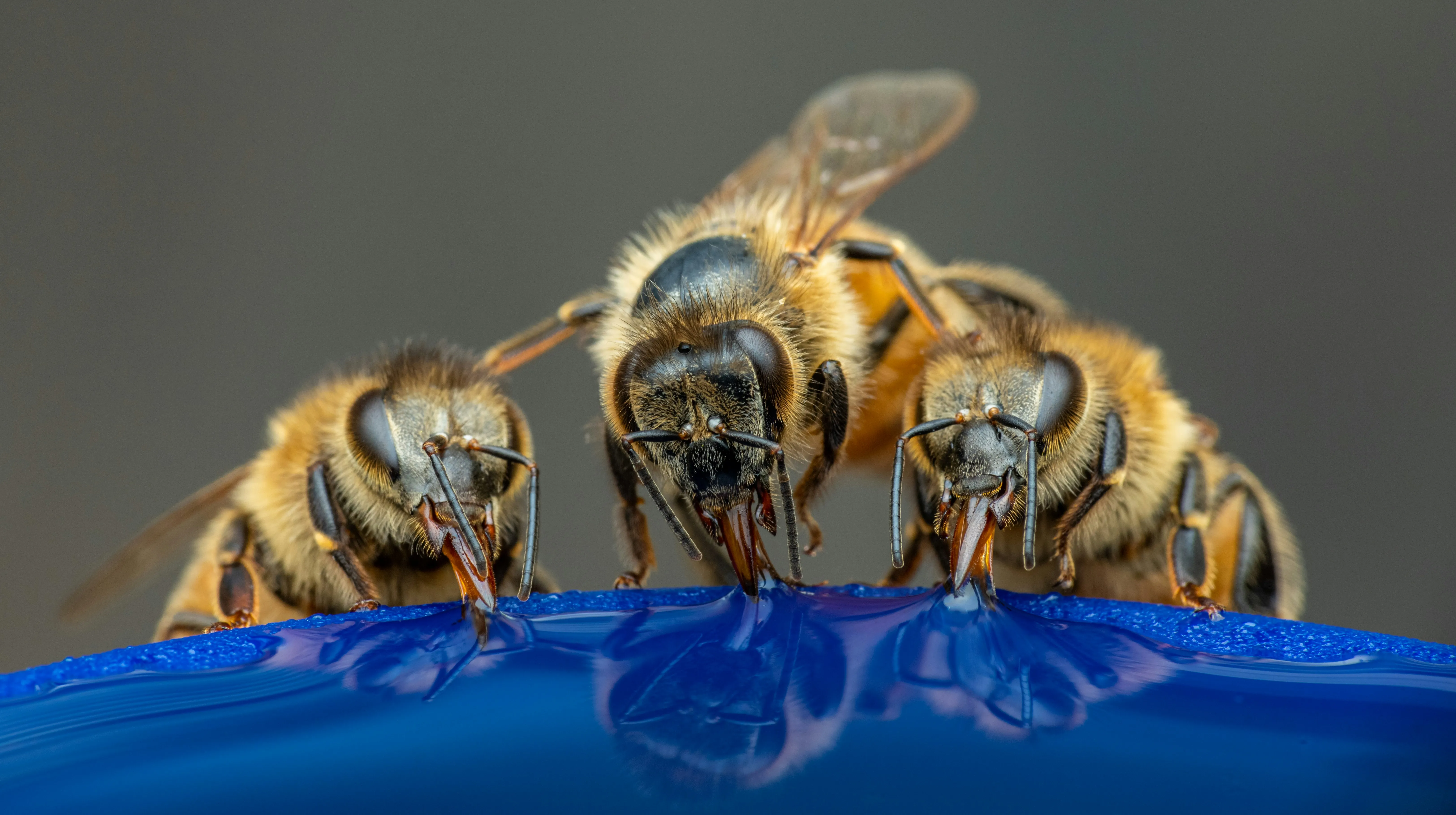
There is a jar of white sugar on the kitchen counter that has nothing to do with our coffee. It is for the bees. Two pounds of it dissolved in two pounds of warm water makes a thin syrup that mimics the sugar concentration of nectar — roughly fifty percent sucrose. We have fed this to colonies in spring, in fall, and once in a desperate February. Every time, we have a conversation about whether we should be doing it at all.
This is a piece about feeding honeybee colonies. But it is also about a question that sits underneath the practice, one that most beekeeping guides skip past on the way to the recipe: when does helping become propping up? When does stewardship become life support?
We do not have a clean answer.
What Feeding Is
Supplemental feeding means providing a managed colony with food it did not produce or forage for itself. The most common forms:
Sugar syrup is sucrose dissolved in water at one of two ratios. A 1:1 mix — equal parts sugar and water by weight — is thin, easy for the bees to take down, and used in spring to simulate incoming nectar and stimulate brood rearing. A 2:1 mix — two parts sugar to one part water — is thick, closer to the consistency of cured honey, and fed in fall when the goal is to add stored weight before winter. The bees still have to process it, fanning off moisture and capping cells, but the heavier syrup requires less work to cure.
Pollen patties are commercial supplements — soy flour, brewer’s yeast, and sometimes real pollen mixed into a dense cake. Bees need protein to raise brood. In early spring, before the red maples and dandelions open, a colony ramping up brood production may outpace the available pollen. Patties bridge the gap. They are not pollen, and bees treat them accordingly — they will eat patties when they have no better option and ignore them the moment real pollen arrives.
Fondant is a solid sugar paste, dense enough that it will not drip or ferment. It sits directly on the top bars, above the cluster. Bees chew at it slowly. Fondant is winter emergency food — you use it when a colony is light on stores and the temperature is too low for syrup.
Dry sugar is the last resort. Granulated white sugar poured onto a sheet of newspaper on the inner cover. The bees will take it if they are desperate. It is crude, inefficient, and sometimes the only thing between a colony and starvation in January.
All of these share a common feature: they are not honey. They are substitutes for honey, and the difference matters more than most feeding guides acknowledge.
When Feeding Is Clearly Right
There are situations where the calculus is straightforward.
A package colony — three pounds of bees shaken into a box with a caged queen they have never met — arrives with nothing. No comb, no stores, no foragers who know the landscape. Feeding 1:1 syrup in this situation is not optional. It is the baseline of responsible management. Without it, the bees must forage for nectar and simultaneously draw wax comb to store it in. The energetics are brutal: bees consume roughly eight pounds of honey to produce one pound of wax. A package colony trying to build comb on forage alone in early April, when nectar sources in Loudoun County are sparse, is a colony under siege.
A split — a new colony created by dividing an existing one — faces a similar deficit. Half the population, half the stores, and no returning foragers, because the field bees will fly back to the parent hive’s location. Feeding gets the split through its first two weeks while it reorients.
A colony going into winter light — under sixty pounds of stored honey in Zone 7a — needs help. We heft our hives in early October. If a hive feels significantly lighter than its neighbors, we feed 2:1 syrup while temperatures still allow the bees to cure it. If nights are already dropping below fifty degrees, we switch to fondant. The alternative is starvation in February, which we have seen and do not care to see again.
Emergency feeding in late winter is the hardest version of this. A colony that went into November with what seemed like adequate stores has consumed them faster than expected — a long cold spell, a larger cluster than anticipated. In February, with no forage for six weeks, you open the hive on a mild afternoon, place a sugar brick on the top bars, and close it quickly. You are breaking the propolis seal. You are letting cold air in. You are doing it because the alternative is worse.
In all of these cases, feeding is not a philosophical question. It is animal husbandry. You took responsibility for these organisms when you put them in a box. Letting them starve because of a principle about self-sufficiency is not a philosophy. It is neglect.
When Feeding Becomes a Crutch
But there is another category, and this is where it gets uncomfortable.
A colony that cannot build up enough stores to survive winter in your location — not because of a bad year, not because of a late split, but because its genetics are not suited to your climate and forage — is a colony that will need to be fed every fall. And every spring. And possibly in between. You are not supplementing. You are sustaining. The colony exists because you are keeping it alive, and if you stopped, it would die.
We have had this colony. Our second year, one of our hives — a purchased nuc from a southern supplier — never built the kind of stores our other colonies did. Same apiary, same tulip poplar flow, same weather. The other hives put away seventy, eighty pounds of surplus. This one managed forty. We fed it in September. We fed it again in October. We put fondant on it in December. It survived, barely, and came out of winter weak.
That summer, we watched it again. Lower population. Slower buildup. Less productive during the flow. We fed it in fall for the second year running. And at some point during the second round of feeding, one of us said what we had both been thinking: this colony is alive because we are subsidizing it.
The question is what you do with that realization.
If we continue feeding, we are maintaining a colony whose genetics are poorly adapted to our environment. If we breed from that queen — or if she swarms and those genetics propagate — we are actively degrading the local gene pool. We are selecting for bees that need us, rather than bees that can sustain themselves in the tulip poplar corridor outside Leesburg.
If we stop feeding, the colony dies. Not probably. Certainly. And we are the ones who brought it here, put it in this box, in this climate. Its failure is partly our failure — we chose the supplier, we accepted the genetics.
There is no version of this that feels entirely right.
What Syrup Is Not
Here is the chemistry that most beekeepers learn eventually, and that changes how you think about feeding.
Honey is not sugar water that bees have processed. Honey is a biochemically complex substance produced through enzymatic modification of plant nectars. A typical honey contains at least 181 identified compounds.1 The major sugars are fructose and glucose — not sucrose, which is what you dissolve in the pot on the stove. When a forager collects nectar, she adds invertase from her hypopharyngeal glands, which cleaves sucrose into its component monosaccharides. But that is only the beginning. The bees also add glucose oxidase, which produces hydrogen peroxide — part of honey’s antimicrobial properties. They add diastase and catalase. The nectar itself contains organic acids, amino acids, minerals, phenolic compounds, and volatile aromatics specific to the plant species it came from.
Cured honey has a pH between 3.2 and 4.5 — acidic enough to inhibit most bacterial growth. It has antimicrobial peptides. It has antioxidants. Its moisture content, reduced to roughly 18 percent through evaporative fanning, creates an osmotic environment hostile to microorganisms. Honey is not just food. It is preserved food, engineered at the molecular level for long-term storage in a warm, dark, living-organism-dense environment.
Sugar syrup is sucrose and water.
When you feed 2:1 syrup, the bees process it. They add invertase. They fan it and cap it. It looks like honey in the comb. But it is not honey. It lacks the organic acids, the mineral content, the volatile aromatics, the full enzymatic profile, and the plant-specific phenolics that make honey what it is. It is a caloric substitute. Calories are not nothing — they are the difference between a colony that survives winter and one that does not. But pretending that cured syrup and cured honey are nutritionally equivalent is like pretending a vitamin pill is equivalent to food. The calories are there. Everything else is diminished.
Research suggests that bees overwintering on sugar stores show higher rates of nosema infection and shorter individual lifespans compared to bees overwintering on honey.2 The mechanisms are not fully understood, but the hypothesis is reasonable: honey evolved as winter bee food over millions of years. It contains compounds — antimicrobials, antioxidants, trace nutrients — that support bee health in ways that sugar alone does not. When we replace honey with syrup, we are substituting the fuel while removing the medicine.
This does not mean feeding is wrong. It means feeding has a cost, and the cost is not zero.
The Treatment-Free Argument
There is a school of thought in beekeeping — the treatment-free philosophy — that argues supplemental feeding interferes with natural selection. The logic goes like this: colonies that cannot gather and store enough food to survive winter in their environment carry genetics that are not adapted to that environment. By feeding those colonies, we keep those genetics alive. By keeping those genetics alive, we prevent the local bee population from adapting through selective pressure. We create dependency instead of resilience.
The counter-argument is not simple, because the treatment-free position is not entirely wrong.
It is true that managed bees in the United States face different selective pressures than feral colonies. We choose our queens from catalogs. We select for gentleness, for productivity, for color. We have not, historically, selected for winter survival or disease resistance. The genetics of many commercially available bees reflect decades of human preference, not ecological fitness.
It is also true that feral colonies — living in tree cavities without management — do exist, and some survive year after year without feeding, without treatment, without any human input. Thomas Seeley’s long-term study of feral colonies in the Arnot Forest in New York documented populations persisting and adapting over decades.3 These bees are smaller, swarm more frequently, manage mite loads through behavioral mechanisms, and forage in a landscape where they have been selecting for fitness for generations.
But here is what the treatment-free argument often omits: we are not managing feral bees. We are managing bees that we brought to this location, placed in standardized equipment, and positioned in a landscape we have altered — cleared for agriculture, fragmented by development, soaked in pesticides from neighboring properties. The conditions under which natural selection would operate cleanly do not exist in a suburban apiary in Loudoun County. The idea that we should step back and let nature sort it out rings differently when we are the ones who changed the terms.
There is also a practical reality. A colony that fails in January because we chose not to feed it does not just disappear. It may have been robbed in its weakened state, spreading mites to neighboring colonies — including feral ones. A dead colony’s comb becomes a reservoir for nosema spores and wax moth larvae. Non-intervention has consequences that extend beyond the individual hive.
Our position, which we hold loosely: feeding is a tool, not a philosophy. Use it when the colony needs it. Question it when the need is chronic. Be honest about what you are doing when you pour sugar into a hive instead of leaving enough honey in the first place.
The Loudoun County Calendar
Feeding decisions are local. What makes sense in our climate, Zone 7a, with our forage base — tulip poplars, black locust, autumn olive, goldenrod — does not necessarily translate to a beekeeper in Vermont or Georgia. Here is what our year looks like.
Early spring (late February through March). If we hefted a hive in January and it felt light, or if a colony is still alive but small and sluggish, this is emergency territory. We place fondant or a sugar brick on the top bars on the first mild afternoon above fifty degrees. We are not trying to stimulate brood rearing. We are trying to prevent starvation during the last hungry weeks before red maple pollen and skunk cabbage open in mid-March.
Package installation (early to mid-April). New packages get 1:1 syrup immediately via frame feeders inside the hive body. They will take it for three to four weeks, drawing comb furiously, until the tulip poplar flow begins in late April. When they stop taking the syrup, the flow is on, and we pull the feeders.
Spring buildup (April through early May). Established colonies generally do not need feeding. The red maples, fruit trees, and dandelions provide enough. But a colony that swarmed and lost half its population, or a split made in April, may need a bump.
Main flow (late April through early June). We do not feed during the nectar flow. Feeding syrup while bees are foraging nectar risks contaminating the honey crop — bees do not segregate the two. Any syrup in the super ends up in your harvest.
Summer dearth (July through August). In Loudoun County, there is a notable gap between the tulip poplar flow ending in June and the goldenrod flow beginning in September. Some beekeepers feed during this dearth. We do not, as a rule. Healthy colonies should have stored enough during the spring flow to sustain themselves through summer. If they did not, that tells us something.
Fall feeding (September through early October). This is the critical window. After we assess winter stores in late August — hefting hives, occasionally pulling a frame to check — any colony that is short gets 2:1 syrup. We finish by the end of September, while nights are warm enough for the bees to cure it. Feeding in October is risky. We learned this the hard way — syrup fed in mid-October sat uncured and fermented in the comb.
Winter (November through February). No syrup. Temperatures are too low for the bees to process it, and the moisture creates fermentation risk. If a colony needs emergency food, we use fondant or dry sugar — solid forms the bees can consume without curing.
The Mechanics
There are several types of feeders, and each has tradeoffs.
Entrance feeders — an inverted jar on a small tray that slides into the hive entrance — are the simplest and the worst. They expose the syrup to the outside, which can trigger robbing from other colonies. They cool down at night, and bees have to travel to the bottom of the hive to access them. We stopped using these after our first season.
Frame feeders replace one or two frames inside the hive body. They hold syrup right next to the cluster, where the bees can access it without breaking formation. The downsides: bees drown in them unless you add a float — a piece of wood or a plastic ladder — and you lose comb space. We use these for package installation because proximity matters more than anything else when a new colony is trying to build out.
Top feeders sit above the inner cover, accessible through a hole. The bees climb up into the feeder chamber. They hold a large volume — a gallon or more — so you refill less often. They are harder for robber bees to find. The downside is that they add height to the hive, and filling them means opening the top of the stack. We use these for fall feeding.
Open feeding — a bucket of syrup set near the apiary — feeds every colony in the area indiscriminately. Stronger colonies outcompete weaker ones, and if a neighbor’s bees are carrying disease, open feeding brings them into contact with yours. We have never done it.
Mountain camp feeding is a winter method — dry sugar poured onto newspaper over the top bars. The bees chew through the paper and consume the sugar as needed. It is crude and has no nutritional value beyond raw calories. It has saved colonies for us in February.
What We Have Fed, and What We Tell Ourselves About It
Our first year, we fed everything. 1:1 to the package in April. 2:1 in September when the hive was light. Fondant in December when we got nervous. Sugar bricks in February. That colony died anyway — not from starvation, but from varroa and the accumulated weight of every other mistake we made that season. We do not know whether the feeding helped prolong its survival by weeks or simply prolonged its decline. Both are possible.
Our second year, we fed the two new packages through installation and stopped when the flow started. We did not feed any established colonies until fall, when one was light. We fed that light colony 2:1 through September. It survived, but weakly. We fed it again the following spring. And the following fall. That was the colony that forced us into the conversation about crutches — about whether we were feeding a bee or feeding our own reluctance to let something fail.
We requeened that hive the third spring with a queen from a local breeder who selects for overwintering success in the mid-Atlantic. Same box, same location. The new colony put away eighty pounds of stores without supplementation. We have not fed it since.
The lesson was not that feeding is wrong. The lesson was that we were using feeding to avoid addressing the actual problem — genetics that were not adapted to our environment and forage. The sugar was not solving anything. It was buying time we were not using.
We still feed packages. We still feed light colonies in September. We would still feed in an emergency. But we are more honest now about what feeding is and is not. It is calories. It is survival. It is not health, and it is not adaptation.
The Larger Question
Here is the thing we keep circling back to, the one that does not have a satisfying answer.
Humans brought Apis mellifera to North America in the 1620s. The honeybee is not native to this continent. It is a European import, carried across the Atlantic in straw skeps and established in a landscape that had its own pollinators — four thousand species of native bees, plus butterflies, moths, beetles, flies, and wasps. We introduced a generalist forager into a complex ecosystem and spent four centuries shaping it to our needs. We bred for docility, for productivity, for the traits that make bees convenient to manage. We put them in boxes. We moved them on trucks. We took their honey and gave them sugar.
Given all of that, the argument that we should not feed because it interferes with natural selection feels incomplete. We interfered a long time ago. We are still interfering. The hive box is an interference. The queen excluder is an interference. The mite treatment is an interference. The whole practice of managed beekeeping is, at some fundamental level, a negotiation between what the bees would do on their own and what we need them to do in a system we designed.
Which does not mean that feeding is always right. It means the line between stewardship and control is not where we thought it was. The question is not whether to intervene, but how much, and for how long, and to what end. The most honest position might be the least comfortable one: we do not know where the line is. We are feeling for it, season by season, colony by colony, paying attention to what the bees are telling us about what they actually need versus what we think they need.
There is a difference between a beekeeper who feeds a struggling colony through one bad winter and a beekeeper who feeds that same colony through every winter. The first is stewardship. The second might be something else — not malice, not negligence, but a kind of well-intentioned dependency that serves neither the bees nor the beekeeper.
We want our bees to be able to survive here — in the tulip poplar corridor outside Leesburg, in Zone 7a, with our specific forage and our specific winters — without chronic support. That is the goal. Feeding is a tool we use when reality falls short of that goal, and we try to notice when the gap between reality and goal is the colony’s problem and when it is ours.
We feed when colonies need it, and we try not to make a habit of it. We feed new packages because we brought them here with nothing. We feed splits because we made them with half a workforce. We feed colonies that are short on stores in fall because leaving them to die when the deficit might be our fault — a late harvest, a poor hive configuration, a missed assessment — is not a principle we are willing to hold.
But we do not feed to avoid hard decisions. If a colony cannot sustain itself in our environment after two seasons with good management, we look at the queen, not the feeder. If we are reaching for the sugar jar every September for the same hive, something is wrong, and the sugar is not the answer.
And we keep feeding, sometimes, when it is the right thing to do. We keep asking whether it is.
References:
- Cianciosi, D., Forbes-Hernandez, T. Y., Afrin, S., et al. “Phenolic compounds in honey and their associated health benefits: A review.” Molecules 23, no. 9 (2018): 2322. Comprehensive survey of honey’s biochemical complexity beyond simple sugars.
- Barker, R. J. and Lehner, Y. “Acceptance and sustenance value of naturally occurring sugars fed to newly emerged honey bees.” Journal of Experimental Zoology 187, no. 2 (1974): 277–285. Early comparison of nutritional outcomes between honey and sugar-fed colonies.
- Seeley, Thomas D. The Lives of Bees: The Untold Story of the Honey Bee in the Wild. Princeton University Press, 2019. Long-term study of feral colony survival and adaptation in the Arnot Forest, including observations on natural selection without beekeeper intervention.
- Wheeler, M. M. and Robinson, G. E. “Diet-dependent gene expression in honey bees: honey vs. sucrose or high fructose corn syrup.” Scientific Reports 4 (2014): 5726. Genomic evidence that diet composition — honey versus sugar substitutes — significantly affects gene expression related to immunity and detoxification.
We sell what the bees don’t need. Interested in trying some? Drop us a line.