- craft
- observation
- beekeeping-practice
- philosophy
The Beekeeper's Hands
Beekeeping is a haptic craft. The knowledge that matters most — frame weight, smoker rhythm, propolis texture — lives in the hands, not the head.
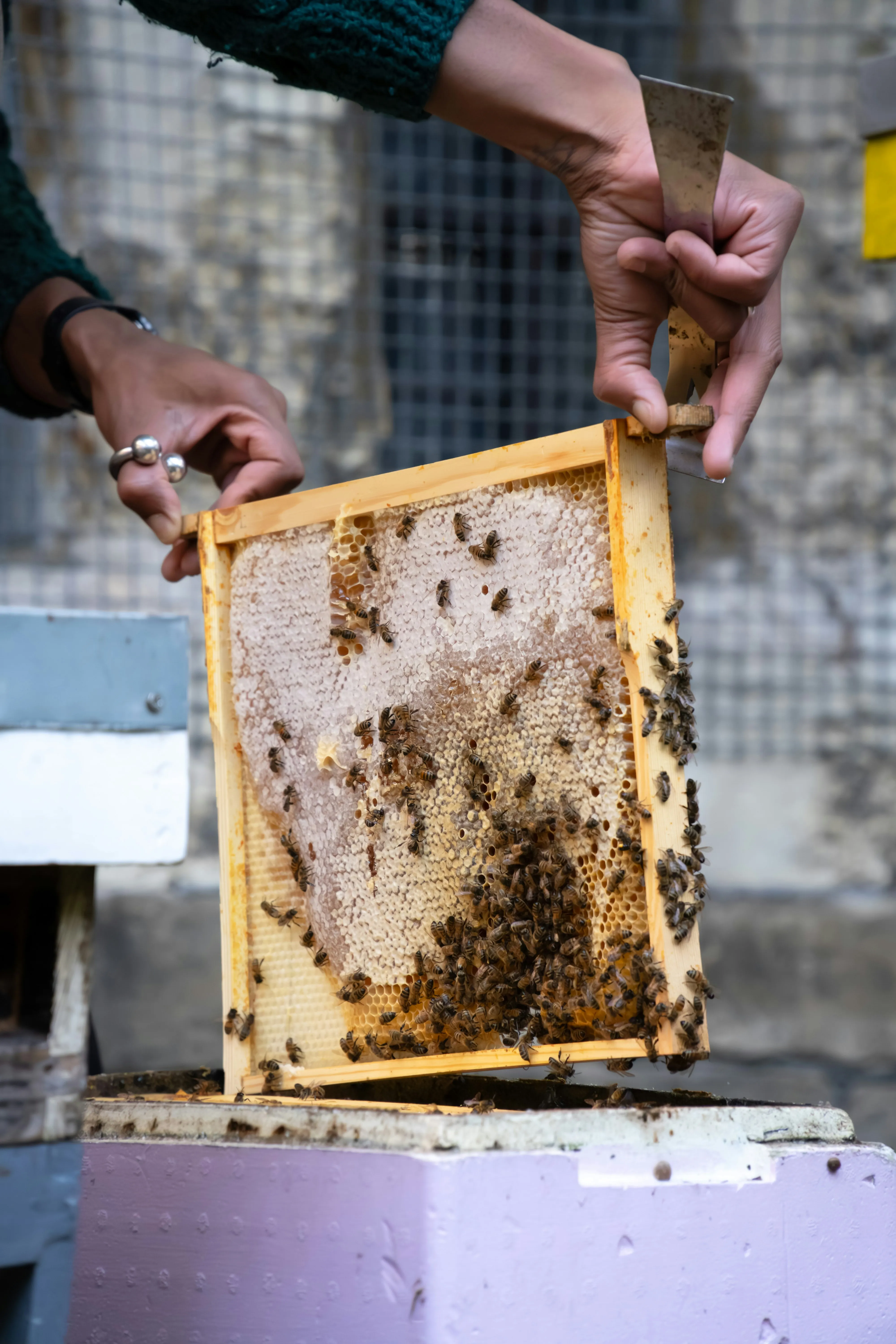
There is a moment, maybe three months into keeping bees, when you realize the books have stopped helping. Not because the books are wrong — most of the good ones are careful and accurate. But because the thing you need to learn next cannot be transmitted through text or video or a well-labeled diagram. It has to come through your hands.
We are two years into this. Six hives outside Leesburg, in a stand of tulip poplars that tower a hundred feet overhead and rain nectar in late April. We have read the books. We have watched the videos. And we can say with some confidence that the most important things we know about beekeeping, we did not learn from any of them.
We learned them through our fingers, our wrists, the muscles in our forearms. Through the particular ache of a hand that has been gripping a hive tool at the wrong angle for an hour. Through the way propolis stains settle into the whorls of a fingerprint and refuse to leave.
Beekeeping is a haptic craft. The knowledge that matters accumulates in the body.
Propolis Stains
You notice the stains before you notice you are learning anything. At first they are just an inconvenience — sticky amber-brown patches on your fingers from handling frames, a dark smear on the back of your wrist where you wiped your hive tool. You wash your hands after an inspection. The soap takes off the surface honey. The propolis stays.
It is a resin, not a fat, so soap and water do nothing meaningful to it. Rubbing alcohol works, slowly, if you scrub hard enough to redden the skin underneath. Acetone works better but leaves your fingertips dried out and cracking. After a few weeks of regular inspections, most beekeepers stop trying to remove it entirely. The stains layer. New deposits over old. A deepening amber-brown that follows the creases of your palms and settles under the edges of your nails.
By midsummer, our hands look like we have been refinishing furniture. The propolis stains are darker in the creases and lighter on the knuckles where the skin stretches and sheds. There is a line of permanent dark brown along the inside of the right index finger where the hive tool rests during inspections — a mark specific to the grip, specific to the tool, specific to the hand that holds it. The left thumb carries a matching deposit from pressing frames back into place.
These marks are a record of contact. Every inspection, every frame lifted, every seal broken — the propolis remembers, even when we do not. In late October, when the hives are closed up for winter and we have not opened a box in weeks, the last traces of propolis are still there. Fading, finally, as the skin renews itself. By November they are gone. By April, we put them back.
The smell stays longer than the color. Even after the visible stains fade, there is a faint resinous sweetness in the skin — tulip poplar bud and pine and something the bees have added that has no name. We catch it sometimes washing dishes in the evening. A ghost of the hive, still living in the oils of our hands.
The Weight of a Frame
Nobody teaches you this. Nobody can.
A standard deep Langstroth frame, fully drawn with comb, weighs about two and a half pounds empty. Fill it with brood — capped larvae, bee bread, a thin crescent of honey at the top — and it weighs around four to five pounds. Fill it with capped honey and it weighs seven, eight, sometimes nine pounds. The difference between a frame of brood and a frame of capped honey is roughly the difference between a paperback novel and a full water bottle.
That sounds easy to distinguish. It is not — at first. When you are new, you are gripping each frame with both hands, arms tense, focused on not dropping it or rolling bees off the comb. Everything feels heavy. Everything feels precarious. You cannot weigh anything because you are too busy trying not to destroy it.
Sometime around the twentieth or thirtieth inspection, something shifts. The grip loosens. The arms relax. You lift a frame out of the box and there is a moment — half a second, maybe less — when the weight registers in your wrist before your conscious mind processes it. Heavy. Honey. Or: lighter than expected. Brood, but not much honey at the top. Or: almost nothing. Empty comb. Drawn but not filled.
This happens without thinking. You do not calculate. You do not compare. The wrist knows. It has calibrated itself through dozens of repetitions, each one slightly different, and it has built a map of weight-to-content that lives somewhere below language. We cannot describe the feeling precisely — it is not pain, not strain, just a quality of resistance as the frame clears the box. A density that speaks.
We rely on this now more than we expected. In midsummer, when we are checking whether to add another super, we do not pull every frame and inspect it visually. We lift two or three from the center of the top box and feel. If the weight says honey, the bees are storing. If the weight says brood, the queen has moved up and we have a different situation. The hands report faster than the eyes, and in the middle of a hot July inspection — sweat running down inside the veil, smoker needing a pump, bees starting to get restless — faster matters.
The old beekeepers we know do this without seeming to notice they are doing it. They lift a frame, tilt it once toward the light, and set it down. Done. They have read the weight, the color, the pattern of capped and uncapped cells, and the mood of the bees on that frame in a single gesture that takes three seconds. That fluency is not knowledge in the way a textbook defines it. It is something the body has absorbed.
Sting Memory
The first sting is an event. You remember everything about it — where you were standing, which hand it hit, the sharp bright pain that felt disproportionate to the size of the creature delivering it. The alarm pheromone, like overripe bananas, rising from the stinger embedded in your skin. The immediate hot swelling that spread across the back of your hand and stayed for two days.
We both remember our first stings. One of us was lifting a frame in early May — the hive was calm, no smoke, bare hands — and a bee caught the web between the thumb and index finger. The other was mowing too close to the apiary entrance in June and took one on the ankle through a sock. Both times, the reaction was large: swelling, redness, itching that lasted three or four days. Both times, the thought was the same. How does something that small produce that much pain.
The twentieth sting is different. Not painless — it still hurts. The venom is the same. The barbed stinger still pumps its dose of melittin and phospholipase into the tissue. But the body’s relationship with that input has changed. The swelling is smaller. The itch resolves in hours instead of days. And somewhere in the mind, the alarm has been turned down. The sting goes from event to information. You note it, you scrape the stinger out with a fingernail, and you keep working.
This is partly immunological. Repeated low-dose exposure to venom produces a shift in the antibody response — less IgE, more IgG — that dampens the allergic component of the reaction. Some beekeepers describe a phase where the reactions get worse before they get better, a temporary sensitization that can last a season or two before tolerance builds. We went through that. There were stings in our first summer that produced more swelling than the very first one, as though the body was learning the threat by overreacting to it.
But the larger shift is not immunological. It is attentional. The first sting hijacks your entire nervous system. The twentieth is processed alongside everything else you are doing — holding a frame, reading a brood pattern, listening to the pitch of the hive. The pain is still there. You have just stopped giving it the whole room.
Veteran beekeepers we have met talk about stings the way a carpenter talks about splinters. It happens. You deal with it. You learn which colonies are more defensive, which times of day to avoid, which movements provoke a response. You learn that the back of the hand and the inside of the wrist hurt more than the forearm. You learn that stings on the face, near the eyes, are worth avoiding — not because of pain but because of swelling that can close an eye for a day. You learn these things not from a chart but from the accumulated record of your own skin.
There is something else, too. Something harder to articulate. After enough stings, you develop a different awareness of the bees’ state. You feel the shift in the hive’s mood — the increased buzzing, the head-butting, the bees pinging off your veil — and you adjust. Slow down. Add smoke. Close the hive and come back tomorrow. The threat of being stung becomes a form of communication. The bees are telling you something, and the consequence of not listening is immediate and physical. Over time, you listen better.
The Smoker
The smoker is the most tactile tool in beekeeping. Everything about it is physical — the crumple of the fuel going in, the rasp of the flint, the bellows under your palm.
Learning to light a smoker and keep it lit is one of those skills that sounds trivial until you fail at it repeatedly. The basic idea is simple: ignite fuel in a metal canister, pump the bellows to push air through, produce cool white smoke. The reality involves false starts, smoldering failures, and a learning curve that lives entirely in the hands.
We use pine needles gathered from under the Virginia pines along our property line, sometimes mixed with dried leaves or burlap scraps. The fuel goes in loosely — packed too tight and the air cannot circulate, too loose and it burns fast and hot. You light a small wad of newspaper or dryer lint at the bottom, pump the bellows gently to build a coal bed, then add fuel on top in stages. Each addition gets a few pumps. You listen for the sound — a soft crackling that means combustion, versus a hiss that means smothering.
The bellows pump is a wrist movement, not an arm movement. New beekeepers squeeze the entire bellows with their full hand, overworking the grip and tiring out in minutes. Experienced beekeepers use a light, rhythmic compression — three fingers and the heel of the palm, a pulse every few seconds, just enough to keep the coals breathing. The angle matters. Tip the smoker too far forward and the fuel shifts, opening air channels that let it burn too hot. Hold it too upright and the smoke pools instead of flowing.
Keeping a smoker lit for a full inspection — forty-five minutes, an hour — requires periodic attention that becomes automatic. You are working a frame with both hands and you feel the bellows cooling against your hip where the smoker hangs from the hive body. Without deciding to, you reach down, give three pumps, and go back to the frame. The wrist knows the rhythm. How often, how hard, what angle.
The smoke itself is not a sedative. It does not calm the bees. What it does is trigger a feeding response — the bees gorge on honey, possibly an evolved preparation for fleeing a fire — and it masks the alarm pheromone that stung bees release. A puff at the entrance before opening the hive. A puff across the top bars when you lift the inner cover. A light drift across the frames if the bees start bearding on your gloves. Not too much — heavy smoke stresses the colony and taints the honey. Just enough.
There is a smell to a well-burning smoker that we have come to associate with the beginning of useful work. Pine needles, carbon, a faint sweetness from the resin. It settles into your bee jacket, your hair, the upholstery of the truck that carries the gear. On summer evenings, we can tell from across the yard whether the smoker is still going. The smell is that specific.
Hive Tool Leverage
A hive tool is a flat piece of steel, about ten inches long, with a bent scraping edge on one end and a flat prying edge on the other. It costs about eight dollars. It is the most important piece of equipment in beekeeping, and the skill of using it well takes longer to develop than anything else we own.
The fundamental task is breaking the propolis seal. Bees glue everything together — frames to the box, the inner cover to the super, boxes to each other. Every joint, every seam, every surface where two pieces of wood meet is bonded with propolis. To inspect a hive, you have to break these bonds without crushing the bees that are standing on them.
This is a matter of pressure. Too little force and the seal does not break — you pry and twist and the frame stays stuck. Too much force and the tool slips through the seal and into the comb, or worse, into a cluster of bees on the other side. The right pressure is firm and controlled. You insert the flat end between the frame’s ear and the box rabbet, twist your wrist — not your arm — and the seal pops with a quiet crack.
That crack is propolis breaking. It sounds like snapping a small twig. With practice, you learn to read the sound. A clean pop means you caught the seal correctly — the frame will slide free. A dull, sticky resistance means the tool is angled wrong, or there is burr comb between the frames that you need to deal with first. A crunch means you have caught a bee. That one stays with you.
The motion becomes very precise over time. We can now break a propolis seal with the tool inserted less than a quarter inch into the gap, using wrist rotation alone, without looking directly at the contact point. This is not a boast — it is simply what repetition produces. The hands develop a sensitivity to the resistance of propolis at different temperatures, different seasons, different thicknesses. Cold propolis in March is brittle and snaps easily. Warm propolis in August is soft and stretchy and requires a different approach — slower, more of a peel than a crack.
Every beekeeper we know has lost a hive tool. They are the socks of the apiary — perpetually migrating, perpetually replaced. The tool you work with for a season develops a patina of propolis and wax along its working edge that feels specific to your hand. A new tool feels foreign for the first few inspections. Slightly wrong. Too clean.
Gloves vs. Bare Hands
This is the debate that never resolves, because there is no right answer. Only tradeoffs.
Gloves protect you from stings. That is the beginning and end of their advantage. Everything else is a disadvantage. Thick leather gloves — the kind that come in most beginner kits — eliminate almost all tactile information from the hive. You cannot feel frame weight. You cannot feel the temperature of the comb. You cannot feel the difference between a bee walking on your finger and a bee preparing to sting. You grip harder than necessary because you cannot feel the frame through the leather, and gripping harder means you are more likely to crush bees, which releases alarm pheromone, which makes the next sting more likely.
We started with leather gloves. Everyone does. Then we moved to nitrile — thin surgical-style gloves that offer minimal sting protection but allow you to feel almost everything through the material. You feel the warmth of the cluster. You feel the texture of capped honey versus capped brood — honey caps are smooth and slightly concave, brood caps are domed and papery. You feel propolis softening under your thumb. You also feel the sting when it comes, right through the nitrile, which provides roughly the same protection as a sheet of paper.
Some days we go bare-handed. Not often, not in every hive, and not when the bees are in a mood. But on a calm morning in late May, when the tulip poplars are blooming and the hives are heavy with nectar and the bees are too busy to care about us — on those mornings, working bare-handed is the closest you get to full contact with the hive.
The warmth is the first thing. A brood frame in full production radiates heat — the cluster maintains about ninety-five degrees Fahrenheit in the brood area. You can feel it before you touch the frame, a pocket of warmth rising from the comb like heat from a woodstove. In your bare hands, that warmth is immediate and communicative. It tells you the brood nest is alive and working. It tells you roughly where the cluster is centered.
We have also felt the cold. Opening a hive in late February to check stores and finding no warmth at all. The frames cold, the comb dry and still. No hum. No movement. A colony that did not make it through the winter. The cold of a dead hive is different from the cold of an empty box — there is a stillness to it, a weight of absence. You feel it in your hands before your eyes confirm what happened.
Bare hands teach you things that gloves cannot. But bare hands also mean you are one moment of inattention away from a sting that will make the next ten minutes of the inspection difficult. So we compromise. Nitrile most of the time. Bare hands when the hive is gentle and we want to learn. Leather gloves when we know a colony is defensive or when we are doing something disruptive like splitting a hive or pulling honey supers. The choice changes hive to hive, visit to visit, sometimes frame to frame.
Temperature
We keep coming back to temperature because it is the sense the hands provide that no other tool replicates. You can buy an infrared thermometer. You can buy thermal imaging cameras designed for hive inspection. We have seen beekeepers use them, and the data is useful. But the hands provide something instruments do not — a continuous, intuitive sense of thermal gradient that updates with every surface you touch.
The outside of a hive body in winter, on a January morning in Loudoun County when the air is twenty-eight degrees and the frost is still on the grass. You put your bare palm flat against the wood. If the colony is alive and clustered, there is a faint warmth — barely perceptible, maybe two or three degrees above ambient — somewhere on the box. You move your hand slowly across the surface, feeling for the warm spot. Found it. The cluster is there, on the south side of the bottom deep, about six inches up from the floor.
That information — where the cluster is, whether it is generating heat, how large the warm zone seems — tells you a great deal about the colony’s state without opening the box. A warm spot that covers most of one side suggests a healthy-sized cluster. A warm spot the size of your palm suggests a cluster that has shrunk dangerously. No warm spot at all, and you prepare yourself for what you will find when you open the hive in spring.
In summer, the thermal information reverses. A hive in full production is warm everywhere. The top of the inner cover, the sides of the supers, even the bottom board. You can feel the metabolic heat of fifty thousand bees processing nectar, building comb, and fanning the hive to regulate temperature. On a ninety-degree August afternoon, the air coming from the entrance is warmer than the ambient air — the bees are actively cooling the interior, and the exhaust heat pours out the front like breath from a furnace.
There is a feeling — we do not know what else to call it — when you lift the inner cover off a strong hive in June and the warm, humid air rises against your face, carrying the smell of honey and wax and fresh pollen. It is like opening an oven, but softer. Alive. The heat has a quality of intention to it. Fifty thousand small bodies, maintaining this temperature, for the brood, for the honey, for the survival of the colony. You are standing in the exhaust of their collective effort.
An instrument would tell you: ninety-five degrees, sixty percent humidity. Your hands and face tell you: this colony is thriving.
Expertise in the Body
There is a concept in philosophy of mind called embodied cognition — the idea that knowledge is not exclusively a property of the brain but is distributed across the body, shaped by physical interaction with the world. We encountered it in the apiary before we encountered the term.
Two years ago, we knew how to keep bees the way you know how to do something you have read about thoroughly. We could describe a hive inspection step by step. We could identify the stages of brood development from photographs. We knew the lifecycle of varroa, the signs of American foulbrood, the theory behind integrated pest management. All of it sat in our heads, organized and labeled and fundamentally useless until we put our hands on a hive.
The transition from knowing to understanding happened in the hands. The first time we felt a frame’s weight and knew, without looking, that it was full of honey. The first time we broke a propolis seal cleanly, without thinking about the angle. The first time we heard the hive’s pitch change and reached for the smoker before the first sting landed.
This is not unique to beekeeping. Surgeons, bakers, mechanics — anyone whose work involves repeated physical contact with materials that are variable, responsive, and unforgiving of inattention. The hands develop a vocabulary that the mind did not teach them.
What surprises us — still, even now — is how much of beekeeping belongs to this category. We assumed it was mostly intellectual. Learn the biology, memorize the seasonal management calendar, understand the diseases. And that foundation matters. But the competence that keeps colonies alive and healthy lives mostly in a different register. It lives in the wrist that feels frame weight. In the fingers that know how hard to push a frame back into position without pinching a bee. In the palm that reads temperature through a wooden wall. In the rhythm of the smoker bellows, maintained without thought while the conscious mind is focused on reading a brood pattern.
There are beekeepers we know who have been at this for thirty or forty years. Watching them work a hive is like watching a pianist sight-read — the movements are so fluid and practiced that you forget you are seeing the product of decades of physical repetition. They do not consult. They do not hesitate. Their hands move through the inspection with a sureness that is not confidence in the intellectual sense — it is the sureness of a body that has done this thing ten thousand times and has absorbed the doing into its own architecture.
We are not there yet. We are still in the early years, where the knowledge is accumulating slowly, frame by frame, sting by sting, season by season. Our hands are still learning. The propolis stains come and go with the seasons. The smoker still goes out sometimes when we get distracted. We still misjudge the pressure on a hive tool and hear that small crunch that means we got it wrong.
But we are closer than we were. The distance was traveled in the hands.
We sell what the bees don’t need. Interested in trying some? Drop us a line.