- behavior
- observation
- colony-life
Night Shift
Most of what a colony does happens after dark. We walked out to the apiary at ten o'clock to listen.
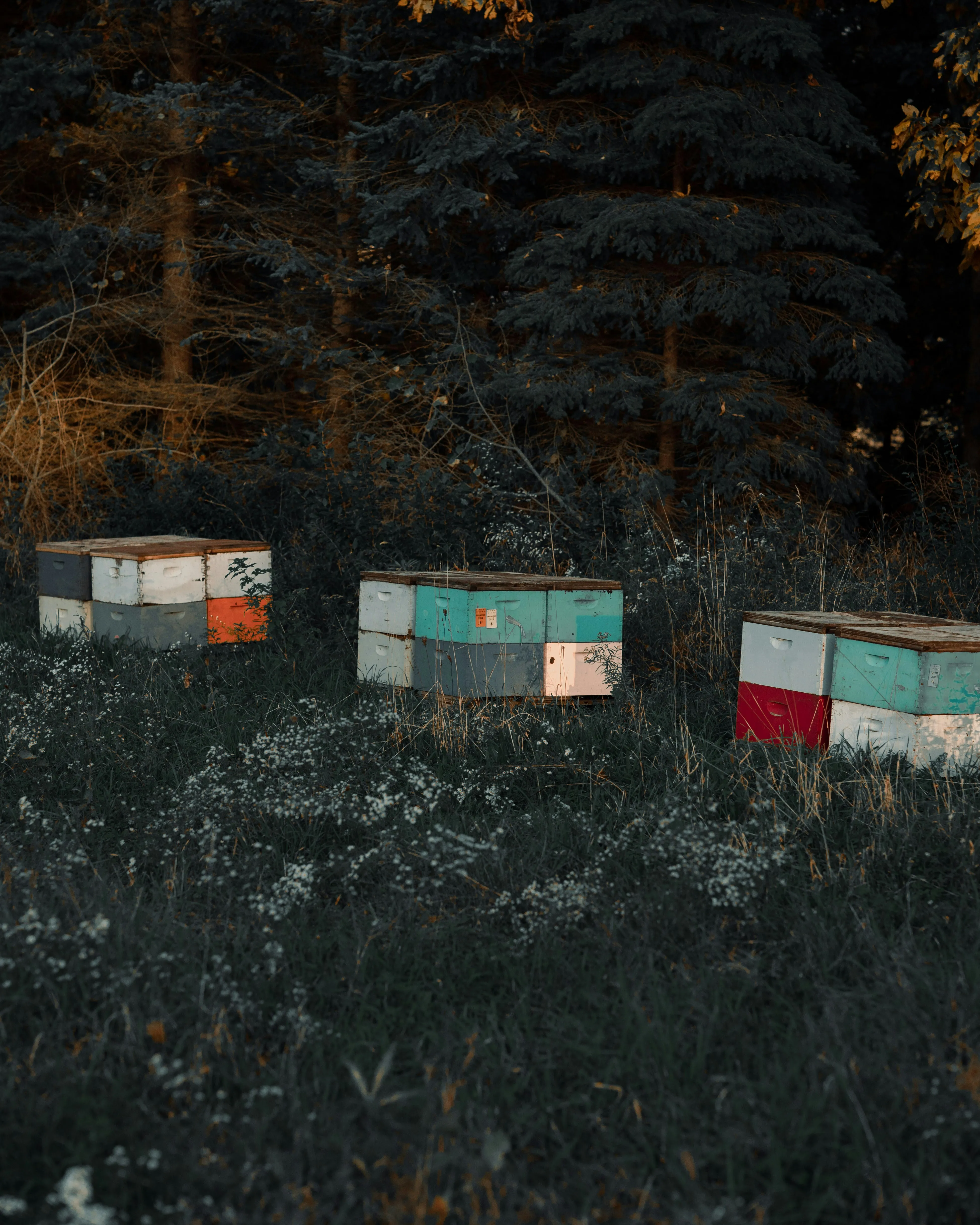
Most writing about honeybees happens in daylight. The photographs, the inspections, the YouTube tutorials — they all take place between nine and five, when the sun is good and the bees are flying. There is a reason for that. Daytime is when the foragers are out, the entrance is busy, the hive is visibly alive. It’s the part that’s easy to watch.
But a colony does not stop when the light goes. In some ways, it is just getting started.
After the Last Forager
In Loudoun County in late summer, the last foragers come home around eight-thirty. The timing tracks the light — earlier in winter, later in June — but the pattern is always the same. The flights get slower. The bees on the landing board stop launching and start receiving. The entrance traffic, which at midday looked like a tiny airport, thins to a trickle.
By nine o’clock, the hive sounds different from the outside. The daytime buzz — high-pitched, scattered, the sound of ten thousand individual flights overlapping — settles into something lower and more continuous. It’s the sound of the colony turning inward. Every forager who spent the day working tulip poplars or goldenrod or whatever was blooming along North Fork Goose Creek is now home, and the hive has to figure out what to do with all of them.
This is the shift change. Foragers who were navigating by the sun a few hours ago transition to house duties. The division of labor in a colony is fluid — a bee’s job depends on her age, the colony’s needs, and the time of day. At night, the workforce consolidates. Everyone is inside. And the real work of processing what they gathered all day begins.
Nectar into Honey
The foragers came home with nectar — carried in their honey stomachs, passed mouth-to-mouth to the house bees at the entrance. But nectar is not honey. It is roughly eighty percent water. Honey is less than twenty percent. That difference has to be worked out, and most of it happens at night.
House bees spread the nectar in thin films across the surface of cells, maximizing the area exposed to air. Then they fan. Hundreds of bees line up near the comb and beat their wings — not to fly, but to move air across the open cells, evaporating water from the nectar. They can keep this up for hours.
If you have ever stood near a hive at night and heard a sound that is not quite buzzing — something softer, more even, almost like a ventilation system running in a quiet building — that is fanning. It is one of the most constant sounds a colony makes, and it is loudest after dark, when the day’s full nectar load is being cured.
We do not fully understand the coordination involved. The bees seem to create airflow patterns through the hive — intake near the bottom, exhaust near the top — that work like a directed ventilation system. But the mechanics of how they organize this without a foreman or a blueprint is one of those things we’re still reading about. The research is ongoing, and honest answers tend to include a lot of “we think” and “it appears that.”
The Builders
Wax production peaks at night. This surprised us when we first learned it, but the logic makes sense once you think about it.
Bees secrete wax from glands on the underside of their abdomen. The glands are most productive in younger bees — roughly ten to sixteen days old — and wax production requires a full stomach and elevated body temperature. During the day, many of these wax-age bees are occupied with other tasks. At night, with the whole colony home and clustered on the comb, conditions are right. The wax flows.
Building comb is slow, deliberate work. A bee secretes a tiny flake of wax, chews it to make it pliable, then presses it into place on the comb face. The cells are built at a precise angle — thirteen degrees from horizontal, tilted slightly upward so the nectar does not run out. The walls are thinner than a sheet of paper. The geometry is hexagonal because hexagons tile a plane with no wasted space and minimal material.
We have opened hives in the morning and found new comb that was not there the day before — bright white, perfectly formed, smelling faintly of beeswax and warm sugar. It was built in the dark, by bees working in a space where no light reaches, navigating entirely by touch and gravity.
Heater Bees
Brood — the eggs, larvae, and pupae developing in their cells — must be kept at ninety-five degrees Fahrenheit. Not approximately. Not roughly. Ninety-five, plus or minus a degree or two. The developing bees are temperature-sensitive in ways that affect everything from their wing formation to their cognitive ability as adults. A few degrees too cool and they emerge with subtle deficiencies.
At night, when the ambient temperature drops, maintaining brood temperature becomes harder. This is where heater bees come in.
A heater bee presses her thorax against the cap of a sealed brood cell and vibrates her flight muscles without moving her wings. The energy generates heat — enough to warm that individual cell and the cells around it. She can raise her thorax temperature to over a hundred degrees. Other heater bees crawl into empty cells scattered throughout the brood nest — cells the queen deliberately left vacant — and radiate heat outward from inside, warming the brood cells on all sides.
This is not a rough system. Research using thermal imaging has shown that heater bees target specific cells. If one area of the brood nest is cooler than another, heater bees move to that area. The empty cells interspersed through the brood pattern, which beekeepers used to interpret as a sign of a failing queen, turn out to be part of the heating infrastructure. The queen leaves them empty on purpose. The colony planned for this.
We think about this every time we look at a frame and see a few scattered gaps in an otherwise solid brood pattern. It used to bother us. Now we understand — or at least we think we do — that those gaps are radiators.
The Guard Shift
The entrance never goes unattended. Even at midnight, guard bees stand at the threshold, facing outward, antennae forward. Their job is the same as during the day — check every returning bee for the colony’s scent, challenge anything unfamiliar — but the threat profile shifts.
At night, the main concern is not robber bees from another hive. It is wax moths, which are nocturnal and try to slip past the guards to lay eggs inside the hive. Small hive beetles, too, are more active after dark. The guards are fewer than during the day, but they are alert. We have seen them intercept moths twice their size at the entrance.
The queen, meanwhile, does not stop. She lays through the night — slower, perhaps, but continuously. A productive queen in summer may lay fifteen hundred eggs a day. That pace does not pause for darkness.
Walking Out at Ten
We started going out to the apiary at night because we were curious. It has become something we do regularly now, not for any management reason, but because it is a different experience of the same hives we work during the day.
The walk out is about two hundred yards through the poplars. We use a red-light headlamp — bees cannot see red light well, so it does not disturb them the way a white flashlight would. The property is quiet at ten o’clock. No traffic on the road. Occasionally a barred owl in the trees to the east.
The first thing you notice, before you reach the hives, is the smell. Warm beeswax and curing nectar carry farther at night, when the air is cool and still. It is sweet but not sugary — more like warm wood and honey and something faintly floral that you cannot quite place. On humid nights in July, the scent reaches us halfway across the yard.
The hives themselves are quiet from a distance. Up close, you hear it — that low, continuous hum. Not the daytime buzz of departures and arrivals, but something more unified. The whole colony breathing. Fanning. Working.
A few bees are usually visible on the landing board. Three or four, maybe six, facing outward. Guards. They do not react to the red light. You can stand a foot away and watch them — antennae sweeping slowly, bodies still. Behind them, in the dark of the entrance, you can sometimes see movement. Bees coming and going from the interior, passing the guards without challenge.
We have never opened a hive at night. There is no reason to, and it would be disruptive. But standing outside one in the dark, listening, you get a sense of the scale of activity happening inside that you cannot see. Tens of thousands of bees building, fanning, heating, feeding, guarding, processing the day’s forage into something that will last through winter.
Sleep, or Something Like It
Individual bees do sleep — though calling it sleep is probably generous. A sleeping bee stops moving, tucks her legs beneath her body, and lets her antennae droop. She may stay like this for fifteen to thirty minutes, usually inside an empty cell or hanging motionless on the face of the comb. Her metabolic rate drops. She is, for a brief window, still.
But the colony never is. At any given moment, some fraction of the population is resting while the rest work. The hive operates on rolling shifts — no single downtime, no closing hour. When one group of fanner bees tires, another takes over. Heater bees rotate positions. The nectar processing continues, cell by cell, through the night.
By dawn, much of the nectar brought in the previous day has been partially cured. The wax builders have added to the comb. The brood has been kept at temperature. The guards have held the entrance. And when the light comes up and the air warms past fifty-five degrees, the foragers will leave again — out through the same entrance they returned to twelve hours earlier, navigating by a sun they have not seen since yesterday.
We sometimes wonder what the bees make of us standing out there in the dark with our red light. Probably nothing. They have work to do.
Sources and further reading:
- Kleinhenz, M. et al. (2003), “Hot bees in empty broodnest cells: heating from within” — thermal imaging research on heater bee behavior and targeted cell warming
- Tautz, J. (2008), The Buzz about Bees: Biology of a Superorganism — comprehensive overview of nocturnal colony activity, wax production cycles, and thermoregulation
- Seeley, T. (2010), Honeybee Democracy — colony decision-making and the distributed intelligence of the hive
- Klein, B. et al. (2008), “Sleep deprivation impairs precision of waggle dance signaling in honey bees” — research on individual bee sleep patterns and their role in colony function
We sell what the bees don’t need. Interested in trying some? Drop us a line.